Articles | Volume 4, issue 1
https://doi.org/10.5194/ar-4-1-2026
© Author(s) 2026. This work is distributed under
the Creative Commons Attribution 4.0 License.
the Creative Commons Attribution 4.0 License.
https://doi.org/10.5194/ar-4-1-2026
© Author(s) 2026. This work is distributed under
the Creative Commons Attribution 4.0 License.
the Creative Commons Attribution 4.0 License.
Research article
| 
07 Jan 2026
Research article |
| 07 Jan 2026
| 07 Jan 2026
Thermodynamic benchmarking of hydrated atmospheric clusters in early particle formation
Ivo Neefjes
Department of Chemistry, Aarhus University, Langelandsgade 140, 8000 Aarhus C, Denmark
Yosef Knattrup
Department of Chemistry, Aarhus University, Langelandsgade 140, 8000 Aarhus C, Denmark
Department of Chemistry, Aarhus University, Langelandsgade 140, 8000 Aarhus C, Denmark
Georg Baadsgaard Trolle
Department of Chemistry, Aarhus University, Langelandsgade 140, 8000 Aarhus C, Denmark
Jonas Elm
Department of Chemistry, Aarhus University, Langelandsgade 140, 8000 Aarhus C, Denmark

Department of Chemistry, Aarhus University, Langelandsgade 140, 8000 Aarhus C, Denmark
Related authors
Ivo Neefjes, Jakub Kubečka, and Jonas Elm
Atmos. Chem. Phys., 26, 7631–7645, https://doi.org/10.5194/acp-26-7631-2026, https://doi.org/10.5194/acp-26-7631-2026, 2026
Short summary
Short summary
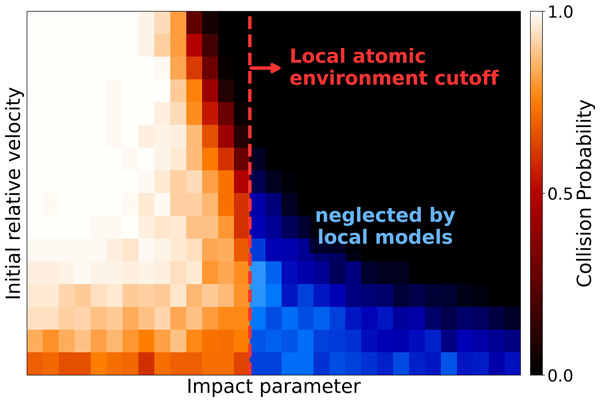
Atmospheric particles impact climate and health. Most particles form through gas molecules colliding and sticking together. We use molecular dynamics accelerated by machine learning to study this process. We found that standard machine learning models often fail to capture the long-range forces driving collisions, and models with explicit long-range corrections are needed. This work provides a blueprint for accurate simulations of particle formation.
Yosef Knattrup, Ivo Neefjes, Jakub Kubečka, and Jonas Elm
Aerosol Research, 3, 237–251, https://doi.org/10.5194/ar-3-237-2025, https://doi.org/10.5194/ar-3-237-2025, 2025
Short summary
Short summary
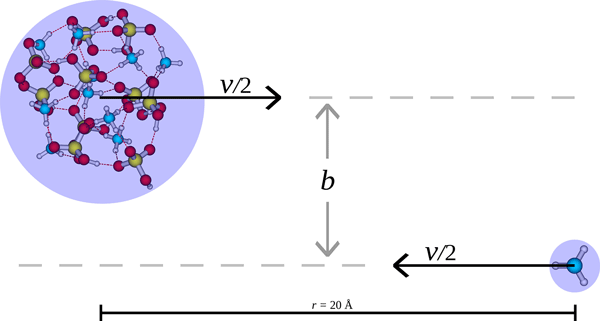
Aerosols, a large uncertainty in climate modeling, can be formed when gas vapors and particles begin sticking together. Traditionally, these particles are assumed to behave like hard spheres that only stick together upon head-on collisions. In reality, particles can attract each other over distances, leading to more frequent sticking events. We found that traditional models significantly undercount these events, with real sticking rates being up to 2.4 times higher.
Huan Yang, Ivo Neefjes, Valtteri Tikkanen, Jakub Kubečka, Theo Kurtén, Hanna Vehkamäki, and Bernhard Reischl
Atmos. Chem. Phys., 23, 5993–6009, https://doi.org/10.5194/acp-23-5993-2023, https://doi.org/10.5194/acp-23-5993-2023, 2023
Short summary
Short summary
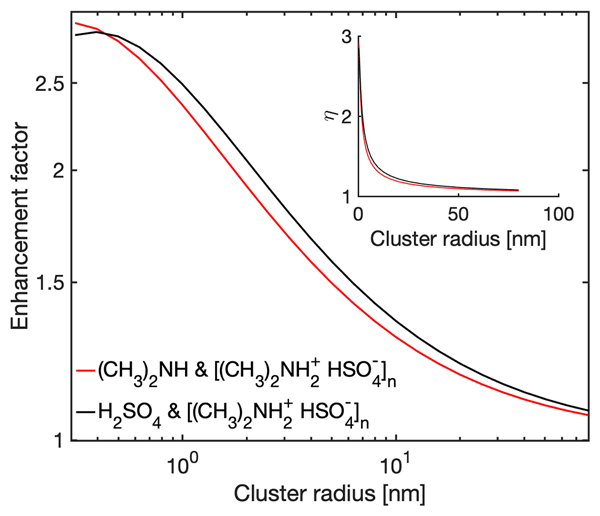
We present a new analytical model for collision rates between molecules and clusters of arbitrary sizes, accounting for long-range interactions. The model is verified against atomistic simulations of typical acid–base clusters participating in atmospheric new particle formation (NPF). Compared to non-interacting models, accounting for long-range interactions leads to 2–3 times higher collision rates for small clusters, indicating the necessity of including such interactions in NPF modeling.
Ivo Neefjes, Roope Halonen, Hanna Vehkamäki, and Bernhard Reischl
Atmos. Chem. Phys., 22, 11155–11172, https://doi.org/10.5194/acp-22-11155-2022, https://doi.org/10.5194/acp-22-11155-2022, 2022
Short summary
Short summary
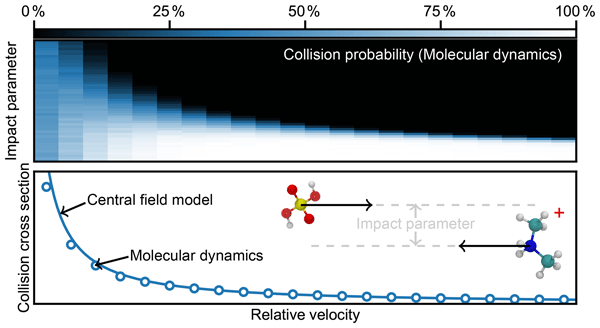
Collisions between ionic and dipolar molecules and clusters facilitate the formation of atmospheric aerosol particles, which affect global climate and air quality. We compared often-used classical approaches for calculating ion–dipole collision rates with robust atomistic computer simulations. While classical approaches work for simple ions and dipoles only, our modeling approach can also efficiently calculate reasonable collision properties for more complex systems.
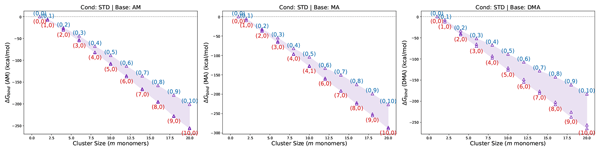
Galib Hasan, Yosef Knattrup, Haide Wu, and Jonas Elm
Aerosol Research, 4, 501–515, https://doi.org/10.5194/ar-4-501-2026, https://doi.org/10.5194/ar-4-501-2026, 2026
Short summary
Short summary
New atmospheric particles affect air quality and climate, but the molecular processes behind their formation remain poorly understood. We used computer simulations to investigate how two common atmospheric acids interact with ammonia and amines during the earliest stages of particle formation. We found that sulfuric acid plays the dominant role in forming the smallest particles, while methanesulfonic acid contributes mainly during later growth, helping to clarify their roles in the atmosphere.
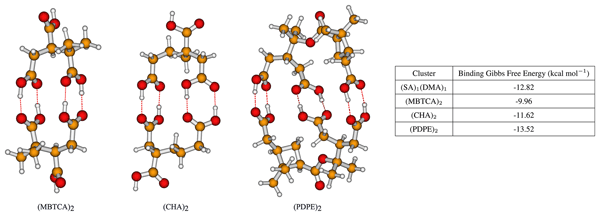
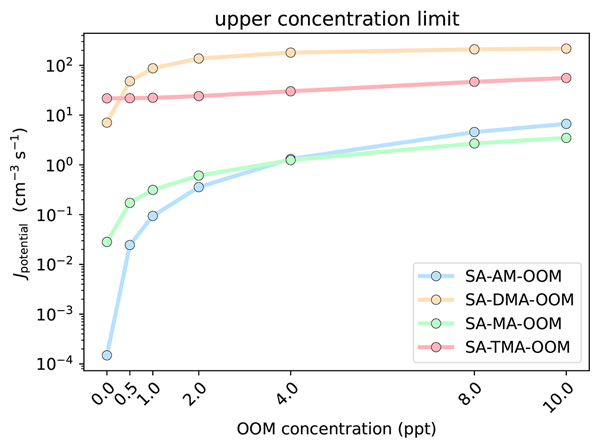
Astrid Nørskov Pedersen, Yosef Knattrup, and Jonas Elm
Aerosol Research, 4, 397–411, https://doi.org/10.5194/ar-4-397-2026, https://doi.org/10.5194/ar-4-397-2026, 2026
Short summary
Short summary
We investigated the new particle formation (NPF) potential of three atmospherically relevant oxygenated organic molecules (OOMs) using high-level computational methods. Cluster thermodynamics and formation rates were evaluated for systems containing sulfuric acid and various nitrogen bases. All three OOMs enhanced cluster formation, with dimethylamine-containing clusters showing the greatest effect. Pinyl diaterpenylic ester formed the most stable clusters due to its molecular flexibility.
Ivo Neefjes, Jakub Kubečka, and Jonas Elm
Atmos. Chem. Phys., 26, 7631–7645, https://doi.org/10.5194/acp-26-7631-2026, https://doi.org/10.5194/acp-26-7631-2026, 2026
Short summary
Short summary
Atmospheric particles impact climate and health. Most particles form through gas molecules colliding and sticking together. We use molecular dynamics accelerated by machine learning to study this process. We found that standard machine learning models often fail to capture the long-range forces driving collisions, and models with explicit long-range corrections are needed. This work provides a blueprint for accurate simulations of particle formation.
Yosef Knattrup, Ivo Neefjes, Jakub Kubečka, and Jonas Elm
Aerosol Research, 3, 237–251, https://doi.org/10.5194/ar-3-237-2025, https://doi.org/10.5194/ar-3-237-2025, 2025
Short summary
Short summary
Aerosols, a large uncertainty in climate modeling, can be formed when gas vapors and particles begin sticking together. Traditionally, these particles are assumed to behave like hard spheres that only stick together upon head-on collisions. In reality, particles can attract each other over distances, leading to more frequent sticking events. We found that traditional models significantly undercount these events, with real sticking rates being up to 2.4 times higher.
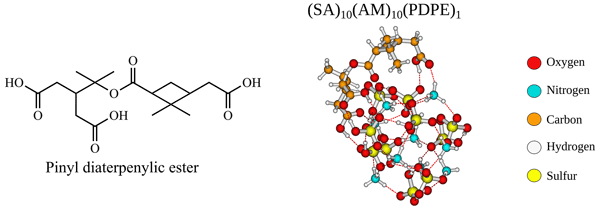
Yosef Knattrup and Jonas Elm
Aerosol Research, 3, 125–137, https://doi.org/10.5194/ar-3-125-2025, https://doi.org/10.5194/ar-3-125-2025, 2025
Short summary
Short summary
Using quantum chemical methods, we studied the uptake of first-generation oxidation products onto freshly nucleated particles (FNPs). We find that pinic acid can condense on these small FNPs at realistic atmospheric conditions, thereby contributing to early particle growth. The mechanism involves two pinic acid molecules interacting with each other, showing that direct organic–organic interactions during co-condensation onto the particle contribute to the growth.
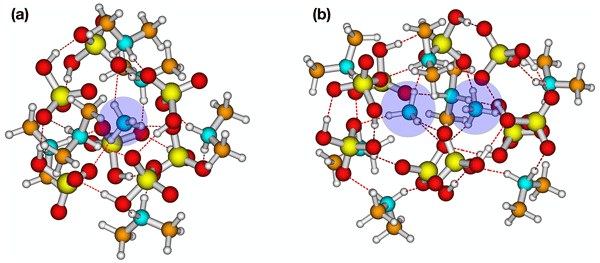
Galib Hasan, Haide Wu, Yosef Knattrup, and Jonas Elm
Aerosol Research, 3, 101–111, https://doi.org/10.5194/ar-3-101-2025, https://doi.org/10.5194/ar-3-101-2025, 2025
Short summary
Short summary
Aerosol formation is an important process for our global climate. However, there are high uncertainties associated with the formation of new aerosol particles. We present quantum chemical calculations of large atmospheric molecular clusters composed of sulfuric acid (SA), ammonia (AM), and dimethylamine (DMA). We find that mixed SA–AM–DMA systems cluster more efficiently for freshly nucleated particles compared to pure SA–AM and SA–DMA systems.
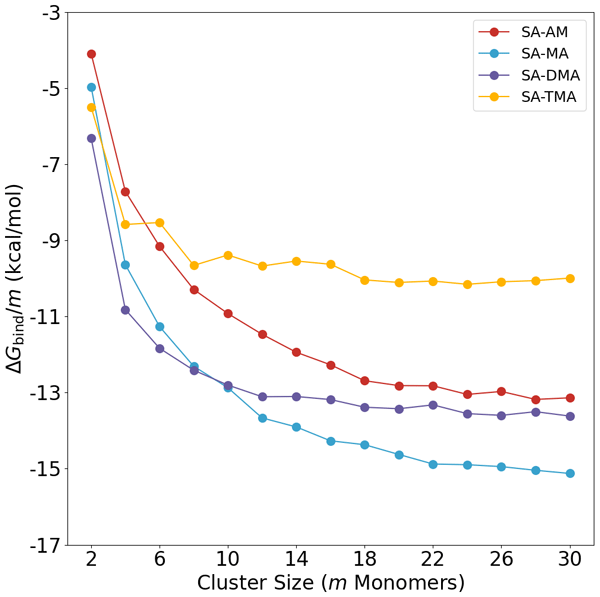
Haide Wu, Yosef Knattrup, Andreas Buchgraitz Jensen, and Jonas Elm
Aerosol Research, 2, 303–314, https://doi.org/10.5194/ar-2-303-2024, https://doi.org/10.5194/ar-2-303-2024, 2024
Short summary
Short summary
The exact point at which a given assembly of molecules represents an atmospheric molecular cluster or a particle remains ambiguous. Using quantum chemical methods, here we explore a cluster-to-particle transition point. Based on our results, we deduce a property-based criterion for defining freshly nucleated particles (FNPs) that act as a boundary between discrete cluster configurations and bulk particles.
Astrid Nørskov Pedersen, Yosef Knattrup, and Jonas Elm
Aerosol Research, 2, 123–134, https://doi.org/10.5194/ar-2-123-2024, https://doi.org/10.5194/ar-2-123-2024, 2024
Short summary
Short summary
Aerosol formation is an important process for our global climate. While inorganic species have been shown to be important for aerosol formation, there remains a large gap in our knowledge about the exact involvement of organics. We present a new quantum chemical procedure for screening relevant organics that for the first time allows us to obtain direct molecular-level insight into the organics involved in aerosol formation.

Jonas Elm, Aladár Czitrovszky, Andreas Held, Annele Virtanen, Astrid Kiendler-Scharr, Benjamin J. Murray, Daniel McCluskey, Daniele Contini, David Broday, Eirini Goudeli, Hilkka Timonen, Joan Rosell-Llompart, Jose L. Castillo, Evangelia Diapouli, Mar Viana, Maria E. Messing, Markku Kulmala, Naděžda Zíková, and Sebastian H. Schmitt
Aerosol Research, 1, 13–16, https://doi.org/10.5194/ar-1-13-2023, https://doi.org/10.5194/ar-1-13-2023, 2023
Huan Yang, Ivo Neefjes, Valtteri Tikkanen, Jakub Kubečka, Theo Kurtén, Hanna Vehkamäki, and Bernhard Reischl
Atmos. Chem. Phys., 23, 5993–6009, https://doi.org/10.5194/acp-23-5993-2023, https://doi.org/10.5194/acp-23-5993-2023, 2023
Short summary
Short summary
We present a new analytical model for collision rates between molecules and clusters of arbitrary sizes, accounting for long-range interactions. The model is verified against atomistic simulations of typical acid–base clusters participating in atmospheric new particle formation (NPF). Compared to non-interacting models, accounting for long-range interactions leads to 2–3 times higher collision rates for small clusters, indicating the necessity of including such interactions in NPF modeling.
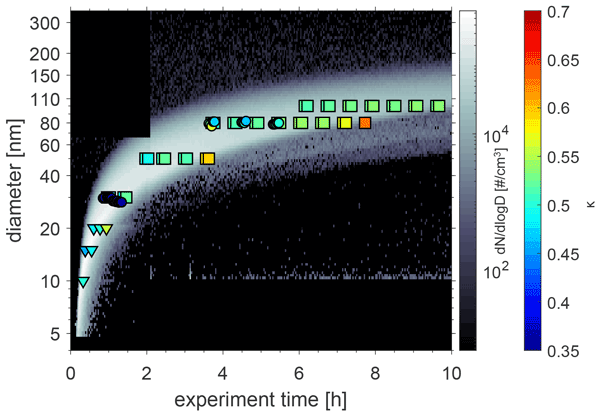
Bernadette Rosati, Sini Isokääntä, Sigurd Christiansen, Mads Mørk Jensen, Shamjad P. Moosakutty, Robin Wollesen de Jonge, Andreas Massling, Marianne Glasius, Jonas Elm, Annele Virtanen, and Merete Bilde
Atmos. Chem. Phys., 22, 13449–13466, https://doi.org/10.5194/acp-22-13449-2022, https://doi.org/10.5194/acp-22-13449-2022, 2022
Short summary
Short summary
Sulfate aerosols have a strong influence on climate. Due to the reduction in sulfur-based fossil fuels, natural sulfur emissions play an increasingly important role. Studies investigating the climate relevance of natural sulfur aerosols are scarce. We study the water uptake of such particles in the laboratory, demonstrating a high potential to take up water and form cloud droplets. During atmospheric transit, chemical processing affects the particles’ composition and thus their water uptake.
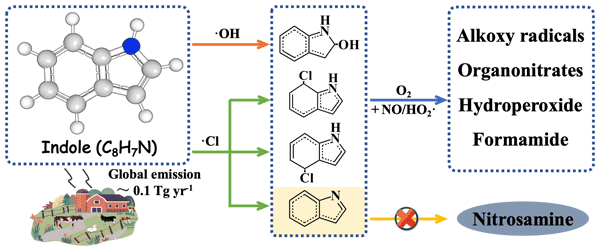
Jingwen Xue, Fangfang Ma, Jonas Elm, Jingwen Chen, and Hong-Bin Xie
Atmos. Chem. Phys., 22, 11543–11555, https://doi.org/10.5194/acp-22-11543-2022, https://doi.org/10.5194/acp-22-11543-2022, 2022
Short summary
Short summary
·OH/·Cl initiated indole reactions mainly form organonitrates, alkoxy radicals and hydroperoxide products, showing a varying mechanism from previously reported amines reactions. This study reveals carcinogenic nitrosamines cannot be formed in indole oxidation reactions despite radicals formed from -NH- H abstraction. The results are important to understand the atmospheric impact of indole oxidation and extend current understanding on the atmospheric chemistry of organic nitrogen compounds.
Ivo Neefjes, Roope Halonen, Hanna Vehkamäki, and Bernhard Reischl
Atmos. Chem. Phys., 22, 11155–11172, https://doi.org/10.5194/acp-22-11155-2022, https://doi.org/10.5194/acp-22-11155-2022, 2022
Short summary
Short summary
Collisions between ionic and dipolar molecules and clusters facilitate the formation of atmospheric aerosol particles, which affect global climate and air quality. We compared often-used classical approaches for calculating ion–dipole collision rates with robust atomistic computer simulations. While classical approaches work for simple ions and dipoles only, our modeling approach can also efficiently calculate reasonable collision properties for more complex systems.

Rongjie Zhang, Jiewen Shen, Hong-Bin Xie, Jingwen Chen, and Jonas Elm
Atmos. Chem. Phys., 22, 2639–2650, https://doi.org/10.5194/acp-22-2639-2022, https://doi.org/10.5194/acp-22-2639-2022, 2022
Short summary
Short summary
Formic acid is screened out as the species that can effectively catalyze the new particle formation (NPF) of the methanesulfonic acid (MSA)–methylamine system, indicating organic acids might be required to facilitate MSA-driven NPF in the atmosphere. The results are significant to comprehensively understand the MSA-driven NPF and expand current knowledge of the contribution of OAs to NPF.
Dina Alfaouri, Monica Passananti, Tommaso Zanca, Lauri Ahonen, Juha Kangasluoma, Jakub Kubečka, Nanna Myllys, and Hanna Vehkamäki
Atmos. Meas. Tech., 15, 11–19, https://doi.org/10.5194/amt-15-11-2022, https://doi.org/10.5194/amt-15-11-2022, 2022
Short summary
Short summary
To study what is happening in the atmosphere, it is important to be able to measure the molecules and clusters present in it. In our work, we studied an artifact that happens inside a mass spectrometer, in particular the fragmentation of clusters. We were able to quantify the fragmentation and retrieve the correct concentration and composition of the clusters using our dual (experimental and theoretical) approach.
Cited articles
Alduchov, O. A. and Eskridge, R. E.: Improved Magnus form approximation of saturation vapor pressure, J. Appl. Meteorol. Climatol., 35, 601–609, https://doi.org/10.1175/1520-0450(1996)035<0601:IMFAOS>2.0.CO;2, 1996. a
Almeida, J., Schobesberger, S., Kürten, A., Ortega, I. K., Kupiainen-Määttä, O., Praplan, A. P., Adamov, A., Amorim, A., Bianchi, F., Breitenlechner, M., David, A., Dommen, J., Donahue, N. M., Downard, A., Dunne, E., Duplissy, J., Ehrhart, S., Flagan, R. C., Franchin, A., Guida, R., Hakala, J., Hansel, A., Heinritzi, M., Henschel, H., Jokinen, T., Junninen, H., Kajos, M., Kangasluoma, J., Keskinen, H., Kupc, A., Kurtén, T., Kvashin, A. N., Laaksonen, A., Lehtipalo, K., Leiminger, M., Leppä, J., Loukonen, V., Makhmutov, V., Mathot, S., McGrath, M. J., Nieminen, T., Olenius, T., Onnela, A., Petäjä, T., Riccobono, F., Riipinen, I., Rissanen, M., Rondo, L., Ruuskanen, T., Santos, F. D., Sarnela, N., Schallhart, S., Schnitzhofer, R., Seinfeld, J. H., Simon, M., Sipilä, M., Stozhkov, Y., Stratmann, F., Tomé, A., Tröstl, J., Tsagkogeorgas, G., Vaattovaara, P., Viisanen, Y., Virtanen, A., Vrtala, A., Wagner, P. E., Weingartner, E., Wex, H., Williamson, C., Wimmer, D., Ye, P., Yli-Juuti, T., Carslaw, K. S., Kulmala, M., Curtius, J., Baltensperger, U., Worsnop, D. R., Vehkamäki, H., and Kirkby, J.: Molecular understanding of sulphuric acid–amine particle nucleation in the atmosphere, Nature, 502, 359–363, https://doi.org/10.1038/nature12663, 2013. a, b
Andersson, M. P.: The shape of water – How cluster formation provides a unifying explanation of water's anomalous properties, J. Mol. Liq., 383, 122169, https://doi.org/10.1016/j.molliq.2023.122169, 2023. a
Andreae, M. O., Talbot, R. W., Andreae, T. W., and Harriss, R. C.: Formic and acetic acid over the central Amazon region, Brazil: 1. dry season, J. Geophys. Res. Atmos., 93, 1616–1624, https://doi.org/10.1029/JD093iD02p01616, 1988. a
Bannwarth, C., Ehlert, S., and Grimme, S.: GFN2-xTB–An accurate and broadly parametrized self-consistent tight-binding quantum chemical method with multipole electrostatics and density-dependent dispersion contributions, J. Chem. Theory Comput., 15, 1652–1671, https://doi.org/10.1021/acs.jctc.8b01176, 2019. a
Bannwarth, C., Caldeweyher, E., Ehlert, S., Hansen, A., Pracht, P., Seibert, J., Spicher, S., and Grimme, S.: Extended tight-binding quantum chemistry methods, WIREs Comput. Mol. Sci., 11, e1493, https://doi.org/10.1002/wcms.1493, 2021. a
Barone, V., Biczysko, M., and Bloino, J.: Fully anharmonic IR and Raman spectra of medium-size molecular systems: accuracy and interpretation, Phys. Chem. Chem. Phys., 16, 1759–1787, https://doi.org/10.1039/C3CP53413H, 2014. a
Birmili, W. and Wiedensohler, A.: New particle formation in the continental boundary layer: Meteorological and gas phase parameter influence, Geophys. Res. Lett., 27, 3325–3328, https://doi.org/10.1029/1999GL011221, 2000. a
Birmili, W., Berresheim, H., Plass-Dülmer, C., Elste, T., Gilge, S., Wiedensohler, A., and Uhrner, U.: The Hohenpeissenberg aerosol formation experiment (HAFEX): a long-term study including size-resolved aerosol, H2SO4, OH, and monoterpenes measurements, Atmos. Chem. Phys., 3, 361–376, https://doi.org/10.5194/acp-3-361-2003, 2003. a
Boy, M. and Kulmala, M.: Nucleation events in the continental boundary layer: Influence of physical and meteorological parameters, Atmos. Chem. Phys., 2, 1–16, https://doi.org/10.5194/acp-2-1-2002, 2002. a
Brandenburg, J. G., Bannwarth, C., Hansen, A., and Grimme, S.: B97-3c: A revised low-cost variant of the B97-D density functional method, J. Chem. Phys., 148, 064104, https://doi.org/10.1063/1.5012601, 2018. a
Burke, K., Perdew, J. P., and Wang, Y.: Derivation of a generalized gradient approximation: The PW91 density functional, in: Electronic density functional theory: Recent progress and new directions, edited by: Dobson, J. F., Vignale, G., and Das, M. P., Springer US, Boston, MA, ISBN 978-1-4899-0316-7, 81–111, https://doi.org/10.1007/978-1-4899-0316-7_7, 1998. a
Carlsson, P. T. M., Celik, S., Becker, D., Olenius, T., Elm, J., and Zeuch, T.: Neutral sulfuric acid–water clustering rates: Bridging the gap between molecular simulation and experiment, J. Phys. Chem. Lett., 11, 4239–4244, https://doi.org/10.1021/acs.jpclett.0c01045, 2020. a
Chai, J.-D. and Head-Gordon, M.: Long-range corrected hybrid density functionals with damped atom–atom dispersion corrections, Phys. Chem. Chem. Phys., 10, 6615–6620, https://doi.org/10.1039/B810189B, 2008. a
Chen, J., Jiang, S., Liu, Y.-R., Huang, T., Wang, C.-Y., Miao, S.-K., Wang, Z.-Q., Zhang, Y., and Huang, W.: Interaction of oxalic acid with dimethylamine and its atmospheric implications, RSC Adv., 7, 6374–6388, https://doi.org/10.1039/C6RA27945G, 2017. a, b
Clark, T., Chandrasekhar, J., Spitznagel, G. W., and Schleyer, P. V. R.: Efficient diffuse function-augmented basis sets for anion calculations. III. The 3-21+G basis set for first-row elements, Li–F, J. Comput. Chem., 4, 294–301, https://doi.org/10.1002/jcc.540040303, 1983. a
Coriani, S., Marchesan, D., Gauss, J., Hättig, C., Helgaker, T., and Jørgensen, P.: The accuracy of ab initio molecular geometries for systems containing second-row atoms, J. Chem. Phys, 123, 184107, https://doi.org/10.1063/1.2104387, 2005. a
Dawson, M. L., Varner, M. E., Perraud, V., Ezell, M. J., Gerber, R. B., and Finlayson-Pitts, B. J.: Simplified mechanism for new particle formation from methanesulfonic acid, amines, and water via experiments and ab initio calculations, Proc. Natl. Acad. Sci., 109, 18719–18724, https://doi.org/10.1073/pnas.1211878109, 2012. a
Del Bene, J. E.: Proton affinities of ammonia, water, and hydrogen fluoride and their anions: A quest for the basis-set limit using the Dunning augmented correlation-consistent basis sets, J. Phys. Chem., 97, 107–110, https://doi.org/10.1021/j100103a020, 1993. a
DePalma, J. W., Bzdek, B. R., Doren, D. J., and Johnston, M. V.: Structure and energetics of nanometer size clusters of sulfuric acid with ammonia and dimethylamine, J. Phys. Chem. A, 116, 1030–1040, https://doi.org/10.1021/jp210127w, 2012. a
DePalma, J. W., Doren, D. J., and Johnston, M. V.: Formation and growth of molecular clusters containing sulfuric acid, water, ammonia, and dimethylamine, J. Phys. Chem. A, 118, 5464–5473, https://doi.org/10.1021/jp503348b, 2014. a
Ditchfield, R., Hehre, W. J., and Pople, J. A.: Self-consistent molecular-orbital methods. IX. An extended Gaussian-type basis for molecular-orbital studies of organic molecules, J. Chem. Phys., 54, 724–728, https://doi.org/10.1063/1.1674902, 1971. a
Dunn, M. E., Evans, T. M., Kirschner, K. N., and Shields, G. C.: Prediction of accurate anharmonic experimental vibrational frequencies for water clusters,(H2O)n, n=2–5, J. Phys. Chem. A., 110, 303–309, https://doi.org/10.1021/jp054958y, 2006. a
Dunning, T. H.: Gaussian basis sets for use in correlated molecular calculations. I. The atoms boron through neon and hydrogen, J. Chem. Phys., 90, 1007–1023, https://doi.org/10.1063/1.456153, 1989. a
Duplissy, J., Merikanto, J., Franchin, A., Tsagkogeorgas, G., Kangasluoma, J., Wimmer, D., Vuollekoski, H., Schobesberger, S., Lehtipalo, K., Flagan, R. C., Brus, D., Donahue, N. M., Vehkamäki, H., Almeida, J., Amorim, A., Barmet, P., Bianchi, F., Breitenlechner, M., Dunne, E. M., Guida, R., Henschel, H., Junninen, H., Kirkby, J., Kürten, A., Kupc, A., Määttänen, A., Makhmutov, V., Mathot, S., Nieminen, T., Onnela, A., Praplan, A. P., Riccobono, F., Rondo, L., Steiner, G., Tome, A., Walther, H., Baltensperger, U., Carslaw, K. S., Dommen, J., Hansel, A., Petäjä, T., Sipilä, M., Stratmann, F., Vrtala, A., Wagner, P. E., Worsnop, D. R., Curtius, J., and Kulmala, M.: Effect of ions on sulfuric acid-water binary particle formation: 2. Experimental data and comparison with QC-normalized classical nucleation theory, J. Geophys. Res. Atmos., 121, 1752–1775, https://doi.org/10.1002/2015JD023539, 2016. a
Elm, J.: An atmospheric cluster database consisting of sulfuric acid, bases, organics, and water, ACS Omega, 4, 10965–10974, https://doi.org/10.1021/acsomega.9b00860, 2019. a
Elm, J.: Clusteromics I: Principles, Protocols, and Applications to Sulfuric Acid–Base Cluster Formation, ACS Omega, 6, 7804–7814, https://doi.org/10.1021/acsomega.1c00306, 2021. a
Elm, J. and Kubečka, J.: Atmospheric Cluster Database (ACDB), https://github.com/elmjonas/ACDB (last access: 30 November 2025), 2024a. a
Elm, J. and Kubečka, J.: Atmospheric Cluster Database (ACDB) (v2.0), Zenodo [data set], https://doi.org/10.5281/zenodo.11422835, 2024b. a
Elm, J. and Mikkelsen, K. V.: Computational approaches for efficiently modelling of small atmospheric clusters, Chem. Phys. Lett., 615, 26–29, https://doi.org/10.1016/j.cplett.2014.09.060, 2014. a
Elm, J., Kubečka, J., Besel, V., Jääskeläinen, M. J., Halonen, R., Kurtén, T., and Vehkamäki, H.: Modeling the formation and growth of atmospheric molecular clusters: A review, J. Aerosol Sci., 149, 105621, https://doi.org/10.1016/j.jaerosci.2020.105621, 2020. a, b
Engsvang, M. and Elm, J.: Modeling the binding free energy of large atmospheric sulfuric acid–ammonia clusters, ACS Omega, 7, 8077–8083, https://doi.org/10.1021/acsomega.1c07303, 2022. a
Falcon-Rodriguez, C. I., Osornio-Vargas, A., Sada-Ovalle, I., and Segura-Medina, P.: Aeroparticles, composition, and lung diseases, Front. Immunol., 7, 1–9, https://doi.org/10.3389/fimmu.2016.00003, 2016. a
Fateley, W. and Miller, F. A.: Torsional frequencies in the far infrared – II: Molecules with two or three methyl rotors, Spectrochim. Acta, 18, 977–993, https://doi.org/10.1016/0371-1951(62)80104-0, 1962. a
Fernández, L., Marigliano, A. G., and Varetti, E.: The vibrational properties of formic acid as monomer and dimer: A DFT study, Vib. Spectrosc., 37, 179–187, https://doi.org/10.1016/j.vibspec.2004.09.001, 2005. a
Francl, M. M., Pietro, W. J., Hehre, W. J., Binkley, J. S., Gordon, M. S., DeFrees, D. J., and Pople, J. A.: Self-consistent molecular orbital methods. XXIII. A polarization-type basis set for second-row elements, J. Chem. Phys., 77, 3654–3665, https://doi.org/10.1063/1.444267, 1982. a
Galloway, J. N., Likens, G. E., Keene, W. C., and Miller, J. M.: The composition of precipitation in remote areas of the world, J. Geophys. Res. Oceans, 87, 8771–8786, https://doi.org/10.1029/JC087iC11p08771, 1982. a
Gao, Y., Fang, H., and Ni, K.: Water clusters and density fluctuations in liquid water based on extended hierarchical clustering methods, Sci. Rep., 12, 8036, https://doi.org/10.1038/s41598-022-11947-6, 2022. a
García-Argote, W., Ruiz, L., Inostroza, D., Cardenas, C., Yañez, O., and Tiznado, W.: Introducing KICK-MEP: Exploring potential energy surfaces in systems with significant non-covalent interactions, J. Mol. Model., 30, 369, https://doi.org/10.1007/s00894-024-06155-0, 2024. a
Ge, P., Luo, G., Huang, W., Xie, H., Chen, J., and Luo, Y.: Theoretical study of the hydration effects on alkylamine and alkanolamine clusters and the atmospheric implication, Chemosphere, 243, 125323, https://doi.org/10.1016/j.chemosphere.2019.125323, 2020. a, b
Gong, X., Zhu, L., and Zhang, R.: Technical note: A theoretical study on the mechanism of citric acid-driven multi-component nucleation of sulfuric acid-base-water clusters , EGUsphere [preprint], https://doi.org/10.5194/egusphere-2023-3113, 2024. a
Gordon, M. S., Binkley, J. S., Pople, J. A., Pietro, W. J., and Hehre, W. J.: Self-consistent molecular-orbital methods. 22. Small split-valence basis sets for second-row elements, J. Am. Chem. Soc., 104, 2797–2803, https://doi.org/10.1021/ja00374a017, 1982. a
Grimme, S.: Supramolecular binding thermodynamics by dispersion-corrected density functional theory, Chem. Eur. J., 18, 9955–9964, https://doi.org/10.1002/chem.201200497, 2012. a
Grimme, S., Bannwarth, C., and Shushkov, P.: A robust and accurate tight-binding quantum chemical method for structures, vibrational frequencies, and noncovalent interactions of large molecular systems parametrized for all spd-block elements (Z=1–86), J. Chem. Theory Comput., 13, 1989–2009, https://doi.org/10.1021/acs.jctc.7b00118, 2017. a
Grimme, S., Hansen, A., Ehlert, S., and Mewes, J.-M.: r2SCAN-3c: A “Swiss army knife” composite electronic-structure method, J. Chem. Phys., 154, 064103, https://doi.org/10.1063/5.0040021, 2021. a
Hamed, A., Korhonen, H., Sihto, S.-L., Joutsensaari, J., Järvinen, H., Petäjä, T., Arnold, F., Nieminen, T., Kulmala, M., Smith, J. N., Lehtinen, K. E. J., and Laaksonen, A.: The role of relative humidity in continental new particle formation, J. Geophys. Res. Atmos., 116, D03202, https://doi.org/10.1029/2010JD014186, 2011. a
Hariharan, P. C. and Pople, J. A.: The influence of polarization functions on molecular orbital hydrogenation energies, Theor. Chim. Acta, 28, 213–222, https://doi.org/10.1007/bf00533485, 1973. a
Haywood, J. and Boucher, O.: Estimates of the direct and indirect radiative forcing due to tropospheric aerosols: A Review, Rev. Geophys., 38, 513–543, https://doi.org/10.1029/1999RG000078, 2020. a
Hehre, W. J., Ditchfield, R., and Pople, J. A.: Self-consistent molecular orbital methods. XII. Further extensions of Gaussian-type basis sets for use in molecular orbital studies of organic molecules, J. Chem. Phys., 56, 2257–2261, https://doi.org/10.1063/1.1677527, 1972. a
Henschel, H., Navarro, J. C., Yli-Juuti, T., Kupiainen-Määttä, O., Olenius, T., Ortega, I. K., Clegg, S. L., Kurtén, T., Riipinen, I., and Vehkamäki, H.: Hydration of atmospherically relevant molecular clusters: Computational chemistry and classical thermodynamics, J. Phys. Chem. A, 118, 2599–2611, https://doi.org/10.1021/jp500712y, 2014. a, b, c
Herzberg, G.: Molecular spectra and molecular structure. 3, electronic spectra and electronic structure of polyatomic molecules, Van Nostrand Reinhold Company, ISBN 9780442033873, 1966. a
Hintze, P. E., Kjaergaard, H. G., Vaida, V., and Burkholder, J. B.: Vibrational and electronic spectroscopy of sulfuric acid vapor, J. Phys. Chem. A., 107, 1112–1118, https://doi.org/10.1021/jp0263626, 2003. a
Hu, Y.-C., Zhang, X.-H., Li, Q.-S., Zhang, Y.-H., and Li, Z.-S.: Effect of water on the structure and stability of hydrogen-bonded oxalic acid dimer, Chem. Phys. Chem., 18, 3375–3383, https://doi.org/10.1002/cphc.201700950, 2017. a
Huber, K. P. and Herzberg, G.: Constants of diatomic molecules, Springer US, Boston, MA, ISBN 978-1-4757-0961-2, 8–689, https://doi.org/10.1007/978-1-4757-0961-2_2, 1979. a
Ianni, J. and Bandy, A.: A theoretical study of the hydrates of (H2SO4)2 and its implications for the formation of new atmospheric particles, J. Mol. Struct. Theochem., 497, 19–37, https://doi.org/10.1016/S0166-1280(99)00182-7, 2000. a
Intergovernmental Panel on Climate Change (IPCC): Climate Change 2021 – The Physical Science Basis: Working Group I Contribution to the Sixth Assessment Report of the Intergovernmental Panel on Climate Change, Cambridge University Press, edited by: Masson-Delmotte, V., Zhai, P., Pirani, A., Connors, S. L., Péan, C., Berger, S., Caud, N., Chen, Y., Goldfarb, L., Gomis, M. I., Huang, M., Leitzell, K., Lonnoy, E., Matthews, J. B. R., Maycock, T. K., Waterfield, T., Yelekçi, O., Yu, R., and Zhou, B.: 147–286 pp., https://doi.org/10.1017/9781009157896.003, 2023. a
Jacobsen, R. L., Johnson, R. D. I., Irikura, K. K., and Kacker, R. N.: Anharmonic vibrational frequency calculations are not worthwhile for small basis sets, J. Chem. Theory Comput., 9, 951–954, https://doi.org/10.1021/ct300293a, 2013. a
Jen, C. N., Bachman, R., Zhao, J., McMurry, P. H., and Hanson, D. R.: Diamine-sulfuric acid reactions are a potent source of new particle formation, Geophys. Res. Lett., 43, 867–873, https://doi.org/10.1002/2015GL066958, 2016. a
Jensen, A. B. and Elm, J.: Massive assessment of the geometries of atmospheric molecular clusters, J. Chem. Theory Comput., 20, 8549–8558, https://doi.org/10.1021/acs.jctc.4c01046, 2024. a, b, c, d
Jensen, A. B., Kubečka, J., Schmitz, G., Christiansen, O., and Elm, J.: Massive assessment of the binding energies of atmospheric molecular clusters, J. Chem. Theory Comput., 18, 7373–7383, https://doi.org/10.1021/acs.jctc.2c00825, 2022. a, b
Bowman, J. M., Carrington, T., and Meyer, H. D.: Variational quantum approaches for computing vibrational energies of polyatomic molecules, Mol. Phys., 106, 2145–2182, https://doi.org/10.1080/00268970802258609, 2008. a
Johnson, R.: NIST 101. Computational Chemistry Comparison and Benchmark Database, https://doi.org/10.18434/T47C7Z, 1999. a, b
Jokinen, T., Sipilä, M., Junninen, H., Ehn, M., Lönn, G., Hakala, J., Petäjä, T., Mauldin III, R. L., Kulmala, M., and Worsnop, D. R.: Atmospheric sulphuric acid and neutral cluster measurements using CI-APi-TOF, Atmos. Chem. Phys., 12, 4117–4125, https://doi.org/10.5194/acp-12-4117-2012, 2012. a
Kállay, M., Nagy, P. R., Mester, D., Rolik, Z., Samu, G., Csontos, J., Csóka, J., Szabó, P. B., Gyevi-Nagy, L., Hégely, B., Ladjánszki, I., Szegedy, L., Ladóczki, B., Petrov, K., Farkas, M., Mezei, P. D., and Ganyecz, Á.: The MRCC program system: Accurate quantum chemistry from water to proteins, J. Chem. Phys., 152, 074107, https://doi.org/10.1063/1.5142048, 2020. a, b
Kállay, M., Nagy, P. R., Mester, D., Gyevi-Nagy, L., Csóka, J., Szabó, P. B., Rolik, Z., Samu, G., Hégely, B., Ladóczki, B., Petrov, K., Csontos, J., Ganyecz, Á., Ladjánszki, I., Szegedy, L., Farkas, M., Mezei, P. D., Horváth, R. A., and Lőrincz, B. D.: MRCC: A quantum chemical program suite, http://www.mrcc.hu (last access: 30 November 2025), 2025. a, b
Keene, W. C. and Galloway, J. N.: Organic acidity in precipitation of North America, Atmos. Environ., 18, 2491–2497, https://doi.org/10.1016/0004-6981(84)90020-9, 1984. a
Keene, W. C., Galloway, J. N., and Holden Jr., J. D.: Measurement of weak organic acidity in precipitation from remote areas of the world, J. Geophys. Res. Oceans, 88, 5122–5130, https://doi.org/10.1029/JC088iC09p05122, 1983. a
Kendall, R. A., Dunning, T. H., and Harrison, R. J.: Electron affinities of the first-row atoms revisited. Systematic basis sets and wave functions, J. Chem. Phys., 96, 6796–6806, https://doi.org/10.1063/1.462569, 1992. a
Kildgaard, J. V., Mikkelsen, K. V., Bilde, M., and Elm, J.: Hydration of atmospheric molecular clusters: A new method for systematic configurational sampling, J. Phys. Chem. A, 122, 5026–5036, https://doi.org/10.1021/acs.jpca.8b02758, 2018a. a
Kildgaard, J. V., Mikkelsen, K. V., Bilde, M., and Elm, J.: Hydration of atmospheric molecular clusters II: Organic acid–water clusters, J. Phys. Chem. A, 122, 8549–8556, https://doi.org/10.1021/acs.jpca.8b07713, 2018b. a
Kirkby, J., Curtius, J., Almeida, J., Dunne, E., Duplissy, J., Ehrhart, S., Franchin, A., Gagné, S., Ickes, L., Kürten, A., Kupc, A., Metzger, A., Riccobono, F., Rondo, L., Schobesberger, S., Tsagkogeorgas, G., Wimmer, D., Amorim, A., Bianchi, F., Breitenlechner, M., David, A., Dommen, J., Downard, A., Ehn, M., Flagan, R. C., Haider, S., Hansel, A., Hauser, D., Jud, W., Junninen, H., Kreissl, F., Kvashin, A., Laaksonen, A., Lehtipalo, K., Lima, J., Lovejoy, E. R., Makhmutov, V., Mathot, S., Mikkilä, J., Minginette, P., Mogo, S., Nieminen, T., Onnela, A., Pereira, P., Petäjä, T., Schnitzhofer, R., Seinfeld, J. H., Sipilä, M., Stozhkov, Y., Stratmann, F., Tomé, A., Vanhanen, J., Viisanen, Y., Vrtala, A., Wagner, P. E., Walther, H., Weingartner, E., Wex, H., Winkler, P. M., Carslaw, K. S.,Worsnop, D. R., Baltensperger, R., and Kulmala, M.: Role of sulphuric acid, ammonia and galactic cosmic rays in atmospheric aerosol nucleation, Nature, 476, 429–433, https://doi.org/10.1038/nature10343, 2011. a
Kjaersgaard, A., Vogt, E., Hansen, A. S., and Kjaergaard, H. G.: Room temperature gas-phase detection and Gibbs energies of water amine bimolecular complex formation, J. Phys. Chem. A., 124, 7113–7122, https://doi.org/10.1021/acs.jpca.0c07399, 2020. a
Knattrup, Y. and Elm, J.: Extrapolating local coupled cluster calculations toward CCSD(T)/CBS binding energies of atmospheric molecular clusters, ChemRxiv, https://doi.org/10.26434/chemrxiv-2025-704l3-v2, 2025. a, b
Knattrup, Y., Kubečka, J., Wu, H., Jensen, F., and Elm, J.: Reparameterization of GFN1-xTB for atmospheric molecular clusters: Applications to multi-acid–multi-base systems, RSC Adv., 14, 20048–20055, https://doi.org/10.1039/D4RA03021D, 2024. a
Kodrycka, M. and Patkowski, K.: Platinum, gold, and silver standards of intermolecular interaction energy calculations, J. Chem. Phys., 151, 070901, https://doi.org/10.1063/1.5116151, 2019. a
Koops, T., Visser, T., and Smit, W.: Measurement and interpretation of the absolute infrared intensities of NH3 and ND3, J. Mol. Struct., 96, 203–218, https://doi.org/10.1016/0022-2860(83)90049-2, 1983. a
Krishnan, R., Binkley, J. S., Seeger, R., and Pople, J. A.: Self-consistent molecular orbital methods. XX. A basis set for correlated wave functions, J. Chem. Phys., 72, 650–654, https://doi.org/10.1063/1.438955, 1980. a
Kruse, H., Szabla, R., and Šponer, J.: Surprisingly broad applicability of the cc-pVnZ-F12 basis set for ground and excited states, J. Chem. Phys., 152, 214104, https://doi.org/10.1063/5.0006871, 2020. a
Kubečka, J., Besel, V., Neefjes, I., Knattrup, Y., Kurtén, T., Vehkamäki, H., and Elm, J.: Computational tools for handling molecular clusters: Configurational sampling, storage, analysis, and machine learning, ACS Omega, 8, 45115–45128, https://doi.org/10.1021/acsomega.3c07412, 2023. a, b
Kubečka, J., Knattrup, Y., Trolle, G. B., Reischl, B., Lykke-Møller, A. S., Elm, J., and Neefjes, I.: Thermodynamics of molecular binding and clustering in the atmosphere revealed through conventional and ML-enhanced umbrella sampling, ACS Omega, 10, 39148–39161, https://doi.org/10.1021/acsomega.5c05634, 2025. a, b, c
Kulmala, M., Kontkanen, J., Junninen, H., Lehtipalo, K., Manninen, H. E., Nieminen, T., Petäjä, T., Sipilä, M., Schobesberger, S., Rantala, P., Franchin, A., Jokinen, T., Järvinen, E., Äijälä, M., Kangasluoma, J., Hakala, J., Aalto, P. P., Paasonen, P., Mikkilä, J., Vanhanen, J., Aalto, J., Hakola, H., Makkonen, U., Ruuskanen, T., Mauldin, R. L., Duplissy, J., Vehkamäki, H., Bäck, J., Kortelainen, A., Riipinen, I., Kurtén, T., Johnston, M. V., Smith, J. N., Ehn, M., Mentel, T. F., Lehtinen, K. E. J., Laaksonen, A., Kerminen, V.-M., and Worsnop, D. R.: Direct Observations of Atmospheric Aerosol Nucleation, Science, 339, 943–946, https://doi.org/10.1126/science.1227385, 2013. a
Kurtén, T., Torpo, L., Ding, C.-G., Vehkamäki, H., Sundberg, M. R., Laasonen, K., and Kulmala, M.: A density functional study on water-sulfuric acid-ammonia clusters and implications for atmospheric cluster formation, J. Geophys. Res. D: Atmos., 112, D04210, https://doi.org/10.1029/2006JD007391, 2007. a
Kurtén, T., Loukonen, V., Vehkamäki, H., and Kulmala, M.: Amines are likely to enhance neutral and ion-induced sulfuric acid-water nucleation in the atmosphere more effectively than ammonia, Atmos. Chem. Phys., 8, 4095–4103, https://doi.org/10.5194/acp-8-4095-2008, 2008. a, b
Laaksonen, A., Kulmala, M., O'Dowd, C. D., Joutsensaari, J., Vaattovaara, P., Mikkonen, S., Lehtinen, K. E. J., Sogacheva, L., Dal Maso, M., Aalto, P., Petäjä, T., Sogachev, A., Yoon, Y. J., Lihavainen, H., Nilsson, D., Facchini, M. C., Cavalli, F., Fuzzi, S., Hoffmann, T., Arnold, F., Hanke, M., Sellegri, K., Umann, B., Junkermann, W., Coe, H., Allan, J. D., Alfarra, M. R., Worsnop, D. R., Riekkola, M.-L., Hyötyläinen, T., and Viisanen, Y.: The role of VOC oxidation products in continental new particle formation, Atmos. Chem. Phys., 8, 2657–2665, https://doi.org/10.5194/acp-8-2657-2008, 2008. a
Lewandowski, H., Koglin, E., and Meier, R. J.: Computational study of the infrared spectrum of acetic acid, its cyclic dimer, and its methyl ester, Vib. Spectrosc., 39, 15–22, https://doi.org/10.1016/j.vibspec.2004.10.003, 2005. a
Li, J., Carlson, B. E., Yung, Y. L., Lv, D., Hansen, J., Penner, J. E., Liao, H., Ramaswamy, V., Kahn, R. A., Zhang, P., Dubovik, O., Ding, A., Lacis, A. A., Zhang, L., and Dong, Y.: Scattering and absorbing aerosols in the climate system, Nat. Rev. Earth Environ., 3, 363–379, https://doi.org/10.1038/s43017-022-00296-7, 2022. a
Li, S., Kjaergaard, H. G., and Du, L.: Infrared spectroscopic probing of dimethylamine clusters in an Ar matrix, J. Environ. Sci., 40, 51–59, https://doi.org/10.1016/j.jes.2015.09.012, 2016. a
Lin, C., Gilbert, A., and Gill, P.: Calculating molecular vibrational spectra beyond the harmonic approximation, Theor. Chem. Acc., 120, 23–35, https://doi.org/10.1007/s00214-007-0292-8, 2008. a
Liu, L., Li, H., Zhang, H., Zhong, J., Bai, Y., Ge, M., Li, Z., Chen, Y., and Zhang, X.: The role of nitric acid in atmospheric new particle formation, Phys. Chem. Chem. Phys., 20, 17406–17414, https://doi.org/10.1039/C8CP02719F, 2018. a
Lohmann, U. and Feichter, J.: Global indirect aerosol effects: A review, Atmos. Phys. Chem., 5, 715–737, https://doi.org/10.5194/acp-5-715-2005, 2005. a
Maroń, M. K., Shultz, M. J., and Vaida, V.: Characterization of the nitric acid–water complex in the infrared and near-infrared region at ambient temperatures in carbon tetrachloride, Chem. Phys. Lett., 473, 268–273, https://doi.org/10.1016/j.cplett.2009.03.071, 2009. a
Maso, M. D., Hyvärinen, A., Komppula, M., Tunved, P., Kerminen, V., Lihavainen, H., Öviisanen, Y., Hansson, H.-C., and Kulmala, M.: Annual and interannual variation in boreal forest aerosol particle number and volume concentration and their connection to particle formation, Tellus B: Chem. Phys. Meteorol., 60, 495–508, https://doi.org/10.1111/j.1600-0889.2008.00366.x, 2008. a
McCurdy, P. R., Hess, W. P., and Xantheas, S. S.: Nitric acid–water complexes: Theoretical calculations and comparison to experiment, J. Phys. Chem. A., 106, 7628–7635, https://doi.org/10.1021/jp020257e, 2002. a
McGrath, M. J., Olenius, T., Ortega, I. K., Loukonen, V., Paasonen, P., Kurtén, T., Kulmala, M., and Vehkamäki, H.: Atmospheric Cluster Dynamics Code: a flexible method for solution of the birth-death equations, Atmos. Chem. Phys., 12, 2345–2355, https://doi.org/10.5194/acp-12-2345-2012, 2012. a
McLean, A. D. and Chandler, G. S.: Contracted Gaussian basis sets for molecular calculations. I. Second row atoms, Z=11–18, J. Chem. Phys., 72, 5639–5648, https://doi.org/10.1063/1.438980, 1980. a
McMurry, P. H.: The history of condensation nucleus counters, Aerosol Sci. Technol., 33, 297–322, https://doi.org/10.1080/02786820050121512, 2000. a
Mei, M., Song, H., Chen, L., Hu, B., Bai, R., Xu, D., Liu, Y., Zhao, Y., and Chen, C.: Early-life exposure to three size-fractionated ultrafine and fine atmospheric particulates in Beijing exacerbates asthma development in mature mice, Part. Fibre Toxicol., 15, 13, https://doi.org/10.1186/s12989-018-0249-1, 2018. a
Merikanto, J., Duplissy, J., Määttänen, A., Henschel, H., Donahue, N. M., Brus, D., Schobesberger, S., Kulmala, M., and Vehkamäki, H.: Effect of ions on sulfuric acid-water binary particle formation: 1. Theory for kinetic- and nucleation-type particle formation and atmospheric implications, J. Geophys. Res. Atmos., 121, 1736–1751, https://doi.org/10.1002/2015JD023538, 2016. a
Miao, S.-K., Jiang, S., Chen, J., Ma, Y., Zhu, Y.-P., Wen, Y., Zhang, M.-M., and Huang, W.: Hydration of a sulfuric acid–oxalic acid complex: Acid dissociation and its atmospheric implication, RSC Adv., 5, 48638–48646, https://doi.org/10.1039/C5RA06116D, 2015. a
Millet, D. B., Baasandorj, M., Farmer, D. K., Thornton, J. A., Baumann, K., Brophy, P., Chaliyakunnel, S., de Gouw, J. A., Graus, M., Hu, L., Koss, A., Lee, B. H., Lopez-Hilfiker, F. D., Neuman, J. A., Paulot, F., Peischl, J., Pollack, I. B., Ryerson, T. B., Warneke, C., Williams, B. J., and Xu, J.: A large and ubiquitous source of atmospheric formic acid, Atmos. Chem. Phys., 15, 6283–6304, https://doi.org/10.5194/acp-15-6283-2015, 2015. a
Müller, M., Hansen, A., and Grimme, S.: ωB97X-3c: A composite range-separated hybrid DFT method with a molecule-optimized polarized valence double-ζ basis set, J. Chem. Phys., 158, 014103, https://doi.org/10.1063/5.0133026, 2023. a
Myllys, N.: The role of hydration in atmospheric salt particle formation, Phys. Chem. Chem. Phys., 25, 7394–7400, https://doi.org/10.1039/D3CP00049D, 2023. a
Myllys, N., Elm, J., and Kurtén, T.: Density functional theory basis set convergence of sulfuric acid-containing molecular clusters, Comput. Theor. Chem., 1098, 1–12, https://doi.org/10.1016/j.comptc.2016.10.015, 2016. a
Myllys, N., Kubečka, J., Besel, V., Alfaouri, D., Olenius, T., Smith, J. N., and Passananti, M.: Role of base strength, cluster structure and charge in sulfuric-acid-driven particle formation, Atmos. Chem. Phys., 19, 9753–9768, https://doi.org/10.5194/acp-19-9753-2019, 2019. a
Myllys, N., Myers, D., Chee, S., and Smith, J. N.: Molecular properties affecting the hydration of acid–base clusters, Phys. Chem. Chem. Phys., 23, 13106–13114, https://doi.org/10.1039/D1CP01704G, 2021. a, b
Nadykto, A. B. and Yu, F.: Strong hydrogen bonding between atmospheric nucleation precursors and common organics, Chem. Phys. Lett., 435, 14–18, https://doi.org/10.1016/j.cplett.2006.12.050, 2007. a
Nagy, P. R. and Kállay, M.: Approaching the basis set limit of CCSD(T) energies for large molecules with local natural orbital coupled-cluster methods, J. Chem. Theory Comput., 15, 5275–5298, https://doi.org/10.1021/acs.jctc.9b00511, 2019. a
Nagy, P. R., Samu, G., and Kállay, M.: Optimization of the linear-scaling local natural orbital CCSD(T) method: Improved algorithm and benchmark applications, J. Chem. Theory Comput., 14, 4193–4215, https://doi.org/10.1021/acs.jctc.8b00442, 2018. a
Nandi, A., Qu, C., Houston, P. L., Conte, R., Yu, Q., and Bowman, J. M.: A CCSD(T)-based 4-body potential for water, J. Phys. Chem. Lett., 12, 10318–10324, https://doi.org/10.1021/acs.jpclett.1c03152, 2021. a
Neese, F.: The ORCA program system, WIREs Comput. Mol. Sci., 2, 73–78, https://doi.org/10.1002/wcms.81, 2012. a
Neese, F.: Software update: The ORCA program system, version 5.0, WIREs Comput. Mol. Sci., 12, e1606, https://doi.org/10.1002/wcms.1606, 2022. a
Nguyen, Q. C., Ong, Y. S., Soh, H., and Kuo, J.-L.: Multiscale approach to explore the potential energy surface of water clusters (H2O)n n ≤ 8, J. Phys. Chem. A, 112, 6257–6261, https://doi.org/10.1021/jp802118j, 2008. a
Odbadrakh, T. T., Gale, A. G., Ball, B. T., Temelso, B., and Shields, G. C.: Computation of atmospheric concentrations of molecular clusters from ab initio thermochemistry, JoVE, e60964, https://doi.org/10.3791/60964, 2020. a
Olenius, T.: ACDC: Atmospheric Cluster Dynamics Code, GitHub [code], https://github.com/tolenius/ACDC, 2018. a
Olenius, T., Kupiainen-Määttä, O., Ortega, I. K., Kurtén, T., and Vehkamäki, H.: Free energy barrier in the growth of sulfuric acid–ammonia and sulfuric acid–dimethylamine clusters, J. Chem. Phys., 139, 084312, https://doi.org/10.1063/1.4819024, 2013. a
Otto, K. E., Xue, Z., Zielke, P., and Suhm, M. A.: The Raman spectrum of isolated water clusters, Phys. Chem. Chem. Phys., 16, 9849–9858, https://doi.org/10.1039/C3CP54272F, 2014. a
Partanen, L., Vehkamäki, H., Hansen, K., Elm, J., Henschel, H., Kurtén, T., Halonen, R., and Zapadinsky, E.: Effect of conformers on free energies of atmospheric complexes, J. Phys. Chem. A., 120, 8613–8624, https://doi.org/10.1021/acs.jpca.6b04452, 2016. a, b, c
Passananti, M., Zapadinsky, E., Zanca, T., Kangasluoma, J., Myllys, N., Rissanen, M. P., Kurtén, T., Ehn, M., Attoui, M., and Vehkamäki, H.: How well can we predict cluster fragmentation inside a mass spectrometer?, Chem. Commun., 55, 5946–5949, https://doi.org/10.1039/C9CC02896J, 2019. a
Pavošević, F., Peng, C., Pinski, P., Riplinger, C., Neese, F., and Valeev, E. F.: SparseMaps – A systematic infrastructure for reduced scaling electronic structure methods. V. Linear scaling explicitly correlated coupled-cluster method with pair natural orbitals, J. Chem. Phys, 146, 174108, https://doi.org/10.1063/1.4979993, 2017. a
Peterson, K. A., Adler, T. B., and Werner, H.-J.: Systematically convergent basis sets for explicitly correlated wavefunctions: The atoms H, He, B–Ne, and Al–Ar, J. Chem. Phys., 128, 084102, https://doi.org/10.1063/1.2831537, 2008. a
Pitman, S. J., Evans, A. K., Ireland, R. T., Lempriere, F., and McKemmish, L. K.: Benchmarking basis sets for density functional theory thermochemistry calculations: Why unpolarized basis sets and the polarized 6-311G family should be avoided, J. Phys. Chem. A, 127, 10295–10306, https://doi.org/10.1021/acs.jpca.3c05573, 2023. a
Ramabhadran, R. O. and Raghavachari, K.: Extrapolation to the gold-standard in quantum chemistry: Computationally efficient and accurate CCSD(T) energies for large molecules using an automated thermochemical hierarchy, J. Chem. Theory Comput., 9, 3986–3994, https://doi.org/10.1021/ct400465q, 2013. a
Rasmussen, F. R., Kubečka, J., Besel, V., Vehkamäki, H., Mikkelsen, K. V., Bilde, M., and Elm, J.: Hydration of atmospheric molecular clusters III: Procedure for efficient free energy surface exploration of large hydrated clusters, J. Phys. Chem. A., 124, 5253–5261, https://doi.org/10.1021/acs.jpca.0c02932, 2020. a
Rasmussen, F. R., Kubečka, J., and Elm, J.: Contribution of methanesulfonic acid to the formation of molecular clusters in the marine atmosphere, J. Phys. Chem. A., 126, 7127–7136, https://doi.org/10.1021/acs.jpca.2c04468, 2022. a
Řezáč, J., Riley, K. E., and Hobza, P.: S66: A well-balanced database of benchmark interaction energies relevant to biomolecular structures, J. Chem. Theory Comput., 7, 2427–2438, https://doi.org/10.1021/ct2002946, 2011. a
Riplinger, C. and Neese, F.: An efficient and near linear scaling pair natural orbital based local coupled cluster method, J. Chem. Phys., 138, 034106, https://doi.org/10.1063/1.4773581, 2013. a
Rognoni, A., Conte, R., and Ceotto, M.: How many water molecules are needed to solvate one?, Chem. Sci., 12, 2060–2064, https://doi.org/10.1039/D0SC05785A, 2021. a
Rolik, Z., Szegedy, L., Ladjánszki, I., Ladóczki, B., and Kállay, M.: An efficient linear-scaling CCSD(T) method based on local natural orbitals, J. Chem. Phys., 139, 094105, https://doi.org/10.1063/1.4819401, 2013. a
Rozenberg, M., Loewenschuss, A., and Nielsen, C. J.: H-bonded clusters in the trimethylamine/water system: A matrix isolation and computational study, J. Phys. Chem. A., 116, 4089–4096, https://doi.org/10.1021/jp3020035, 2012. a
Schmitz, G. and Elm, J.: Assessment of the DLPNO binding energies of strongly noncovalent bonded atmospheric molecular clusters, ACS Omega, 5, 7601–7612, https://doi.org/10.1021/acsomega.0c00436, 2020. a, b, c
Schütt, K., Unke, O., and Gastegger, M.: Equivariant message passing for the prediction of tensorial properties and molecular spectra, Int. Conf. Mach. Learn., 9377–9388, https://doi.org/10.48550/arXiv.2102.03150, 2021. a
Schütt, K. T., Kessel, P., Gastegger, M., Nicoli, K. A., Tkatchenko, A., and Müller, K.: SchNetPack: A deep learning toolbox for atomistic systems, J. Chem. Theory Comput., 15, 448–455, https://doi.org/10.1021/acs.jctc.8b00908, 2019. a
Schütt, K. T., Hessmann, S. S. P., Gebauer, N. W. A., Lederer, J., and Gastegger, M.: SchNetPack 2.0: A neural network toolbox for atomistic machine learning, J. Chem. Phys., 158, 144801, https://doi.org/10.1063/5.0138367, 2023. a
Shimanouchi, T.: Tables of Molecular Vibrational Frequencies, Consolidated Volume I, National Bureau of Standards, Washington, D.C., National Standard Reference Data Series, https://doi.org/10.6028/NBS.NSRDS.39, 1972. a
Sipilä, M., Berndt, T., Petäjä, T., Brus, D., Vanhanen, J., Stratmann, F., Patokoski, J., III, R. L. M., Hyvärinen, A.-P., Lihavainen, H., and Kulmala, M.: The role of sulfuric acid in atmospheric nucleation, Science, 327, 1243–1246, https://doi.org/10.1126/science.1180315, 2010. a
Smith, J. N., Draper, D. C., Chee, S., Dam, M., Glicker, H., Myers, D., Thomas, A. E., Lawler, M. J., and Myllys, N.: Atmospheric clusters to nanoparticles: Recent progress and challenges in closing the gap in chemical composition, J. Aerosol Sci., 153, 105733, https://doi.org/10.1016/j.jaerosci.2020.105733, 2021. a
Soulard, P. and Tremblay, B.: Vibrational study of methylamine dimer and hydrated methylamine complexes in solid neon supported by ab initio calculations, J. Mol. Struct., 1236, 130308, https://doi.org/10.1016/j.molstruc.2021.130308, 2021. a
Spitznagel, G. W., Clark, T., Schleyer, P. v. R., and Hehre, W. J.: An evaluation of the performance of diffuse function-augmented basis sets for second row elements, Na–Cl, J. Comput. Chem., 8, 1109–1116, https://doi.org/10.1002/jcc.540080807, 1987. a
Stewart, J. J.: Optimization of parameters for semiempirical methods VI: More modifications to the NDDO approximations and re-optimization of parameters, J. Mol. Model., 19, 1–32, https://doi.org/10.1007/s00894-012-1667-x, 2012. a
Telfah, A., Charifi, Z., Latelli, N., Qattan, I. A., Baaziz, H., Al-Bataineh, Q. M., Alsaad, A., and Sabirianov, R.: Formation of hydrogen bonding network of methane sulfonic acid at low degree of hydration (MSA)m ⋅ (H2O)n (m=1–2 and n=1–5), Sci. Rep., 14, 11252, https://doi.org/10.1038/s41598-024-61364-0, 2024. a
Temelso, B., Archer, K. A., and Shields, G. C.: Benchmark structures and binding energies of small water clusters with anharmonicity corrections, J. Phys. Chem. A, 115, 12034–12046, https://doi.org/10.1021/jp2069489, 2011. a, b
Temelso, B., Morrell, T. E., Shields, R. M., Allodi, M. A., Wood, E. K., Kirschner, K. N., Castonguay, T. C., Archer, K. A., and Shields, G. C.: Quantum Mechanical Study of Sulfuric Acid Hydration: Atmospheric Implications, J. Phys. Chem. A, 116, 2209–2224, https://doi.org/10.1021/jp2119026, 2012. a
Temelso, B., Mabey, J. M., Kubota, T., Appiah-Padi, N., and Shields, G. C.: ArbAlign: A tool for optimal alignment of arbitrarily ordered isomers using the Kuhn–Munkres algorithm, J. Chem. Inf. Model., 57, 1045–1054, https://doi.org/10.1021/acs.jcim.6b00546, 2017. a
Tikhonov, D. S., Gordiy, I., Iakovlev, D. A., Gorislav, A. A., Kalinin, M. A., Nikolenko, S. A., Malaskeevich, K. M., Yureva, K., Matsokin, N. A., and Schnell, M.: Harmonic Scale Factors of Fundamental Transitions for Dispersion-corrected Quantum Chemical Methods, ChemPhysChem, 25, e202400547, https://doi.org/10.1002/cphc.202400547, 2024. a, b, c
Torrie, G. M. and Valleau, J. P.: Monte Carlo free energy estimates using non-Boltzmann sampling: Application to the sub-critical Lennard-Jones fluid, Chem. Phys. Lett., 28, 578–581, https://doi.org/10.1016/0009-2614(74)80109-0, 1974. a
Tribello, G. A., Cuny, J., Eshet, H., and Parrinello, M.: Exploring the free energy surfaces of clusters using reconnaissance metadynamics, J. Chem. Phys., 135, 114109, https://doi.org/10.1063/1.3628676, 2011. a
Trolle, G. B., Kubečka, J., and Elm, J.: Modeling local aerosol surface environments: Clustering of pyruvic acid analogs, water, and Na+, Cl− ions, ACS Omega, 10, 1470–1485, https://doi.org/10.1021/acsomega.4c09196, 2025. a
Tröstl, J., Chuang, W. K., Gordon, H., Heinritzi, M., Yan, C., Molteni, U., Ahlm, L., Frege, C., Bianchi, F., Wagner, R., Simon, M., Lehtipalo, K., Williamson, C., Craven, J. S., Duplissy, J. and Adamov, A. and Almeida, J., Bernhammer, A. K., Breitenlechner, M., Brilke, S., Dias, A., Ehrhart, S., Flagan, R. C., Franchin, A., Fuchs, C., Guida, R., Gysel, M., Hansel, A., Hoyle, C. R., Jokinen, T., Junninen, H., Kangasluoma, J., Keskinen, H., Kim, J., Krapf, M., Kürten, A., Laaksonen, A., Lawler, M., Leiminger, M., Mathot, S., Möhler, O., Nieminen, T., Onnela, A., Petäjä, T., Piel, F. M., Miettinen, P., Rissanen, M. P., Rondo, L., Sarnela, N., Schobesberger, S., Sengupta, K., Sipilä, M., Smith, J. N., Steiner, G., Tomè, A., Virtanen, A., Wagner, A. C., Weingartner, E., Wimmer, S., Winkler, P. M., Ye, P., Carslaw, K. S., Curtius, J., Dommen, J., Kirkby, J., Kulmala, M., Riipinen, I., Worsnop, D. R., Donahue, N. M., and Baltensperger, U.: The role of low-volatility organic compounds in initial particle growth in the atmosphere, Nature, 533, 527–531, https://doi.org/10.1038/nature18271, 2016. a
Vanhanen, J., Mikkilä, J., Lehtipalo, K., Sipilä, M., Manninen, H. E., Siivola, E., Petäjä, T., and Kulmala, M.: Particle size magnifier for nano-CN detection, Aerosol Sci. Technol., 45, 533–542, https://doi.org/10.1080/02786826.2010.547889, 2011. a
Vehkamäki, H., Kulmala, M., Napari, I., Lehtinen, K. E. J., Timmreck, C., Noppel, M., and Laaksonen, A.: An improved parameterization for sulfuric acid–water nucleation rates for tropospheric and stratospheric conditions, J. Geophys. Res. Atmos., 107, AAC 3-1–AAC 3-10, https://doi.org/10.1029/2002JD002184, 2002. a
Vogt, E. and Kjaergaard, H. G.: Vibrational spectroscopy of the water dimer at jet-cooled and atmospheric temperatures, Annu. Rev. Phys. Chem., 73, 209–231, https://doi.org/10.1146/annurev-physchem-082720-104659, 2022. a
Wang, M., Kong, W., Marten, R., He, X.-C., Chen, D., Pfeifer, J., Heitto, A., Kontkanen, J., Dada, L., Kürten, A., Yli-Juuti, T., Manninen, H. E., Amanatidis, S., Amorim, A., Baalbaki, R., Baccarini, A., Bell, D. M., Bertozzi, B., Bräkling, S., Brilke, S., Murillo, L. C., Chiu, R., Chu, B., Menezes, L.-P. D., Duplissy, J., Finkenzeller, H., Carracedo, L. G., Granzin, M., Guida, R., Hansel, A., Hofbauer, V., Krechmer, J., Lehtipalo, K., Lamkaddam, H., Lampimäki, M., Lee, C. P., Makhmutov, V., Marie, G., Mathot, S., Mauldin, R. L., Mentler, B., Müller, T., Onnela, A., Partoll, E., Petäjä, T., Philippov, M., Pospisilova, V., Ranjithkumar, A., Rissanen, M., Rörup, B., Scholz, W., Shen, J., Simon, M., Sipilä, M., Steiner, G., Stolzenburg, D., Tham, Y. J., Tomé, A., Wagner, A. C., Wang, D. S., Wang, Y., Weber, S. K., Winkler, P. M., Wlasits, P. J., Wu, Y., Xiao, M., Ye, Q., Zauner-Wieczorek, M., Zhou, X., Volkamer, R., Riipinen, I., Dommen, J., Curtius, J., Baltensperger, U., Kulmala, M., Worsnop, D. R., Kirkby, J., Seinfeld, J. H., El-Haddad, I., Flagan, R. C., and Donahue, N. M.: Rapid growth of new atmospheric particles by nitric acid and ammonia condensation, Nature, 581, 184–189, https://doi.org/10.1038/s41586-020-2270-4, 2020. a
Weber, K. H., Morales, F. J., and Tao, F.-M.: Theoretical study on the structure and stabilities of molecular clusters of oxalic acid with water, J. Phys. Chem. A, 116, 11601–11617, https://doi.org/10.1021/jp308499f, 2012. a
Weber, K. H., Liu, Q., and Tao, F.-M.: Theoretical study on stable small clusters of oxalic acid with ammonia and water, J. Phys. Chem. A, 118, 1451–1468, https://doi.org/10.1021/jp4128226, 2014. a
Weigend, F., Häser, M., Patzelt, H., and Ahlrichs, R.: RI-MP2: Optimized auxiliary basis sets and demonstration of efficiency, Chem. Phys. Lett., 294, 143–152, https://doi.org/10.1016/S0009-2614(98)00862-8, 1998. a
Westermann, S., Langer, M., Boike, J., Heikenfeld, M., Peter, M., Etzelmüller, B., and Krinner, G.: Simulating the thermal regime and thaw processes of ice-rich permafrost ground with the land-surface model CryoGrid 3, Geosci. Model Dev., 9, 523–546, https://doi.org/10.5194/gmd-9-523-2016, 2016. a
Woo, K. S., Chen, D. R., Pui, D. Y. H., and McMurry, P. H.: Measurement of Atlanta aerosol size distributions: Observations of ultrafine particle events, Aerosol Sci. Technol., 34, 75–87, https://doi.org/10.1080/02786820120056, 2001. a
Woon, D. E. and Dunning, T. H.: Gaussian basis sets for use in correlated molecular calculations. III. The atoms aluminum through argon, J. Chem. Phys., 98, 1358–1371, https://doi.org/10.1063/1.464303, 1993. a
Wu, H., Engsvang, M., Knattrup, Y., Kubečka, J., and Elm, J.: Improved configurational sampling protocol for large atmospheric molecular clusters, ACS Omega, 8, 45065–45077, https://doi.org/10.1021/acsomega.3c06794, 2023. a
Wu, H., Knattrup, Y., Jensen, A. B., and Elm, J.: Cluster-to-particle transition in atmospheric nanoclusters, Aerosol Research, 2, 303–314, https://doi.org/10.5194/ar-2-303-2024, 2024. a
Xu, C.-X., Jiang, S., Liu, Y.-R., Feng, Y.-J., Wang, Z.-H., Huang, T., Zhao, Y., Li, J., and Huang, W.: Formation of atmospheric molecular clusters of methanesulfonic acid–Diethylamine complex and its atmospheric significance, Atmos. Environ., 226, 117404, https://doi.org/10.1016/j.atmosenv.2020.117404, 2020. a
Xu, Y., Nadykto, A. B., Yu, F., Jiang, L., and Wang, W.: Formation and properties of hydrogen-bonded complexes of common organic oxalic acid with atmospheric nucleation precursors, J. Mol. Struct. Theochem., 951, 28–33, https://doi.org/10.1016/j.theochem.2010.04.004, 2010. a
Yazgi, D. and Olenius, T.: J-GAIN v1.1: a flexible tool to incorporate aerosol formation rates obtained by molecular models into large-scale models, Geosci. Model Dev., 16, 5237–5249, https://doi.org/10.5194/gmd-16-5237-2023, 2023. a
Zapadinsky, E., Passananti, M., Myllys, N., Kurtén, T., and Vehkamäki, H.: Modeling on fragmentation of clusters inside a mass spectrometer, J. Phys. Chem. A., 123, 611–624, https://doi.org/10.1021/acs.jpca.8b10744, 2019. a
Zhang, B., Yang, S., Huang, Q.-R., Jiang, S., Chen, R., Yang, X., Zhang, D. H., Zhang, Z., Kuo, J.-L., and Jiang, L.: Deconstructing vibrational motions on the potential energy surfaces of hydrogen-bonded complexes, CCS Chemistry, 3, 829–835, 2021. a
Zhang, J. and Dolg, M.: ABCluster: The artificial bee colony algorithm for cluster global optimization, Phys. Chem. Chem. Phys., 17, 24173–24181, https://doi.org/10.1039/C5CP04060D, 2015. a
Zhang, J. and Dolg, M.: Global optimization of clusters of rigid molecules using the artificial bee colony algorithm, Phys. Chem. Chem. Phys., 18, 3003–3010, https://doi.org/10.1039/C5CP06313B, 2016. a
Zhang, R., Shen, J., Xie, H.-B., Chen, J., and Elm, J.: The role of organic acids in new particle formation from methanesulfonic acid and methylamine, Atmos. Chem. Phys., 22, 2639–2650, https://doi.org/10.5194/acp-22-2639-2022, 2022. a
Zhao, Y. and Truhlar, D. G.: The M06 suite of density functionals for main group thermochemistry, thermochemical kinetics, noncovalent interactions, excited states, and transition elements: Two new functionals and systematic testing of four M06-class functionals and 12 other functionals, Theor. Chem. Acc., 120, 215–241, https://doi.org/10.1007/s00214-007-0310-x, 2007. a
Zhu, Y.-P., Liu, Y.-R., Huang, T., Jiang, S., Xu, K.-M., Wen, H., Zhang, W.-J., and Huang, W.: Theoretical study of the hydration of atmospheric nucleation precursors with acetic acid, J. Phys. Chem. A, 118, 7959–7974, https://doi.org/10.1021/jp506226z, 2014. a
Short summary
We investigated how water vapor affects the earliest steps of atmospheric aerosol formation, a key process influencing clouds and climate. By benchmarking quantum-chemical methods, we identified reliable approaches for modeling hydrated molecular clusters of common atmospheric acids and bases. We show that humidity moderately stabilizes certain clusters but only modestly alters particle formation rates. These findings sharpen our understanding of clusters and their role in aerosol formation.
We investigated how water vapor affects the earliest steps of atmospheric aerosol formation, a...


Altmetrics
Final-revised paper
Preprint