Articles | Volume 4, issue 1
https://doi.org/10.5194/ar-4-211-2026
© Author(s) 2026. This work is distributed under
the Creative Commons Attribution 4.0 License.
https://doi.org/10.5194/ar-4-211-2026
© Author(s) 2026. This work is distributed under
the Creative Commons Attribution 4.0 License.
Numerical study of the collection of aerosol particles by falling deformable drops
Thibaut Ménard
University of Rouen-Normandie, CORIA – UMR 6614 CNRS, St-Étienne-du-Rouvray, 76800, France
Emmanuel Reyes
University of Rouen-Normandie, CORIA – UMR 6614 CNRS, St-Étienne-du-Rouvray, 76800, France
Wojciech Aniszewski
CNRS UPR 288 – EM2C, Centrale Supelec & Universite Paris-Saclay, Gif-sur-Yvette, France
Pascal Lemaitre
Autorité de Sûreté Nucléaire et de Radioprotection (ASNR), PSN-RES/SCA/LPMA, 91400, Saclay, France
Institut National de Recherche et de Sécurité (INRS), Vandoeuvre-lès-Nancy, 54500, France
Related authors
No articles found.
Pascal Lemaitre, Arnaud Quérel, Alexis Dépée, Alice Guerra Devigne, Marie Monier, Thibault Hiron, Chloé Soto Minguez, Daniel Hardy, and Andrea Flossmann
Atmos. Chem. Phys., 24, 9713–9732, https://doi.org/10.5194/acp-24-9713-2024, https://doi.org/10.5194/acp-24-9713-2024, 2024
Short summary
Short summary
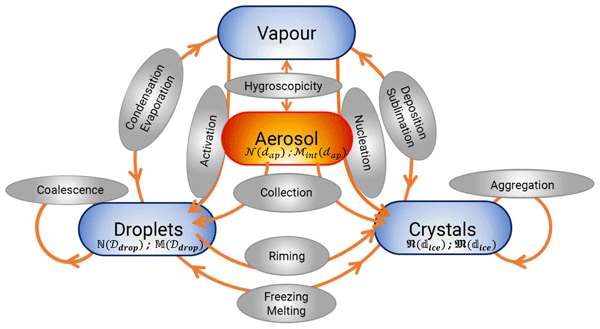
A new in-cloud scavenging scheme is proposed. It is based on a microphysical model of cloud formation and may be applied to long-distance atmospheric transport models (> 100 km) and climatic models. This model is applied to the two most extreme precipitating cloud types in terms of both relative humidity and vertical extension: cumulonimbus and stratus.
Noredine Rekeb, Benjamin Sutter, Emmanuel Belut, Evelyne Géhin, and Raymond Olsen
Aerosol Research, 2, 183–198, https://doi.org/10.5194/ar-2-183-2024, https://doi.org/10.5194/ar-2-183-2024, 2024
Short summary
Short summary
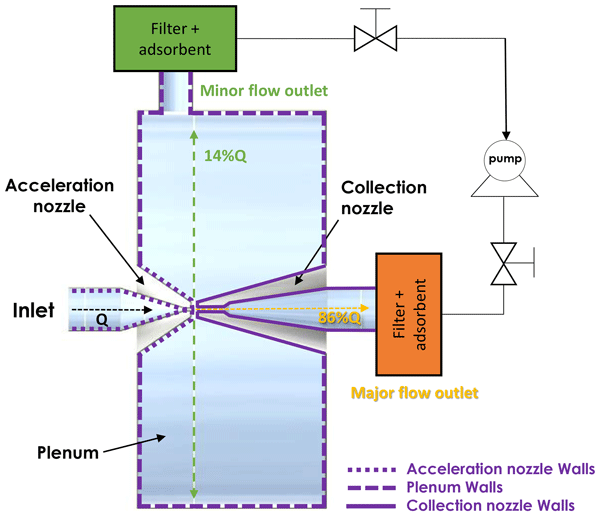
This study addresses challenges in semivolatile organic compound (SVOC) aerosol sampling. Despite its promise, experimental evaluations of the semivolatile aerosol dichotomous sampler (SADS) reveal issues with leakiness, assembly repeatability, and significant wall losses for particles larger than 2 µm. Findings suggest the need for improvements in airtightness, nozzle alignment, and assembly repeatability for the SADS to fulfil its theoretical potential in workplace exposure assessments.
Anthony C. Jones, Adrian Hill, John Hemmings, Pascal Lemaitre, Arnaud Quérel, Claire L. Ryder, and Stephanie Woodward
Atmos. Chem. Phys., 22, 11381–11407, https://doi.org/10.5194/acp-22-11381-2022, https://doi.org/10.5194/acp-22-11381-2022, 2022
Short summary
Short summary
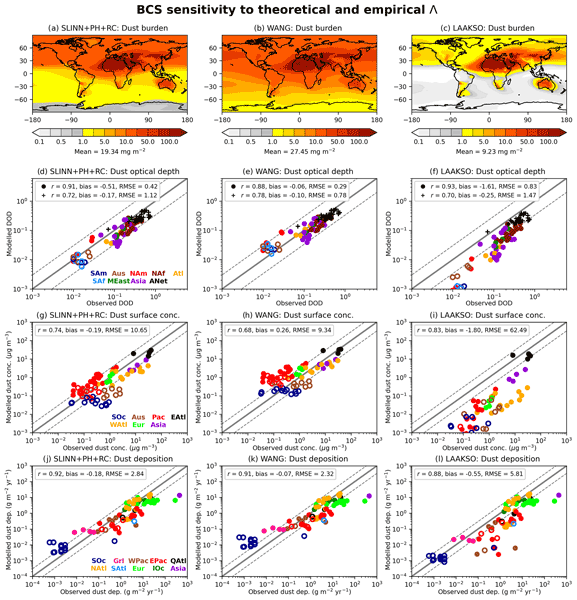
As raindrops fall to the ground, they capture aerosol (i.e. below-cloud scavenging or BCS). Many different BCS schemes are available to climate models, and it is unclear what the impact of selecting one scheme over another is. Here, various BCS models are outlined and then applied to mineral dust in climate model simulations. We find that dust concentrations are highly sensitive to the BCS scheme, with dust atmospheric lifetimes ranging from 5 to 44 d.
Cited articles
AIAA: Guide for the Verification and Validation of Computational Fluid Dynamics Simulations (AIAA G-077-1998 (2002)), American Institute of Aeronautics and Astronautics, Inc., https://doi.org/10.1016/S0376-0421(02)00005-2, 1998. a
Aniszewski, W.: Improvements, Testing and Development of the ADM-τ Sub-grid Surface Tension Model for two-phase LES, J. Comput. Phys., 327, 389–415, 2016. a
Aniszewski, W., Ménard, T., and Marek, M.: Volume of Fluid (VOF) type advection methods in two-phase flow: A comparative study, Comput. Fluids, 97, 52–73, https://doi.org/10.1016/j.compfluid.2014.03.027, 2014. a
Balla, M., Kumar Tripathi, M., and Sahu, K. C.: Shape oscillations of a nonspherical water droplet, Phys. Rev. E, 99, 023107, https://doi.org/10.1103/PhysRevE.99.023107, 2019. a
Beard, K. V. and Chuang, C.: A new model for the equilibrium shape of raindrops, J. Atmos. Sci., 44, 1509–1524, 1987. a
Beard, K. V., Ochs III, H. T., and Kubesh, R. J.: Natural oscillations of small raindrops, Nature, 342, 408–410, 1989. a
Belut, E.: Collecte des aérosols par les gouttes : impact du phénomène de capture arrière en régime laminaire stationnaire, in: Proceedings of CFA 2019 – Congrès Français sur les Aérosols 2019, Paris, France, https://doi.org/10.25576/ASFERA-CFA2019-16616, 2019. a, b
Cunningham, E.: On the Velocity of Steady Fall of Spherical Particles through Fluid Medium, The Royal Society Publishing, 83, 357–365, 1910. a
Dépée, A., Lemaitre, P., Gelain, T., Monier, M., and Flossmann, A.: Laboratory study of the collection efficiency of submicron aerosol particles by cloud droplets – Part I: Influence of relative humidity, Atmos. Chem. Phys., 21, 6945–6962, https://doi.org/10.5194/acp-21-6945-2021, 2021. a, b, c, d, e, f
Duret, B., Reveillon, J., Menard, T., and Demoulin, F.: Improving primary atomization modeling through {DNS} of two-phase flows, Int. J. Multiphas. Flow, 55, 130–137, https://doi.org/10.1016/j.ijmultiphaseflow.2013.05.004, 2013. a
Ebel, J., Anderson, J. L., and Prieve, D.: Diffusiophoresis of latex particles in electrolyte gradients, Langmuir, 4, 396–406, 1988. a
Elgobashi, S.: Prediction of the particle-laden jet with a two-equation turbulence model, Journal of Multiphase Flow, 10, 687–710, 1984. a
Hu, F., Wang, R., and Chen, X.: A modified fifth-order WENOZ method for hyperbolic conservation laws, J. Comput. Appl. Math., 303, 56–68, https://doi.org/10.1016/j.cam.2016.02.027, 2016. a
Lemaitre, P., Sow, M., Quérel, A., Dépée, A., Monier, M., Menard, T., and Flossmann, A.: Contribution of phoretic and electrostatic effects to the collection efficiency of submicron aerosol particles by raindrops, Atmosphere, 11, 1028, https://doi.org/10.3390/atmos11101028, 2020. a
Liu, X.-D., Osher, S., and Chan, T.: Weighted essentially non-oscillatory schemes, J. Comput. Phys., 115, 200–212, 1994. a
Ménard, T., Tanguy, S., and Berlemont, A.: Coupling level set/VOF/ghost fluid methods: Validation and application to 3D simulation of the primary break-up of a liquid jet, Int. J. Multiphas. Flow, 33, 510–524, 2007. a
Min, C. and Gibou, F.: A second order accurate level set method on non-graded adaptive cartesian grids, J. Comput. Phys., 225, 300–321, https://doi.org/10.1016/j.jcp.2006.11.034, 2007. a
Mohaupt, M., Minier, J. P., and Tanière, A.: A new approach for the detection of particle interactions for large-inertia and colloidal particles in a turbulent flow, Int. J. Multiphas. Flow, 37, 746–755, 2011. a
Popinet, S.: Numerical Models of Surface Tension, Annu. Rev. Fluid Mech., 50, 49–75, https://doi.org/10.1146/annurev-fluid-122316-045034, 2018. a
Ren, W., Reutzsch, J., and Weigand, B.: Direct Numerical Simulation of Water Droplets in Turbulent Flow, Fluids, 5, https://doi.org/10.3390/fluids5030158, 2020. a
Reyes, E.: Collection of aerosol particles by falling deformable drops, TIB AV-Portal [video], https://doi.org/10.5446/s_1993, 2025. a, b, c
Shapiro, S. S. and Wilk, M. B.: An analysis of variance test for normality (complete samples), Biometrika, 52, 591–611, 1965. a
Shi, J., Hu, C., and Shu, C.-W.: A Technique of Treating Negative Weights in WENO Schemes, J. Comput. Phys., 175, 108–127, https://doi.org/10.1006/jcph.2001.6892, 2002. a
Shu, C.-W.: Essentialy Non-Oscillatory and Weighted Essentially Non-Oscillatory Schemes for Hyperbolic Conservation Laws, NASA Langley Research Center, https://doi.org/10.1007/BFb0096355, 1997. a, b, c
Slinn, W. G. N.: Some approximations for the wet and dry removal of particles and gases from the atmosphere, Water Air Soil Poll., 7, 513–543, https://doi.org/10.1007/BF00285550, 1977. a
Student: The probable error of a mean, Biometrika, 6, 1–25, https://doi.org/10.2307/2331554, 1908. a
Sussman, M. and Puckett, E. G.: A Coupled Level Set and Volume-of-Fluid Method for Computing 3D and Axisymmetric Incompressible Two-Phase Flows, J. Comput. Phys., 162, 301–337, https://doi.org/10.1006/jcph.2000.6537, 2000. a
Sussman, M., Smereka, P., and Osher, S.: A Level Set Approach for Computing Solutions to Incompressible Two-Phase Flow, J. Comput. Phys., 114, 146–159, https://doi.org/10.1006/jcph.1994.1155, 1994. a
Szakall, M., Diehl, K., Mitra, S. K., and Borrmann, S.: A wind tunnel study on the shape, oscillation, and internal circulation of large raindrops with sizes between 2.5 and 7.5 mm, J. Atmos. Sci., 66, 755–765, 2009. a
Talbot, L.: Thermophoresis-a review, Progr. Astronaut. Aero., 74, 467–488, 1981. a
Tanguy, S.: Développement d'une méthode de suivi d'interface. Applications aux écoulements diphasiques, PhD thesis, Université de Rouen, https://theses.hal.science/tel-00007613 (last access: 1 June 2026), 2004. a
Tanguy, S. and Berlemont, A.: Application of a level set method for simulation of droplet collisions, Int. J. Multiphas. Flow, 31, 1015–1035, 2005. a
Wang, A., Song, Q., and Yao, Q.: Behavior of hydrophobic micron particles impacting on droplet surface, Atmos. Environ., 115, 1–8, 2015. a
Welch, J. E., Harlow, F. H., Shannon, J. P., and Daly, B. J.: The MAC method-a computing technique for solving viscous, incompressible, transient fluid-flow problems involving free surfaces, Tech. rep., Los Alamos National Lab. (LANL), Los Alamos, NM, United States, https://www.osti.gov/servlets/purl/4563173 (last access: 1 June 2026), 1965. a
Short summary
This study uses advanced computer simulations to explore how falling water drops remove airborne particles. It shows that, when drops deform and oscillate, their motion strongly affects how efficiently aerosols are captured. The model accurately predicts drop speed and shape, but capture rates can differ from experiments by up to an order of magnitude. These gaps likely stem from missing physical effects (evaporation), uncertainties in aerosol measurements, and numerical inaccuracies.
This study uses advanced computer simulations to explore how falling water drops remove airborne...
Altmetrics
Final-revised paper
Preprint