the Creative Commons Attribution 4.0 License.
the Creative Commons Attribution 4.0 License.
 | 04 Sep 2026
Challenges in measuring sticky biogenic ice-nucleating macromolecules

Martin I. Daily
Polly B. Foster
Jack P. Macklin
James B. McQuaid
Mark D. Tarn
Benjamin J. Murray
Ice-nucleating particles (INPs) are aerosol particles that influence mixed-phase clouds and in doing so impact weather and climate worldwide. To improve our understanding of ice production in mixed-phase clouds, we need techniques capable of accurately measuring atmospheric INP concentration spectra. However, there are sometimes discrepancies between the techniques commonly used to measure ambient INP concentrations, particularly when used in environments with abundant biogenic ice-nucleating material. Proteins and macromolecules adsorb to surfaces, such as filters, but the impact of this interaction on INP measurements is unknown. Here, we compare a widely used technique that involves washing collected aerosol particles off polycarbonate filters into aqueous suspension for subsequent INP droplet freezing assay (wash-off), with a technique where droplets are placed directly atop PTFE filters on a cold stage (drop-on) and also an online technique using an expansion chamber. Our results show that the wash-off technique underestimates the INP activity when free ice-nucleating proteins are present due to the poor recovery of the proteins from the filter into the wash-off suspension. However, there is much better agreement between techniques for INPs associated with coarse-mode mineral dust particles or cell fragments and for polysaccharide INPs from pollen. These findings indicate that some field-based INP measurements that use a wash-off technique may produce atmospheric INP concentrations that are biased low, particularly in regions with abundant proteinaceous INPs.
- Article
(3647 KB) - Full-text XML
-
Supplement
(1926 KB) - BibTeX
- EndNote


Clouds existing in the mixed-phase temperature regime (0 to −38 °C) contain supercooled liquid water droplets and ice particles (Korolev et al., 2017). The transition from supercooled liquid to ice in these clouds is strongly influenced by the population of ice-nucleating particles (INPs), which initiate freezing via heterogeneous nucleation (Vali et al., 2015). The properties of clouds such as their lifetime, precipitation formation, and electrification (Korolev et al., 2017), as well as the radiative balance (Korolev et al., 2017; Sun and Shine, 1994), are influenced by the concentration of ice crystals, which is itself influenced by ambient INP concentrations (DeMott et al., 2010; Murray et al., 2012; Kanji et al., 2017; Murray et al., 2021; Toll et al., 2024). Reducing uncertainties associated with mixed-phase cloud feedbacks therefore requires improving our understanding of the global distribution of and variability in INPs, which depends on reliable and accurate measurements of INP spectra in the field (Murray et al., 2021).
INP measurement techniques fall broadly into two categories: offline and online. Each approach has distinct advantages and limitations, and commonly used methods are described in some detail in DeMott et al. (2018). In general, offline techniques are more sensitive than online instruments and rely on collecting aerosol samples followed by laboratory processing to determine the INP spectra (the cumulative INP concentration as a function of temperature). Many offline techniques employ filter-based collection, in which ambient aerosol particles are collected onto filters and later processed. The most common of these is the wash-off technique, where particles are collected onto a polycarbonate filter. The filter is later suspended in ultrapure water and agitated so that particles are washed off the filter into suspension. The suspension is then aliquoted (e.g. deposited as sessile droplets onto hydrophobic surfaces or into sample wells in multi-well plates) and cooled to observe freezing (O'Sullivan et al., 2018; Adams et al., 2020; Hiranuma et al., 2021; Porter et al., 2022; Gong et al., 2022; Barr et al., 2023; Sze et al., 2023; Wilbourn et al., 2024; Böhmländer et al., 2025; Tarn et al., 2024; Wex et al., 2025). Other filter-based offline techniques are more direct because the collected particles remain on the filter surface during the nucleation experiments. This can be achieved by pipetting water droplets directly onto polytetrafluoroethylene (PTFE) filters in the drop-on technique (Schnell, 1982; Price et al., 2018; Sanchez-Marroquin et al., 2020, 2023; Raif et al., 2024), inducing condensation onto nitrocellulose filters in a condensation-on-filter technique (Santachiara et al., 2010; Rinaldi et al., 2017; Nicosia et al., 2017; Rinaldi et al., 2025), condensation onto coated glass (Mason et al., 2016; Si et al., 2018; Irish et al., 2019), or by immersing punches of quartz filters in water (Conen et al., 2012, 2022).
Online INP measurement techniques differ fundamentally in that they sample and analyse ambient air directly, providing almost-real-time INP concentrations. For example, the Portable Ice Nucleation Experiment (PINE) chamber is a cloud simulation chamber instrument that measures INPs by generating clouds under defined conditions (Möhler et al., 2021). Ambient air is sampled into the chamber and is cooled adiabatically due to a reduction in pressure. In the mixed-phase regime, aerosol particles activate as cloud condensation nuclei (CCN) upon chamber conditions reaching water saturation, and any INPs immersed in the resulting droplets may initiate freezing. Ice crystals grow more rapidly than supercooled droplets and can therefore be distinguished and counted using an optical particle counter (OPC) on the basis of their size. Another commonly used online instrument type is the continuous flow diffusion chamber (CFDC), which consists of two ice-coated walls (either parallel plates or concentric cylinders). By controlling the wall temperatures, the specific temperature and supersaturation conditions of the sample flow can be influenced. INPs active under those conditions will nucleate ice crystals, which are detected downstream (Rogers, 1988; Rogers et al., 2001; Garimella et al., 2016). While the availability of multiple INP measurement techniques is advantageous, differences in measurement principles and instrument-specific limitations can influence reported INP concentrations.
Many comparisons between INP measurement techniques report good overall agreement across instruments, environments, and platforms. For example, measurements in agricultural, semi-arid, and semi-rural regions across the western United States using a CFDC, condensation-on filter, and wash-off techniques reported reasonable agreement across all sites above −20 °C (DeMott et al., 2017). Aircraft-based campaigns have also demonstrated consistent behaviour between wash-off techniques and CFDC measurements, including good agreement during sampling over California (Levin et al., 2019) and during observation of aged wildfire smoke (Barry et al., 2021). An intercomparison at the Puy de Dôme observatory, involving CFDC, wash-off, condensation-on-filter, and PINE instruments, found that most measurements agreed within a factor of 5 between −10 and −25 °C (Lacher et al., 2024). Laboratory studies further support these findings, with agreement reported between techniques for atomised Snomax® (hereafter Snomax) suspensions (Wex et al., 2015; DeMott et al., 2018) and aerosolised soil dust (DeMott et al., 2018).
Despite these examples of good agreement, several aircraft and ground-based measurement studies have reported substantial discrepancies between techniques, particularly when comparing the wash-off technique to others that require less sample processing. For example, an aircraft campaign sampling INPs over south-eastern England found that for samples analysed by both the wash-off and drop-on filter techniques, there was disagreement 40 % of the time, with the wash-off INP spectra often detecting up to an order of magnitude lower INP concentration at temperatures higher than −22 °C (Sanchez-Marroquin et al., 2021). Similarly, measurements of wildfire emissions in the United States showed that wash-off techniques consistently measured lower INP activity than an online CFDC instrument, with discrepancies sometimes reaching 2 orders of magnitude (Barry et al., 2021). During an airborne campaign in the central Great Plains, discrepancies of up to an order of magnitude were also observed between wash-off and CFDC measurements, particularly at temperatures above −25 °C (Patnaude et al., 2025). When interpreting these differences, it should be noted that the CFDC employed in both studies used an impactor to limit sampling to aerosol below 2.5 µm and that this typically operated at or below −19 °C, rather than in the warmer regime, where other discrepancies have been observed. Aircraft measurements in New Mexico further showed that wash-off-derived INP concentrations were sometimes lower than those obtained using the drop-on technique, especially above −25 °C (Daily et al., 2026). Comparable discrepancies have also been reported in ground-based studies. Measurements from Svalbard indicated that INP concentrations from a more direct condensation-on-filter analysis were generally higher than those obtained using the wash-off technique, especially at warmer temperatures, with differences of a factor of 3 at −22 °C and up to a factor of 8 at −15 °C (Rinaldi et al., 2021). A comparison between PINE and the wash-off technique in the eastern North Atlantic Ocean reported that the wash-off technique measured over an order of magnitude fewer INPs per litre than PINE at −20 °C (Wilbourn et al., 2024; this paper also presents data from the continental USA, where there was good agreement between a wash-off technique and PINE). Taken together, these observations suggest that the wash-off technique may underestimate INP activity compared with other methods that require less sample processing, consistent with the loss of INPs during the wash-off procedure. Discrepancies are most pronounced at warmer temperatures (i.e. > −15 °C), where biogenic INPs are expected to dominate (Murray et al., 2012; Huang et al., 2021).
The ice-nucleating ability of biological INPs often stems from the presence of ice-nucleating macromolecules (INMs), including proteins and polysaccharides (Pummer et al., 2015). These macromolecules are often associated with larger entities such as bacterial cells, cell fragments, pollen grains, or mineral dust particles (Pummer et al., 2015; Tarn et al., 2025). Ice-nucleating proteins (INpro), particularly when aggregated or anchored to particle surfaces, can trigger freezing at temperatures only slightly below 0 °C (Pummer et al., 2015; Lukas et al., 2022) and are therefore important contributors to atmospherically relevant ice nucleation. Soil dusts, a major source of INPs active above −15 °C (Conen et al., 2011; O'Sullivan et al., 2014), often contain fungal INpro that are internally mixed with mineral dust particles (Mayer, 1994; Fröhlich-Nowoisky et al., 2015; O'Sullivan et al., 2016; Conen and Yakutin, 2018; Eufemio et al., 2026). Adsorption of fungal INpro in soil dust is observed to be partially reversible (O'Sullivan et al., 2016), suggesting that soil dust suspensions could contain both mineral-dust-bound proteins and free proteins. Similar behaviour is observed in the artificial snow-making product Snomax, produced from Pseudomonas syringae bacteria, where INpro are embedded within cells and fragments (Yankofsky et al., 1981; Turner et al., 1991). Although INpro typically reside at the cell membrane (Govindarajan and Lindow, 1988; Mueller et al., 1990; Schwidetzky et al., 2023), they can be isolated by 0.2 µm filtration (Bieber and Borduas-Dedekind, 2024; Alden et al., 2025). As such, Snomax isolate serves as a proxy for environmentally relevant aerosol containing externally mixed INpro or INpro mixed with soluble material. Additional examples of INMs occur in lichens (Moffett et al., 2015; Eufemio et al., 2023), sea spray aerosol (Wang et al., 2015; Cochran et al., 2017), and pollen. The polysaccharides found in pollen are capable of nucleating ice at similar temperatures to intact pollen grains (Pummer et al., 2012).
Although the ice-nucleating activity of INMs is increasingly well documented, their interaction with surfaces remains poorly explored. However, in other fields, proteins have been observed to interact strongly with a variety of surfaces, and non-specific adsorption is well documented (Locascio et al., 1999; Atthoff and Hilborn, 2007; Rashid et al., 2021). Proteins tend to adhere more readily to hydrophobic surfaces (Young et al., 1988; Marshall et al., 1993; Henry et al., 2003); however Latour (2020) notes that protein adsorption is relevant for virtually any process in which a protein-containing solution comes into contact with a surface. Polycarbonate filters used in the wash-off technique are treated with polyvinylpyrrolidone (PVP) to render them hydrophilic. While PVP reduces protein adsorption, it does not eliminate it (Robinson and Williams, 2002), and protein adsorption has been observed on PVP-treated polycarbonate membranes (Tracey and Davis, 1994). On hydrophilic surfaces such as PVP-treated polycarbonate, adsorption occurs through hydrogen bonding between polar amino acid residues of the protein and polar groups of the surface (Latour, 2020). Once proteins adhere to a surface, adsorption is often irreversible, and proteinaceous INMs cannot be removed by simply rinsing with water (Lim et al., 1971; Larsson, 1980; Marshall et al., 1993; Rabe et al., 2011). The ability of proteins to adsorb to surfaces is particularly relevant for biological INPs in environmental samples. While not as well documented as protein adsorption, there is evidence that polysaccharides can adsorb to surfaces (Ulbricht et al., 2009). However, it remains unclear if polysaccharides and other macromolecules adsorb as strongly as proteins. The tendency of INMs to adhere to surfaces, including polycarbonate filters, raises the possibility that conventional wash-off techniques may not recover them, resulting in the discrepancies reported in the literature.
Our hypothesis is that the discrepancies in INP concentrations between techniques are related to the loss of “sticky” ice-nucleating macromolecules (INMs) during sample recovery, including ice-nucleating proteins (INpro) that are not anchored to larger particles such as mineral dusts or cell fragments. These “free” INMs may become adsorbed to the polycarbonate filter membrane and are therefore not recovered into the wash-off suspension for detection. To test this hypothesis, we performed a set of controlled experiments using well-defined aerosol samples in a laboratory aerosol chamber, where we collected samples using two filter-based techniques alongside the PINE online instrument. In addition, we developed a method to detect ice-nucleating entities that remain adsorbed on polycarbonate filters.
To test our theory of sticky INMs, samples of ice-nucleating materials were aerosolised into an aerosol chamber and then sampled onto filters or into the PINE. Polycarbonate filters were analysed using the wash-off technique (O'Sullivan et al., 2018), and PTFE filters were analysed using the drop-on technique (Price et al., 2018), both followed by droplet freezing assays. The PINE was used for some experiments to complement the filter measurements. In this section, we describe the components of our experimental system.
2.1 Aerosol sampling setup
The aerosol chamber is a 0.729 m3 aluminium cube with an inlet and multiple outlet ports, allowing different instruments and sampling inlet systems to be fitted. Before any experiments took place, the chamber was flushed with filtered dry air overnight to ensure a low background aerosol concentration. After flushing, the sample material was aerosolised into the chamber as described below. Aerosolised material entered the chamber through an inlet on the side of the chamber. A small internal mixing fan positioned directly below this inlet ensured that the aerosol was well distributed throughout the chamber. To minimise sampling biases, outlet ports for additional instruments were within 7 cm of the centre of the chamber base. During operation, the aerosol chamber was maintained at ambient pressure. A schematic diagram of the aerosol sampling system can be seen in Fig. 1.
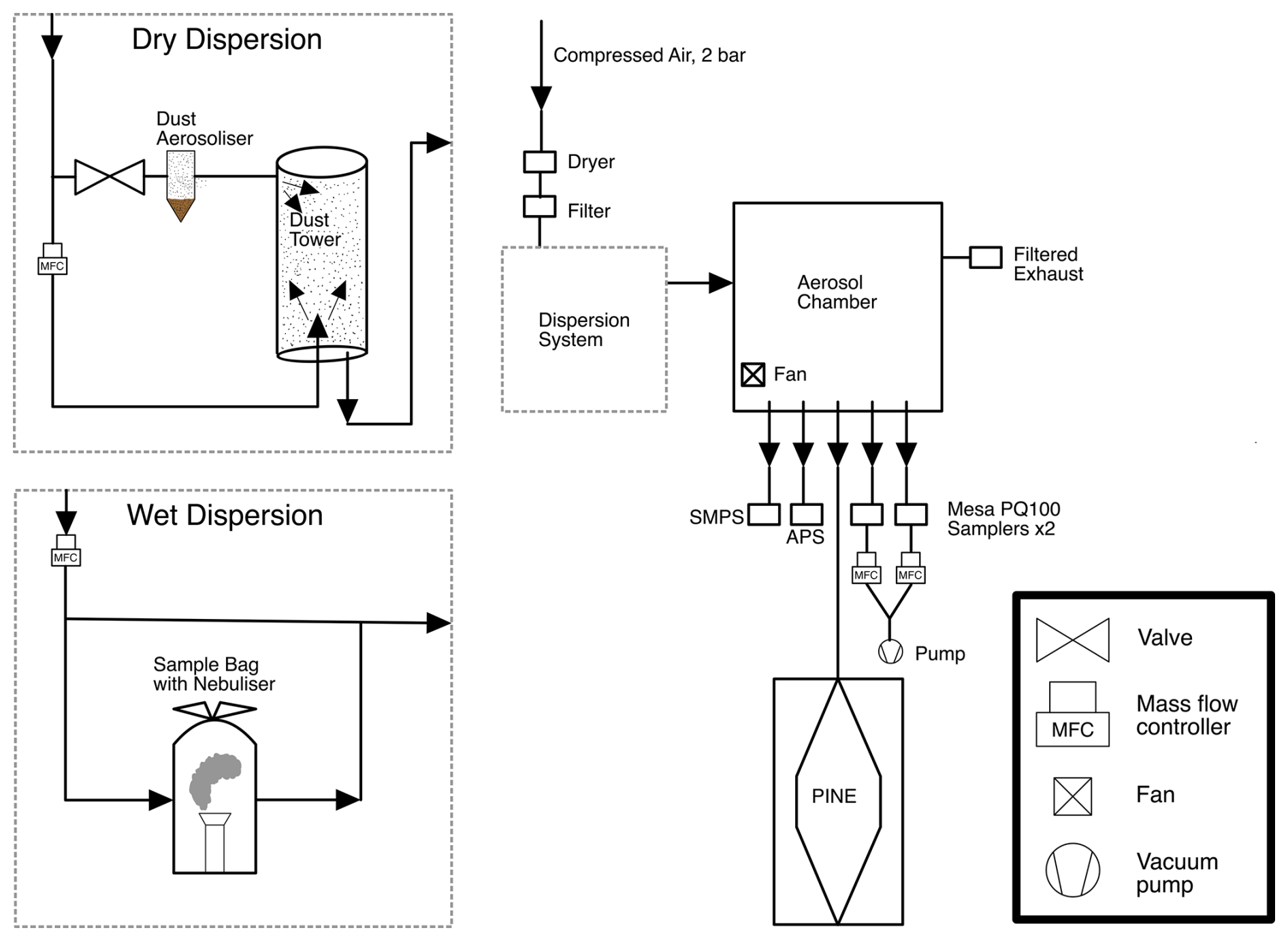
Figure 1Schematic diagram of the aerosol generation and sampling system. Dry samples were loaded into a centrifuge tube and aerosolised into the dust tower before entering the main aerosol chamber. Liquid samples and filtrates were aerosolised using a nebuliser.
Due to differing physical properties, each material required an appropriate dispersion method. Dry, particulate samples were dispersed using the dry-dispersion approach. For this method, the sample material was loaded into a 15 mL centrifuge tube, which served as the dust aerosoliser. The aerosoliser was mounted at the top of the dust tower (Grimm Aerosol Technik GmbH, Germany), a cylindrical chamber 97 cm in height, 26 cm diameter, used to mix and dilute the aerosol before entering the main chamber. A HEPA-filtered air line pressurised to 2 bar was connected to a valve adjacent to the aerosoliser. When triggered, this valve briefly opened, directing a pulse of pressurised air across the sample surface. This rapid airflow caused the particles to become aerosolised before entering the dust tower. Within the tower, the aerosol was diluted with filtered air introduced at the base, regulated by a Sierra SmartTrak® 100 (Sierra Instruments, USA) mass flow controller (MFC) at 30 L min−1 or, if PINE was active, 34 L min−1. The dust tower operated at a slightly elevated internal pressure, ensuring a continuous and stable flow of aerosol from the dust tower to the main sampling chamber.
For liquid sample suspensions and filtrates, a medical nebuliser (Omron MicroAir U22, Japan) was used. The nebuliser had a mass median aerodynamic diameter of 4.2 µm. The nebuliser was placed inside a clean, sealable polyethylene bag with a filtered airflow. The airflow was set to 34 L min−1 during experiments with PINE and 30 L min−1 without PINE. To prevent the bag from over-pressurising and exploding, the filtered air was split, with only half passing through the bag and the other half through a bypass line. Before entering the chamber, the two air lines reconnected. When the nebulised sample entered the aerosol chamber, the water evaporated due to sub-saturated conditions, leaving dry aerosol particles.
For all experiments in this study, particle size distributions were measured using a TSI Aerodynamic Particle Sizer (APS) 3321 spectrometer and a TSI Scanning Mobility Particle Sizer (SMPS) 3938 spectrometer (TSI Inc., Aachen, Germany). The APS sampled 5 L min−1 from the chamber and quantified particles from 0.523 to 19.81 µm in aerodynamic diameter. The SMPS sampled at 3.3 L min−1 and measured particle concentrations between 14.6 and 685.4 nm in electrical mobility diameter. The size distributions from both instruments were merged to obtain a complete aerosol size spectrum from 20 nm to 14 µm, which was then used to calculate the total aerosol surface concentration for subsequent analysis. The APS and SMPS were merged following the procedure described in Möhler et al. (2008), and more details can be found in Sect. S4.
2.2 Filter sampling
For INP filter measurements, we used two Mesa Laboratories Inc. (Butler, NJ, USA) BGI PQ100 filter samplers. A 50 cm aluminium sample tube with an internal diameter of 2.3 cm was connected to the PQ100 filter holders and inserted directly into the chamber. Each sample tube was placed 25 cm away from the chamber centre (50 cm apart). Then, 47 mm diameter filters were inserted into the filter holder, which was 6 cm below the end of the sample tube. In parallel samplers, we used 0.4 µm pore diameter polycarbonate track-etched membrane filters (Whatman® Nuclepore 10417112, Cytiva Life Sciences, USA) and 1.2 µm equivalent pore diameter polytetrafluoroethylene (PTFE) membranes (Sartorius® 11803–47——N, Germany). Despite having different equivalent pore sizes, both filter types are expected to have high aerosol collection efficiencies (> 90 %; 0.01–0.4 µm), with reported efficiencies exceeding 95 % for particles larger than 0.15 µm (Zíková et al., 2015; Soo et al., 2016). Collection efficiency depends on filter characteristics and sampling conditions, but the variability due to collection efficiency is expected to be smaller than potential differences between the wash-off and drop-on techniques. To assess potential sampling-location bias, both samplers were operated simultaneously using the same filter type while sampling chamber aerosol. The resulting INP activities agree within 1 °C, indicating no systematic difference between sampling positions (Sect. S2 in the Supplement). The filter type assigned to each sampler was alternated throughout the campaign to minimise any residual position-related bias. Each sampler was controlled by a Sierra SmartTrak® 100 mass flow controller (MFC) connected to a vacuum pump (S55JXTJN8535, Gast, USA). Both MFCs were set to 10 L min−1. The vacuum pump pulled air from the aerosol chamber through the filter membranes, which collected any particles in the sampled air.
2.3 Droplet freezing analysis
After sampling, the filters were immediately analysed using the Microlitre Nucleation by Immersed Particle Instrument (µL-NIPI). This technique is an offline droplet freezing assay to quantify the immersion mode freezing INP spectra (Whale et al., 2015). The µL-NIPI methodology depends on the filter material. The polycarbonate filters were processed using the wash-off µL-NIPI method (O'Sullivan et al., 2018), while the PTFE filters were processed using the drop-on NIPI method (Price et al., 2018). The different techniques are illustrated in Fig. 2. In all experiments, Agar Scientific rectangular glass cover slips (48 mm × 64 mm) were washed in ultrapure water (18.2 MΩ water filtered by Arium Pro UV, Sartorius, Germany) and isopropanol before being immersed in ClearVue® rain repellent (Turtle Wax, USA) for 30 min. The slide was then rinsed again with water and dried using zero-grade nitrogen. The ClearVue created a hydrophobic coating on the glass slide to increase the contact angle between the glass slide and the water droplets.
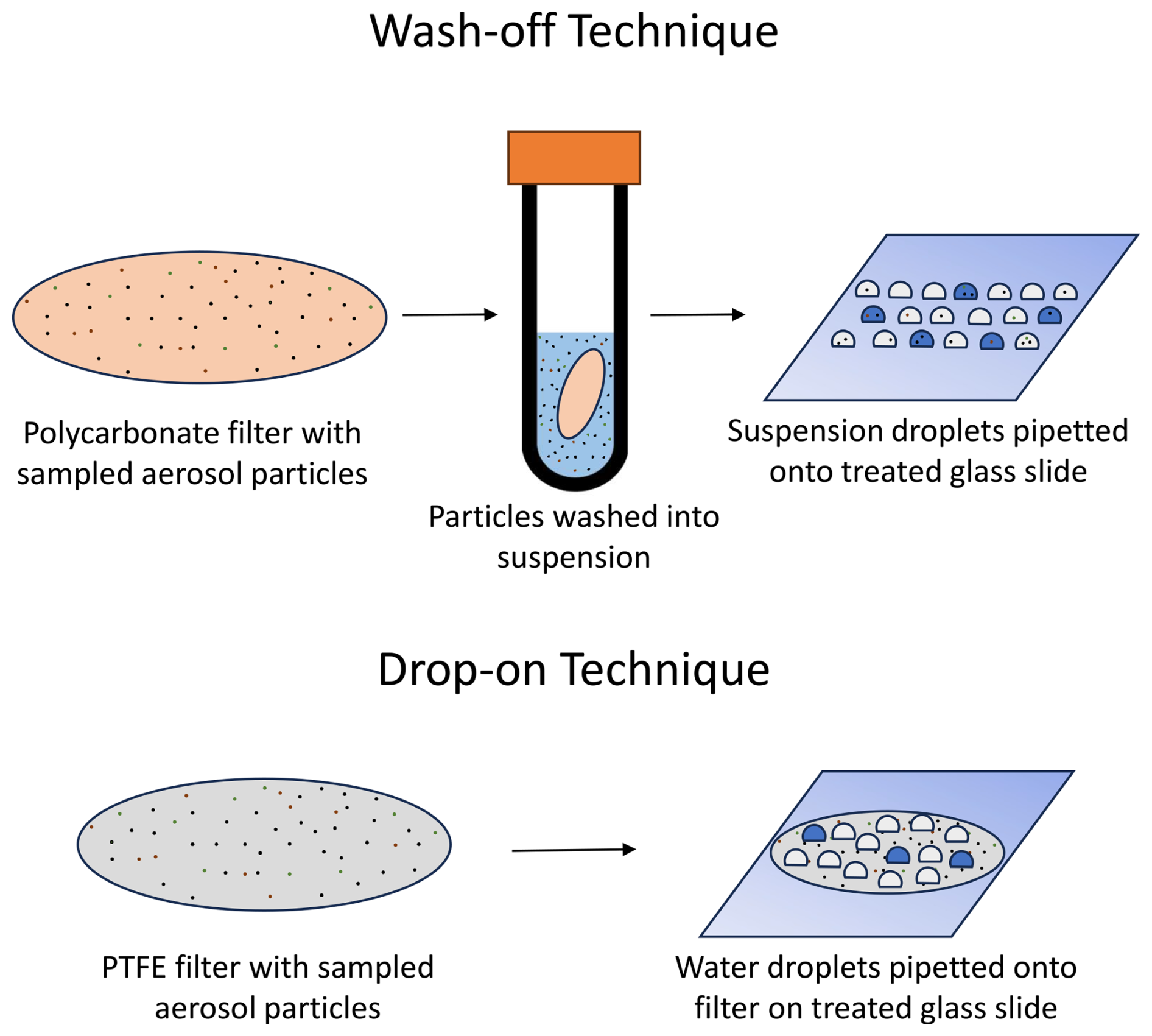
Figure 2The µL-NIPI cold stage analysis technique for two types of filters. Polycarbonate filters were placed into 5 mL of water and mixed for 30 min. The wash-off suspension was then pipetted onto a glass slide before being cooled until all droplets were frozen. PTFE filters were collected from the filter sampler, and water droplets were directly pipetted onto the filter atop a glass slide before being cooled on a cold stage via the drop-on method.
During the wash-off technique, after the polycarbonate filter had been removed from the sampler filter holder, it was placed into a 50 mL centrifuge tube with 5 mL of ultrapure water. The centrifuge tube was mixed on a rotary mixer at 30 rpm for 30 min. Following mixing, approximately 140 droplets of 2 µL volume of the sample suspension were pipetted (Picus® Electronic Pipette, 0.2–10 µL, Sartorius, Germany) directly onto the treated glass slide. Prior to each set of repeated experiments, the suspension was remixed on a rotary mixer for 10 min. The pipette was capable of dispensing five droplets before refilling was required. To minimise settling of larger particles, the suspension was manually agitated before each refill. During the drop-on technique, the PTFE filter containing the sampled particles was placed directly onto a treated glass slide (as described above), and approximately 100 × 2 µL droplets of ultrapure water were pipetted directly onto the filter surface.
After pipetting, the treated glass slides with droplets were placed on the µL-NIPI cold stage. The cold stage was programmed to cool down at 1 °C min−1. To prevent frost formation on the cold stage during analysis, we used a low flow (0.4 L min−1) of zero-grade nitrogen over the droplets during the experiment. A camera placed over the cold stage recorded a video that detected droplet freezing. A Python software was used to automatically detect nucleation events and determine the temperatures associated with each frozen droplet (Barr et al., 2023).
Throughout the study, filter handling blanks were taken before every new aerosol sample material was introduced. These handling blanks sampled the same volume as the samples, from a clean aerosol chamber with filtered inlet air. These were subtracted from the sample data to remove any background contamination (Vali, 2019; Sanchez-Marroquin et al., 2021; Raif et al., 2024; Tarn et al., 2024; Daily et al., 2026). All the data from the study (handling blanks and samples) were binned into 0.5 °C temperature bins. The differential freezing nucleus spectrum, k(T) (cm−3 °C−1), was then calculated for each bin using Eq. (1) (Vali, 1971, 2019):
where Vdrop is the volume of the pipetted droplet (2 µL), ΔT is the temperature bin width (0.5 °C), ΔN is the number of freezing events in the temperature bin (between T−0.25 °C and T+0.25 °C), and N(T) is number of unfrozen droplets in the temperature bin (freezing colder than T−0.5 °C).
Background k(T) curves were created for the PTFE and the polycarbonate filter blanks (Sect. S1). The average of all the blanks was used as the background k(T), and the standard deviation of the background runs represented the uncertainty in the background measurement. For sample data, if multiple runs were carried out on one wash-off suspension, the k(T) value was the mean of the separate runs, and the uncertainty was the standard deviation. For experiments with no repeats, the error was determined by the Poisson counting statistics and propagated to k(T) (Raif et al., 2024). To determine the k(T) value, the background value, kbg(T), was subtracted from the sample value, ksample(T) (Eq. 2). If the sample k(T) value happened to fall within the background, this resulted in a sample k(T) value of 0 cm−3 °C−1 at that given temperature. The background subtraction method used during this study is further described in Barr et al. (2023) and Raif et al. (2024).
We then calculated the cumulative freezing nucleus concentration, K(T), by summing the background-subtracted k(T) values for temperatures warmer than T. The cumulative freezing nucleus concentration can be calculated using Eq. (3).
K(T) does not account for the volume of sampled air or the dilution by the amount of water used. To directly compare samples of different sampling volumes, the INP number concentration (NINP, L−1) was used. The INP concentration gives the number of INPs in a given volume of sampled air. We use Eq. (4) to calculate the INP concentration for the wash-off technique and Eq. (5) for the drop-on technique:
where Vsusp is the volume of the wash-off suspension, Vair is the volume of sampled air, A is the area of the filter exposed to the airstream in the sampler, Vdrop is the volume of a pipetted droplet, and α is the footprint area of the drop in contact with the filter. For this study, Vsusp = 5 mL and Vdrop = 2 µL. Additionally, A = 11 cm2 and α = 1.357 mm2 (Sanchez-Marroquin et al., 2021).
To compare the ice-nucleating activity derived from different experiments with different aerosol loadings and particle size distributions, we use the active site density (ns(T), cm−2). The active site density is the number of ice-nucleating active sites per unit of surface area of ice-nucleating material (Vali et al., 2015). The active site density is defined in Eq. (6):
where s is the total surface area of the particles per unit volume of sampled air and has units of µm2 cm−3. The total surface area was calculated by finding the area under the curve from the vs. particle diameter (Dp) curve, mathematically shown in Eq. (7):
The uncertainty associated with the background-subtracted k(T) values was propagated through the calculation of K(T) and subsequently through to NINP(T) for both the drop-on and wash-off techniques. The uncertainty in ns(T) was calculated by combining the NINP(T) uncertainty with that of the total particle surface area, s, using standard error propagation in quadrature. While NINP(T) shows how numerous INPs are in a sample, ns(T) shows how active the INPs are, making ns(T) useful for this study, where the aerosol loading and aerosol type vary. For each individual experiment, ns(T), plotted with its uncertainty, can be found in Sect. S3.
2.4 PINE-1B
In some experiments, the Portable Ice Nucleation Experiment version 1B (PINE-1B, Bilfinger GmbH, Germany) was connected to the aerosol chamber. PINE is an expansion chamber with pressure-drop-induced cooling to activate INPs via immersion and deposition mode freezing (Möhler et al., 2021). The PINE-1B is described in Ponsonby et al. (2024). All PINE experiments in this study used the PINE-1B (PINE hereafter).
The PINE operated in three modes: flush, expansion, and refill. During the flush mode, sample air was drawn through the system at 4 L min−1 for 5 min. The air entered through the inlet, was dried by two counterflow Nafion dryers in parallel, and then flowed into the top of the PINE chamber. It exited through the bottom of the chamber and passed through the WELAS 2500 (Palas GmbH, Germany) optical particle counter (OPC) connected to a Promo 2000 control unit (Palas GmbH). After 5 min of flushing, the instrument switched to expansion mode. The inlet valve at the top of the chamber closed, and air was pumped out at 4 L min−1. As the chamber pressure decreased, the relative vapour pressure over ice and water increased, while the temperature decreased quasi-adiabatically, triggering the formation of a mixed-phase cloud through activation of INPs and CCN. The resulting cloud droplets and ice crystals passed through the WELAS OPC, which measured particle diameter and number. During the expansion phase, the incoming sample air was bypassed around the chamber directly to the outlet to maintain the upstream flow rates. Once the chamber pressure reached 800 hPa, the PINE switched to refill mode. The refill valve above the chamber opened, and the chamber outlet was closed. This allowed sample air to slowly refill (approximately 1 L min−1) and repressurise the chamber. When the chamber pressure reached 950 mbar, the PINE returned to the flush mode, allowing the chamber to equilibrate with ambient pressure. The entire cycle lasted approximately 8 min and was then repeated throughout the experimental period.
The phase of sampled particles was determined by whether the detected particle was larger or smaller than the ice threshold, which was manually determined based on an individual expansion's particle size distribution, which was typically bimodal. The ice threshold was defined as the size representing the cut-off between the smaller-diameter water droplet mode and the larger-diameter ice particle mode. Each expansion was then divided into five equal-sized pressure bins, and any data below 850 hPa were removed (Sect. S5). The total number of ice particles detected in each pressure bin was Nmeas. We can then determine the INP concentration (NINP(T)) using Eq. (8). As the PINE was an expansion chamber and cools the air parcel via pressure-controlled adiabatic cooling, the adiabatic temperature was used for measurements (King, 2024). The initial, pre-expansion, temperature was measured by thermocouples in the chamber. The temperature during the expansion was then calculated assuming the expansion was adiabatic, using the dry adiabatic lapse rate until the parcel was saturated before switching to the saturated adiabatic lapse rate, as used in Ponsonby et al. (2024). The adiabatic assumption was supported by the match between measured droplet onset relative humidity and water saturation reported by Ponsonby et al. (2024).
where Nmeas is the ice crystal number concentration detected by the OPC in each pressure bin, τ is the mean transit time of particles through the detector, tbin is the pressure bin duration, and Vd is the detection volume of the OPC. Since we use pressure bins, the duration is the duration of each pressure bin (usually between 3 and 8 s), and the volume is the volume of air passed through the OPC over the course of the pressure bin. The temperature used for each pressure bin was the coldest temperature of the detected ice particles. The WELAS used in the PINE-1B did not sample the entire flow from the chamber (only approximately 10 %; Möhler et al., 2021), so to account for this, the transit time and detection volume must be included in the calculation. To calculate the active site density, we use Eq. (6).
2.5 Analysis of residual INPs on washed polycarbonate filters
Our hypothesis is that INMs are adsorbed to the polycarbonate filter and do not come off in the washing process. To test this, we analysed punches of the washed filters for INPs using the InfraRed-Nucleation by Immersed Particle Instrument (IR-NIPI) (Fig. 3) (Harrison et al., 2018; Daily et al., 2023). The IR-NIPI is an immersion mode freezing instrument that uses an infrared camera to detect ice nucleation events in aqueous aliquots contained in the wells of 96-well plates, into which we placed 5 mm punches of filters. When we used the IR-NIPI, the wash-off suspension had been in the freezer for about a year. The centrifuge tubes containing the frozen wash-off suspension with the immersed polycarbonate filter were allowed to thaw at room temperature for 30 min. They were then placed on a rotary mixer (Clifton™ RM2, UK) for 30 min. Afterwards, the filter was removed from the suspension, and 15 × 5 mm diameter punches were taken using a 5 mm diameter stainless steel tissue biopsy punch (WellTech Rapid Core 5.0, Taiwan). The punches were placed into wells in half of a 96-well plate and submerged in 100 µL of pure water each. The remaining filter was put into a clean centrifuge tube with clean water and was washed vigorously by shaking and spraying with ultrapure water to remove any further particles. An additional 15 punches were placed in wells in the other half of the 96-well plate with 100 µL of water each. The punches and water were put in every other well to avoid being influenced by the release of latent heat of freezing from adjacent wells. To assess the background of the analysis method, we performed four experiments with punches of blank filters.

Figure 3The IR-NIPI analysis process. (1) The polycarbonate filter was washed during the wash-off technique as in Fig. 2. (2) The washed filter was removed from the wash-off suspension. (3) 5 mm diameter punches of the washed filter were taken using a biopsy punch. (4) Filter punches were placed in a 96-well plate with 100 µL of pure water for IR-NIPI analysis. (5) This process was repeated with a second, more vigorous wash.
The assay tray was then placed onto the IR-NIPI's cold stage and cooled down at a rate of 1.3 °C min−1, corresponding to the tray actually cooling at approximately 1 °C min−1 (Harrison et al., 2018). An infrared camera recorded the temperature of the water's surface in each well. When the water froze at subzero temperatures, the temperature in the well jumped to 0 °C due to the release of latent heat and then slowly cooled back down to the plate temperature. The nucleation temperature was assumed to be the coldest temperature recorded for each well before the jump to 0 °C. The freezing temperatures can then be used to calculate a fraction frozen, giving the fraction of frozen wells at a given temperature (Eq. 9).
where nice(T) is the number of frozen wells at a given temperature, and ntot is the total number of wells with water and filter punches. Background measurements of new, clean filters were plotted next to the data from washed filters to provide context that the samples were above or in the background. To determine whether the washed-filter-punch analysis was different from the background, we used an integrated squared difference (ISD) test (Whale et al., 2026). We only draw attention to this (ISD) test if the washed filter analysis was found not to be statistically significant compared to the background. There is a temperature gradient between the measured surface film temperature (measured by IR) and the base of the wells that is poorly characterised (Beall et al., 2017). Because the filter punch samples could not be placed and held at a consistent position within the wells, individual samples likely experienced different thermal conditions (e.g. variations in vertical position or contact with the well walls). This introduced an unknown and variable temperature uncertainty, which we estimate to be within approximately 5 °C. Hence, we do not derive active site density (ns(T)) from IR-NIPI data and instead present fraction frozen curves that provide a measure of the ice nucleation activity of material retained on the washed filters relative to clean filters.
A set of well-defined aerosol dispersions were created to test the hypothesis that macromolecules stick to filters and are not recovered into the wash-off aqueous suspension. We selected samples that contain INMs, including proteins and polysaccharides. A subset of samples consisted of filtered suspensions, where particles larger than 0.2 µm had been removed. These filtrates contained free macromolecules that we anticipated would interact with the filter. We also tested a set of dry-dispersed materials that, along with macromolecules, contained many coarse-mode particles. Some proportion of the ice-nucleating proteins (INpro) reside on these larger particles, and we hypothesise that these larger particles will be recovered into the wash-off suspension.
3.1 Dry-dispersed samples
We dry-dispersed three samples containing biogenic INPs: Alaskan Copper River dust, UK agricultural soil dust, and a lyophilised bacterial material (Snomax). Information about each material can be found in Table 1, and size distributions are in Fig. S4 in the Supplement.
(Barr et al., 2023)(Thompson, 2024)Table 1Information about the dry-dispersed materials used during this study.

3.1.1 Dry Snomax
Snomax® snow inducer is a freeze-dried commercial product manufactured by Snomax International in Englewood, CO, USA. It is used for artificial snow production and contains material derived from Pseudomonas syringae, a bacterium with efficient ice-nucleating proteins (Yankofsky et al., 1981; Turner et al., 1991). Snomax is most commonly worked with in its bulk form, where no filtering of the substance takes place (Wex et al., 2015; DeMott et al., 2018; Polen et al., 2016), and is the most commonly used “biological” INPs (Tarn et al., 2025).
3.1.2 Copper River dust
The Copper River dust sample was collected from the Copper River delta near Cordova, Alaska (60.4° N, 145.0° W) in October 2019 (Barr et al., 2023). Surface material was collected, sieved to < 45 µm, stored at −20 °C until use, and subsequently aerosolised in the aerosol chamber using the dry-dispersion method.
3.1.3 Agricultural soil dust
The agricultural soil dust was collected from field no. 1246 at the University of Leeds Research Farm near Tadcaster, UK (53.869° N, 1.320° W) on 12 October 2022 (Thompson, 2024). Agricultural soil dust, like other soil dusts, is mineral dust with internally mixed biogenic material, some of which is adsorbed to the mineral surfaces (Mayer, 1994; Conen et al., 2011; O'Sullivan et al., 2016). The soil was air-dried in the oven at 27 °C for 2–3 h and was dry-dispersed into the aerosol chamber.
3.2 Wet-dispersed samples
We wet-dispersed four samples that contain aqueous filtrates of free biogenic INPs: agricultural soil, lichen, pollen, and Snomax. In addition, we wet-dispersed a sea surface microlayer sample. Information about each material can be found in Table 2, and size distributions are in Fig. S8.
(Thompson, 2024)(Proske et al., 2025)(Wilson et al., 2015)Table 2Information about the wet-dispersed materials used during this study. Information includes the sample source and experiment dates.

3.2.1 Snomax filtrate
The Snomax filtrate was made by making a suspension with 0.001 g of Snomax in 10 mL of ultrapure water. The Snomax suspension was mixed on the vortex mixer for 30 s and left for 1 h to allow large particles to fall out. We then filtered the suspension through a 0.2 µm filter to remove large particles. The filtrate was aerosolised via wet dispersion.
3.2.2 Lichen filtrate
The Hypogymnia physodes lichen used during this study was collected from Scots pine trees at Hyytiälä Forest Station, Finland (61.845° N, 24.292° E), in spring 2018 (Proske et al., 2025). Lichen has been observed to nucleate at temperatures just below freezing and contain highly stable ice-nucleating proteins from the fungal mycobiont that are more potent than those found in bacterial INPs (Eufemio et al., 2023, 2025). The lichen filtrate was prepared by suspending 0.14 g of lichen in 25 mL of ultrapure water and placing it on a rotary mixer at 30 rpm for 30 min. The lichen supernatant was poured into another centrifuge tube to remove the large pieces of lichen and then filtered to 0.2 µm before being wet-dispersed for experiments. The lichen was filtered following Eufemio et al. (2023, 2025), which filtered the sample to separate the macromolecules from the cellular debris.
3.2.3 Pollen filtrate
The pollen filtrate in this study was made from silver birch pollen (Betula pendula, Pharmallerga, Czechia). Pollen contains suspendible macromolecules (thought to be polysaccharides) responsible for nucleation that can be isolated from the larger grains (Pummer et al., 2012). The pollen filtrate was made by placing 0.25 g in 5 mL of ultrapure water. This suspension was vortexed for 30 s before being placed in the refrigerator overnight. The suspension was then filtered to remove any particles larger than 0.2 µm and wet-dispersed for experiments. This method was similar to those used in Augustin et al. (2013), O'Sullivan et al. (2015), Daily et al. (2022), and Pummer et al. (2012).
3.2.4 Sea surface microlayer
The sea surface microlayer (SML) sample was collected during the ACCACIA campaign off the eastern coast of Greenland on 28 July 2013 (SML12 from Wilson et al., 2015) and stored at −40 °C. The SML was put directly into the nebuliser and wet-dispersed with no filtration.
3.2.5 Agricultural soil filtrate
The agricultural soil filtrate was derived from the agricultural soil dust used for the dry-dispersion experiments. To isolate the macromolecules associated with agricultural soil dust, we added 0.337 g of soil to 48 mL of water, then vortexed (Labnet VX100, USA) for 30 s and left for 1 h to allow larger particles to settle. The supernatant was then filtered (Sartorius Minisart 0.2, Germany) to remove particles larger than 0.2 µm. During experiments, the soil filtrate was wet-dispersed.
In this section, we contrast the ice-nucleating activity derived from wash-off and drop-on techniques where the corresponding filters were collected in parallel. In addition, we present PINE measurements for a subset of the materials investigated, as well as IR-NIPI measurements of ice-nucleating material retained on washed polycarbonate filters.

Figure 4INP experiments and washed-filter-punch results for proteinaceous bacterial (Snomax) samples. Agreement is good when INpro are mixed with larger particles, but the wash-off underestimates INP activity once the proteins are isolated. (a) Active site density versus temperature for dry-dispersed Snomax experiments with the wash-off, drop-on, and PINE results. (b) Active site density versus temperature for wet-dispersed Snomax filtrate experiments with the wash-off, drop-on, and PINE results. (c) IR-NIPI experiment results from the washed polycarbonate filter punches from dry Snomax experiment 72. (d) IR-NIPI experiment results from the washed polycarbonate filter punches from Snomax filtrate experiments 42 and 44.
4.1 Bacterial (Snomax)
To address our hypothesis that INMs stick to polycarbonate filters, we have studied Snomax material in both a dry-dispersed form, where coarse-mode material is present, and also in a wet-dispersed filtrate form, where particles larger than 0.2 µm have been removed, leaving behind free proteins. The results are shown in Fig. 4. The drop-on and wash-off techniques for the dry-dispersed samples agree to within about 3 °C (with substantial run-to-run variability), whereas for the wet-dispersed filtrate, the wash-off method produces freezing curves that are about 9 °C colder than the drop-on technique. The PINE results are consistent with the drop-on results and inconsistent with the wash-off results for the wet-dispersed filtrate experiments. Analysis of the washed polycarbonate filter punches from both the dry Snomax and Snomax filtrate reveals that highly active ice-nucleating material remains on the filter, even after a second, more vigorous wash (Fig. 4d). These experiments support our hypothesis that the free INpro are adsorbed to the polycarbonate filter, resulting in a low bias in the wash-off results.
There is substantial experiment-to-experiment variability in the dry Snomax results. For example, experiment 72 produced higher ns(T) values for both the wash-off and drop-on techniques (Fig. S5). This difference across experiments is likely due to the inconsistencies in our dry-dispersion technique for dry Snomax. When comparing dry Snomax size distributions (Fig. S5a and Table S1 in the Supplement), experiment 72 had a smaller peak diameter than experiments 70 and 71. We noted that dry Snomax readily accumulated electrostatic charge during handling, which may have contributed to variability in both the size distribution and ice-nucleating activity. In contrast, reproducibility was excellent for the wet-dispersed Snomax experiments, where the aerosol generation process did not appear to be affected by static charging. The use of an aerosol neutraliser prior to sampling could potentially reduce variability associated with particle charging and improve the reproducibility of the generated aerosol in future experiments. Despite the experiment-to-experiment variability in dry-dispersed Snomax, within each experiment, the wash-off ns(T) results are systematically around a factor of 10 lower than the drop-on ns(T) results (Fig. S5). This coincides with substantial ice nucleation activity on the filter from the analysis of the washed filter. These results with dry-dispersed Snomax are consistent with our hypothesis that, while larger particles can be recovered into the wash-off volume, a substantial proportion of the INpro remains adsorbed to the filter and is therefore lost from the analysis.
Our dry Snomax results have a similarly shaped ns(T) curve to that reported in the literature (Wex et al., 2015; DeMott et al., 2018), with a steeply increasing ns(T) above ∼ −10 °C and a plateau at lower temperatures. This parametrisation is derived from a combination of offline droplet freezing and online dry-dispersed techniques. There are no ns values for wet-dispersed Snomax filtrate, but nm curves in the literature (Alden et al., 2025) qualitatively show a similar trend to our data, with the nm values plateauing around −10 °C.
4.2 Lichen
Like bacterial ice-nucleating material, the ice-nucleating ability of lichens is also thought to be related to ice nucleating proteins (Kieft, 1988; Kieft and Ahmadjian, 1989; Eufemio et al., 2025; Proske et al., 2025); hence we might expect similar interactions between the INpro and polycarbonate filters as for Snomax. The results presented in Fig. 5a for lichen filtrate confirm this, with the wash-off technique detecting lower INP activity than the drop-on technique. PINE data are unfortunately only available for temperatures below −30 °C, making a comparison between PINE and the filter techniques difficult. We also note that there is greater uncertainty in individual wash-off experiments due to the proximity to the backgrounds, which introduces uncertainty when performing the background-subtraction procedure (see Fig. S10 for uncertainties associated with this data). Analysis of the washed polycarbonate filter reveals that the freezing temperatures are above the background runs by about 1 °C; however, by using the ISD test described in Whale et al. (2026), the difference between the most active background and the washed filter punches is not statistically significant. This means that we cannot say with certainty that we detected a signal above the background on the washed filters.

Figure 5INP experiments and washed-filter-punch results for lichen samples. The wash-off technique detects lower INP activity than the drop-on technique. (a) Active site density versus temperature for the lichen filtrate experiments with the wash-off, drop-on, and PINE results. (b) IR-NIPI experiment results from the washed polycarbonate filter punches from Lichen filtrate experiment 48.
4.3 Pollen
We studied pollen filtrates because the ice-nucleating entities are thought to be polysaccharides (Pummer et al., 2015) and may have different interactions with polycarbonate filter surfaces compared to INpro. The pollen filtrate results show good agreement between techniques, with both the wash-off and drop-on measurements agreeing within an order of magnitude below −14 °C. The pollen filtrate spectrum is very steep, with all measured activity occurring between −13 and −17.5 °C, consistent with the previous literature (Pummer et al., 2012; Kinney et al., 2024). Despite the strong agreement between the two filter measurement techniques, a substantial amount of ice-nucleating material remained on the polycarbonate filter after washing (Fig. 6b). Although we expect a few degrees of temperature bias in the IR-NIPI due to the larger well volume, the reported data are about 3.5 °C warmer than the warmest point in either the wash-off or drop-on results. It has been suggested that the activity of birch pollen washing water can actually increase after freeze drying or numerous freeze–thaw cycles (Wieland et al., 2025). The polycarbonate filter used for IR-NIPI analysis was stored in the freezer for about 1 year, possibly leading to the increase in activity seen on the washed filter. Polysaccharides have also been observed to adhere to surfaces, being a key cause of biofouling in membrane bioreactors used for water treatment (Meng et al., 2017). Different polysaccharides interact differently with surfaces, suggesting there are different mechanisms for polysaccharides to adsorb to surfaces (Meng et al., 2021). However, adsorption due to polysaccharides is thought to be more reversible than adsorption of proteins (Meng et al., 2017). Our work suggests that a significant proportion of ice-nucleating polysaccharides in the pollen are recovered into suspension; hence a low bias in the wash-off is not observed.
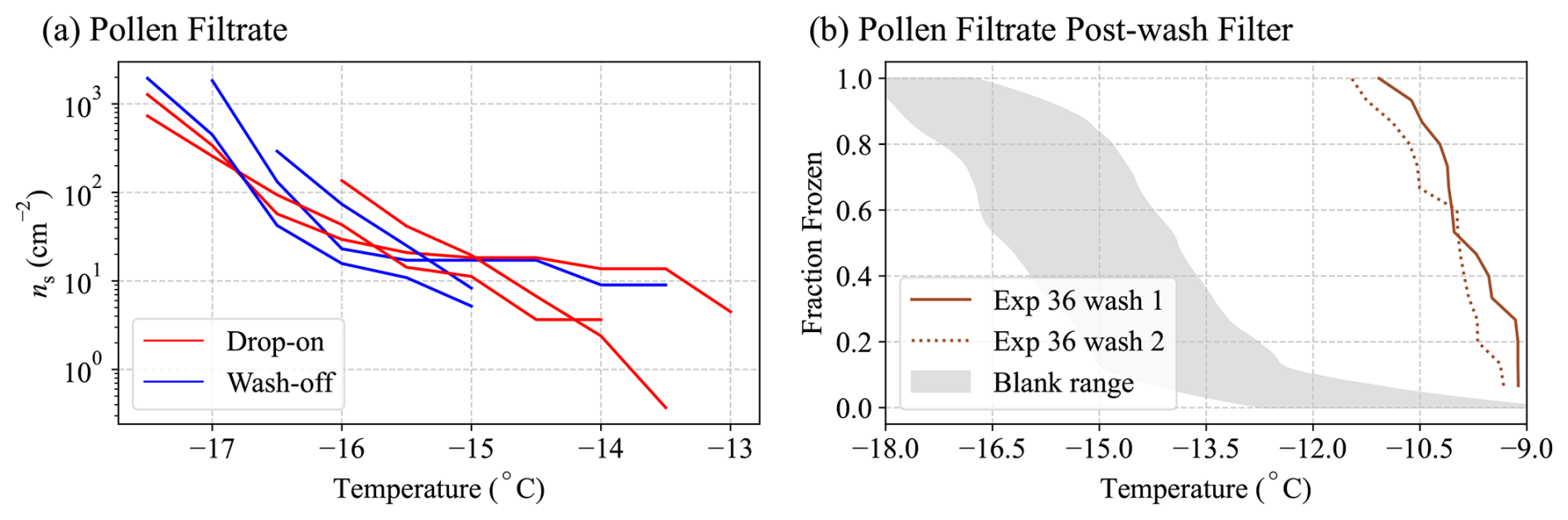
Figure 6INP experiments and washed-filter-punch results for pollen filtrate. The wash-off and drop-on techniques report similar activity, despite INPs remaining on the washed filter punches. (a) Active site density versus temperature for the pollen filtrate experiments and (b) the IR-NIPI results for the washed polycarbonate filter punches from experiment 36.
4.4 Sea surface microlayer
To evaluate the performance of the wash-off technique in marine regions, we used the sea surface microlayer (SML12 in Wilson et al., 2015) as a proxy for sea spray aerosol, a known INP type (Wilson et al., 2015; DeMott et al., 2016; Hartmann et al., 2020). The results in Fig. 7a show substantial disagreement between the wash-off and drop-on techniques. The wash-off curves are consistently flatter above 22 °C, and the wash-off measurements exhibit over an order of magnitude variability, compared with only about a factor of 5 for the drop-on data. Individual wash-off experiments also show larger uncertainties, due to high counting uncertainty in the flatter regions and proximity to the background at lower temperatures (Fig. S12). Although PINE operated at lower temperatures than offline techniques, it aligns more closely with the higher INP activity measured by the drop-on method, but unfortunately, the overlap between the filter techniques and PINE is poor. The data from the washed-filter-punch analysis (Fig. 7b) reveal that we did not detect a signal above background in experiment 55, and the results from experiment 54 are borderline. To determine if there was a statistical difference, we used the ISD test. There is a 7 % probability that the washed filter from experiment 54 is within the background, but washing this filter again increases this probability to 26 %. The background signal for the washed filter analyses corresponds to the warmest freezing temperatures observed in most filter experiments, so if material is adsorbed to washed filters, the freezing signal would be weak relative to the background.
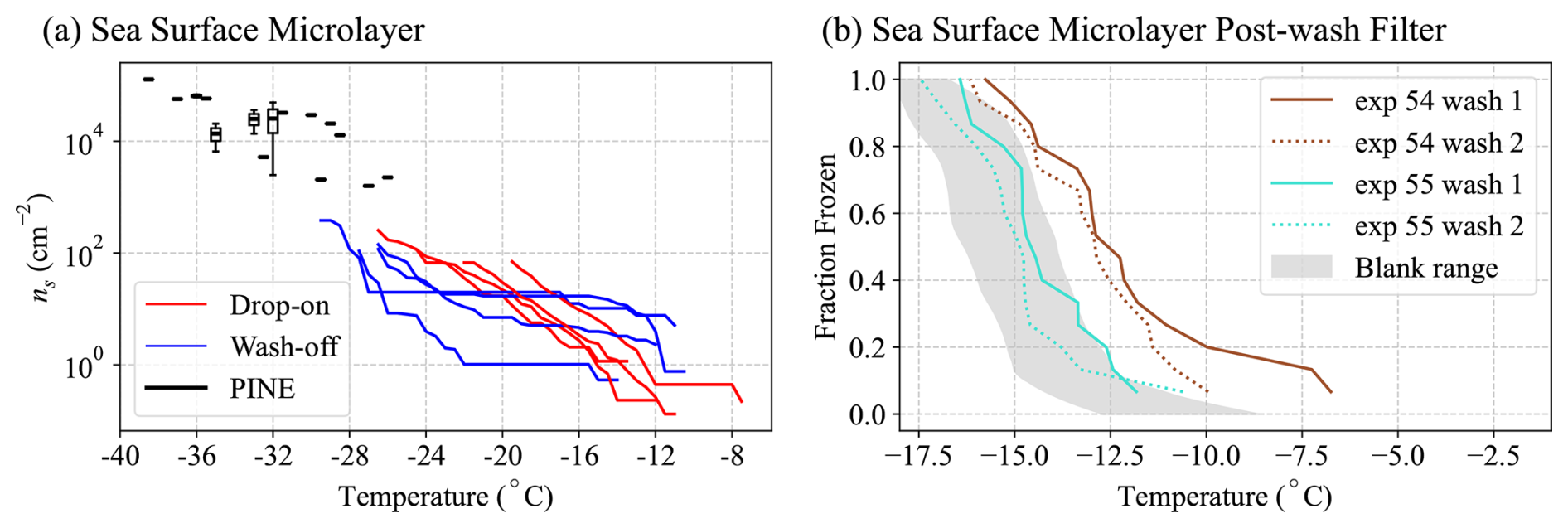
Figure 7INP experiments and washed-filter-punch results for the sea surface microlayer sample. The higher experiment-to-experiment variability in the wash-off results implies that the recovery of INPs is variable. (a) Active site density versus temperature for the sea surface microlayer experiments and (b) the IR-NIPI results for the washed polycarbonate filter punches from experiments 54 and 55.
In three out of four wash-off experiments, the wash-off technique detected higher activity than the drop-on technique above −16 °C. It is possible that INPs in the wash-off suspension aggregated before analysis, meaning that some droplets contained large, highly active aggregates, while the rest of the droplets contained less active material, as discussed in Ickes et al. (2020). Sea spray aerosol, which is influenced by the sea surface microlayer (Russell et al., 2010), is extremely variable, and the INP concentration increases with phytoplankton blooms (DeMott et al., 2016). Sea spray aerosol can contain a complex variety of different organic materials such as saccharides, amino acids, lipids, and proteins (Russell et al., 2010; Cochran et al., 2017; Kuznetsova et al., 2005). In fact, Wang et al. (2015) show that different organic components can dominate freezing at different times. It is not possible to say which component was active in our sample, although Wilson et al. (2015) suggested INP activity could be due to phytoplankton exudates, which Xi et al. (2021) suggest nucleate ice via polysaccharide- or protein-containing nanogels. Overall, the wash-off results are much less consistent than the drop-on results, perhaps due to a combination of macromolecule adsorption and aggregation in the wash-off suspension.
4.5 Soil dusts (Copper River dust and agricultural soil dust)
To test our hypothesis for INpro-containing soil dust samples, we carried out a similar approach to the one we used with the Snomax samples. We tested two dry-dispersed soil dusts and then a wet-dispersed filtrate sample derived from the agricultural soil dust sample. Both filter techniques generally reported good agreement for dry-dispersed Copper River dust and agricultural soil dust. However, in both samples, the average ns(T) from the drop-on experiments was about 1.5 times that of the wash-off average. The filter-based results are consistent with previous wash-off measurements of Copper River dust (Barr et al., 2023) as well as PINE data (King, 2024), while the agricultural dust experiments agree with previous wash-off experiments reported by Thompson (2024). Analysis of the washed filter punches in both samples (Fig. 8d and e) reported activity above background levels, implying that soil dust-derived ice-nucleating entities were adsorbed to the polycarbonate filter surface.

Figure 8INP experiments and washed-filter-punch results for soil dust samples. Agreement between techniques is better for the samples including larger mineral dust particles, but the macromolecular isolation in the soil filtrate experiment accentuates the discrepancy. Active site density versus temperature for Copper River dust (a), agricultural soil dust (b), and the agricultural soil filtrate (c) and the IR-NIPI results from Copper River dust (d), agricultural soil dust (e), and the agricultural soil filtrate (f).
For the dry-dispersed soil samples, we observed that the experiment-to-experiment variability for the wash-off technique was greater than for the drop-on technique. For example, five out of the seven Copper River dust experiments (Fig. S6) report good agreement between the wash-off and drop-on results within the uncertainty. This indicates that the recovery of particles into suspension is variable. These experiments were all performed with the same methodology, i.e. on a rotary mixer for 30 min at 30 rpm. However, we have minimal control over how the filter folds and crumples during the washing process, and it is possible that areas of the filter are not as well washed in some experiments. The efficacy of the recovery of particles into suspension may also contribute to the low bias seen in the literature for ambient aerosol. The crumpling of the polycarbonate filter in the washing process has the potential to affect all wash-off samples, not just those containing free INMs. This crumpling could possibly explain why there is a greater variability in the wash-off results than there is in the drop-on results.
When the agricultural soil dust was suspended in water, then filtered to remove particles larger than 0.2 µm (Fig. 8c), the wash-off ns(T) is substantially lower than the drop-on above −21 °C. Once again, uncertainty in individual experiments was much larger for the wash-off data than the drop-on, due to proximity to the background (Fig. S13). The PINE measurements were only made below −28 °C, at lower temperatures than the filter measurements. IR-NIPI analysis reveals that there is ice-nucleating material that remains on the polycarbonate filter post-wash, but it is not statistically different from the background. By removing the larger particles, we have removed the warmer-temperature INPs, meaning that our filter results from the chamber experiments only start around the same temperature as the background in the IR-NIPI. Regardless, overall, the results are consistent with a proportion of the ice-nucleating material from soils sticking to the polycarbonate filters and not being recovered into the wash-off suspension.
5.1 Dependence of wash-off recovery on INP mixing state
The results presented above indicate that variable adsorption of different types of ice-nucleating material to polycarbonate filters is a systematic feature of the wash-off technique, and the impact on the measurement of INPs varies depending on the nature of the sampled aerosol. A consistent pattern emerged across all experiments in which INpro were likely involved. Specifically, when the INP population was dominated by free INpro (i.e. the INpro were not bound to larger cell fragments or mineral particles), such as in our filtrate experiments, the wash-off technique dramatically under-reported INP activity. When INpro were internally mixed with mineral dust or cellular fragments (i.e. INpro were bound to cell fragments or mineral particles), wash-off and drop-on INP spectra were in much better agreement. However, even in the cases where the drop-on and wash-off techniques agreed within scatter between experiments, ice-nucleating material was still observed to be left behind on the polycarbonate filters, as proven by testing filter punches in the IR-NIPI. These observations highlight that the mixing state of INpro with other aerosol particle types is critical in determining the accuracy of the wash-off technique and also that externally mixed (or free) INpro are the most susceptible to adsorption onto the filter, leading directly to undercounting in wash-off measurements.
Throughout this study, we aimed to determine whether adsorption of externally mixed (“free”) INMs onto polycarbonate filters causes the wash-off technique to underestimate INP activity. For the purpose of this study, we define “free” macromolecules as those not bound to larger particles such as mineral dusts or cellular fragments. While proteins were expected to exhibit strong affinity to the polycarbonate filter, it was not clear whether other INMs, such as polysaccharides, would behave similarly. The pollen filtrate experiments show that polysaccharide-based INMs also adhere to the polycarbonate membrane, indicating that adsorption is not limited to INpro, even though the wash-off measurement was consistent with the drop-on spectra, within experimental uncertainties. This suggests that polysaccharide adsorption occurs. However, the steep freezing spectrum of pollen means that even partial recovery of ice-nucleating polysaccharides is sufficient to produce reliable wash-off spectra.
In contrast, the lower recovery of free INpro appears to be the primary driver of the discrepancies observed in proteinaceous samples, most notably in the Snomax filtrate. Free macromolecules are present in the bulk, unfiltered samples such as the dry Snomax and soil dusts, but their contribution to ice nucleation is masked by the larger, more efficient INPs associated with cell fragments or mineral particles. As a result, even when free macromolecules adsorb to the polycarbonate membrane, their loss has a minimal effect on the wash-off INP spectra. However, once the larger particles are removed, and only the small, externally mixed macromolecules remain, their adsorption onto the filter leads to the undercounting of ice-nucleating activity in the wash-off technique. This distinction between bulk and filtered samples underscores the importance of externally mixed free INpro in determining wash-off recovery.
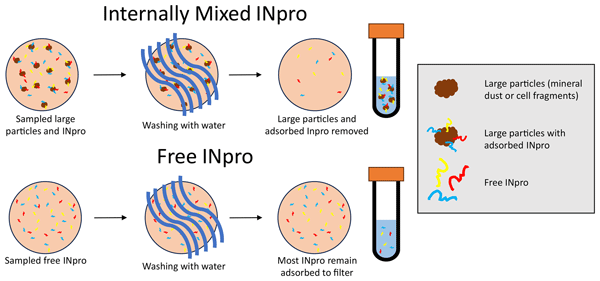
When a sample is collected, all particles in the sampled air deposit onto the polycarbonate filter, including large aggregates, internally mixed INMs, and small free macromolecules. Once deposited, intermolecular forces between the particle surfaces and the filter membrane promote adsorption. Particles with relatively large surface areas, such as mineral dust particles in fertile soil dusts or cell fragments in dry Snomax, evidently experience sufficient hydrodynamic drag during washing to overcome these adhesive forces, allowing them to detach and enter suspension. In contrast, small macromolecules have much lower drag forces and therefore remain strongly bound to the filter membrane, meaning they are not recoverable in the wash-off suspension (Fig. 9). We suggest that macromolecular adsorption is universal across different samples, although its impact is influenced by the presence of externally mixed INMs. We conclude that adsorption is a fundamental and unavoidable feature of the wash-off technique, but the degree of bias depends on sample properties.
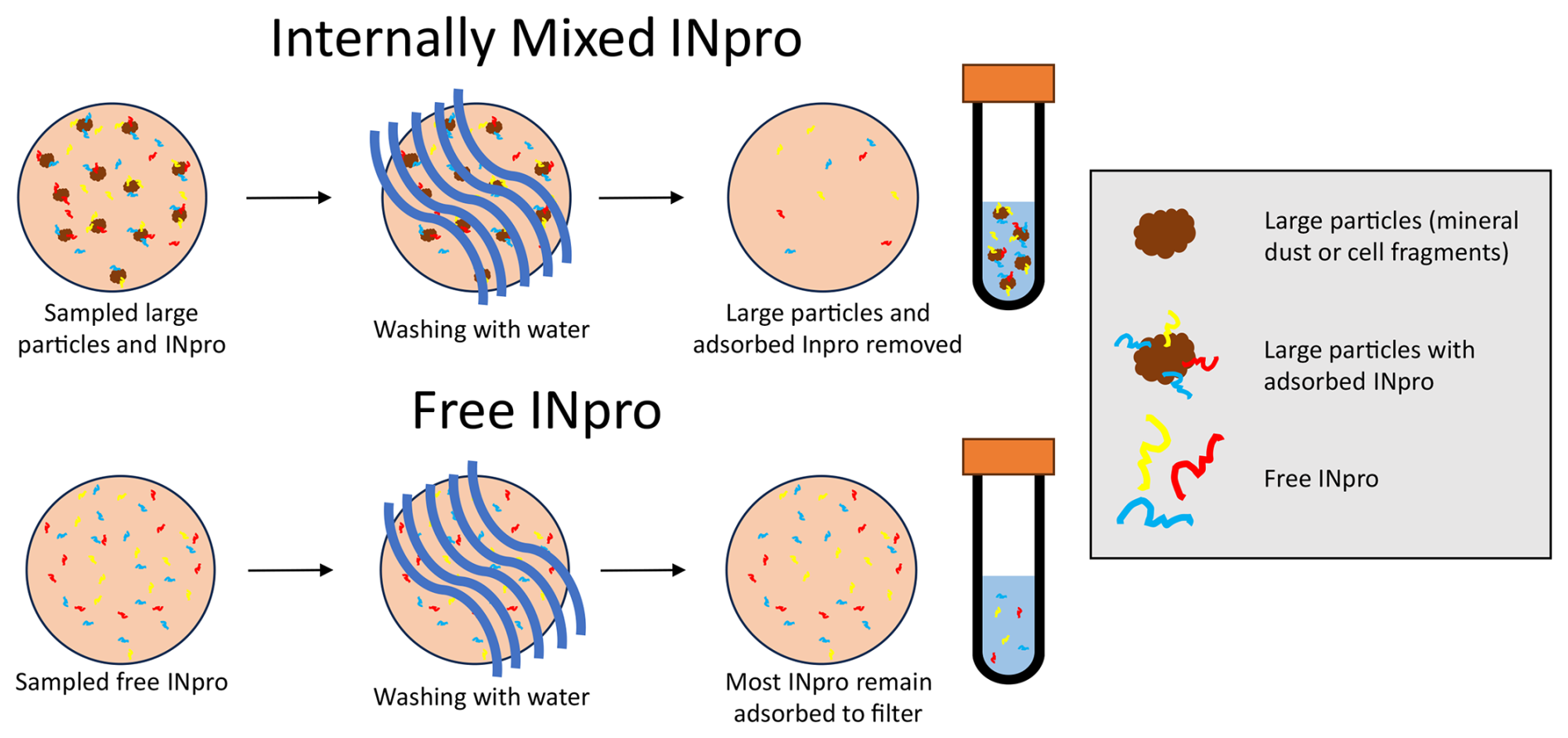
Figure 9Conceptual diagram illustrating how the presence or absence of larger particles influences ice-nucleating protein (INpro) recovery during the wash-off technique. (a) When larger particles, such as mineral dust or cell fragments, are present, INpro aggregates on particle surfaces, forming highly active, particle-associated INPs that are efficiently recovered into the wash-off suspension. (b) When large particles are removed by filtration, INpro remain as free macromolecules that can adsorb to the polycarbonate filter surface and are not efficiently recovered during the wash-off process, leading to a low bias in measured INP concentration.
5.2 Implications for interpreting field INP measurements
These laboratory findings have direct implications for the interpretation of field-based INP measurements, particularly in environments where the aerosol population is dominated by free INpro. Based on previous field observations, we suggest that the presence of free INpro is variable both spatially and temporally. For example, Wilbourn et al. (2024) observed good agreement in INP concentrations between techniques in the southern Great Plains in the central USA but poor agreement in the remote eastern North Atlantic. The aerosol number concentration was about an order of magnitude higher at the southern Great Plains site compared to the North Atlantic, but the total aerosol surface area was 2 orders of magnitude higher, most likely influenced by higher abundance of soil dust in the region (Subba et al., 2021). Additionally, the measurements in the southern Great Plains took place in the autumnal pollen period, so this site may also have been influenced by pollen (Subba et al., 2021). As we have seen in our experiments, soil dust and its internally mixed macromolecules (Fig. 8a and b) are well recovered by the wash-off technique. Additionally, although the INMs in pollen have been observed to adsorb to the filters (Fig. 6b), we also saw that a significant amount of material was recovered, leading to the wash-off technique agreeing with the drop-on technique within uncertainty (Fig. 6a). Hence, we suggest that the aerosol in this region was composed of materials that are recovered in the wash-off technique, consistent with the good agreement between the wash-off and PINE measurements. However, the eastern North Atlantic site sampled by Wilbourn et al. (2024) is dominated by submicron sea spray aerosol and long-range-transported continental material (Wood et al., 2015; Zheng et al., 2018; Knopf et al., 2022). Our sea surface microlayer experiments (Fig. 7a) exhibited similar temperature-dependent activity to Wilbourn et al. (2024), including sporadic nucleation events at warm temperatures and a sharp increase in activity around −22 °C. Our experiments also show that detectable ice-nucleating material was present on the washed filter punches. The discrepancy reported by Wilbourn et al. (2024) is thus most likely due to the presence of macromolecules that are poorly recovered by the wash-off technique.
Our findings could also help provide context for the discrepancies reported by Sanchez-Marroquin et al. (2021). Back trajectories illustrate variability in air mass histories, including time spent over both land and ocean and frequent transitions between the boundary layer and free troposphere. This likely results in correspondingly variable aerosol sources, such that some experiments sampled air masses containing more or fewer INpro. Consequently, the degree of agreement between the wash-off and drop-on techniques varies across experiments, which we suggest reflected the differences in the underlying aerosol populations. Samples with a higher fraction of free INpro would be susceptible to wash-off undercounting, while samples dominated by dust would be less affected. The results from Wilbourn et al. (2024) and Sanchez-Marroquin et al. (2021) indicate that disagreement between the wash-off and other direct INP measurement techniques should not be interpreted solely as instrumental uncertainty, but rather as evidence for the presence of free INpro in the ambient aerosol population.
There are also implications for the modelling of global INP concentrations and their subsequent influence on clouds. Models rely on parametrisations of the ice-nucleating activity of various aerosol species, but also on measurements to test their accuracy (Vergara-Temprado et al., 2017; Hummel et al., 2018; McCluskey et al., 2023; Zhao et al., 2021; Herbert et al., 2025). For example, a parametrisation commonly used in global models for the ice-nucleating activity of sea spray aerosol is based on wash-off measurements (McCluskey et al., 2018), which may under-report the ice-nucleating ability of sea spray. This can only be tested with new measurements. Similarly, many of the ambient INP measurements that were used in the global model study of Herbert et al. (2025) were made with the wash-off technique, with unknown bias. This might imply that the INP concentrations in some locations are greater than currently suggested by models.
5.3 Consequences for INP sampling and technique selection
The implications of these findings extend directly to how INP sampling and measurement should be approached. While we present evidence of INMs sticking to the polycarbonate membrane, it is also possible that macromolecules adsorb onto other surfaces during the wash-off process, such as sample containers or pipette tips. These considerations highlight that sample processing steps can introduce additional opportunities for macromolecule loss. Similar losses may also occur in offline sampling approaches, as well as in filter collection that relies on collection devices, such as impingers, where macromolecules could adsorb onto the walls of the collection vessel. As a result, INPs suspended in water during sampling may be under-represented even before downstream processing begins. We should aim to minimise INP losses in our measurement techniques by using methods that require fewer processing steps and therefore fewer opportunities for macromolecule adsorption. More direct techniques, such as online or direct filter-processing methods, are not only less prone to the loss of ice-nucleating material but are also more representative of the behaviour of INPs in the atmosphere. Accordingly, these findings emphasise the need for careful method selection and testing when quantifying INPs, particularly when free macromolecules may contribute to the ice-nucleating population.
The limitations identified here do not negate the utility of the wash-off technique or the use of polycarbonate filters. Wash-off suspensions remain particularly valuable for treated-sample analysis, such as heat or chemical treatments to determine the biological contribution to INP activity (Daily et al., 2022). In addition, the smooth, non-fibrous surface of polycarbonate filters is advantageous for particle-resolved analyses using scanning electron microscopy with energy-dispersive spectroscopy (SEM-EDS), enabling the identification of particle types and mixing states not available through INP analysis alone. One potential avenue for improving recovery from the polycarbonate filters is the use of sonication to release sampled aerosol into suspension. Sonication has been employed in several INP measurement studies (Reicher et al., 2019; Chen et al., 2021; Li et al., 2023; Sun et al., 2024; Li et al., 2026). However, sonication may also alter the structure of ice-nucleating proteins through denaturation or fragmentation (De Leo et al., 2017), potentially reducing the measured INP activity. Sonication was not employed in this study, but its utility as a means of improving filter recovery while preserving ice-nucleating activity should be evaluated in future studies. In this way, the wash-off technique and polycarbonate filter sampling can provide important information regarding INP composition and sources, even in cases where adsorption limits the recovery of free INMs.
The findings of this study have implications for how past INP measurements obtained using the wash-off technique should be interpreted. While we can provide recommendations for future INP measurements, the extent to which historical datasets are affected is difficult to determine because the chemical composition and mixing state of the sampled INPs are rarely known for field-collected material. In the absence of this information, it is not feasible to apply a universal correction factor to account for the loss of externally mixed INMs. However, previous measurements will still serve as a reasonable lower bound of the INP activity in a region, particularly for samples containing mineral dusts or cellular fragments, for which our results suggest the wash-off recovery remains largely robust. Not all wash-off data will be impacted by adsorption, but to know whether the data are reliable, another, more direct measurement technique is required. For example, in the southern Great Plains data from Wilbourn et al. (2024), the agreement between the wash-off technique and PINE indicates that the wash-off results are accurate. In contrast, in the eastern North Atlantic Ocean, the wash-off method reports lower INP activity than PINE, suggesting that the technique is not appropriate for that environment. A similar logic applies to Sanchez-Marroquin et al. (2021): agreement implies robust effective wash-off recovery, whereas divergence signals the presence of externally mixed macromolecules lost during processing. When drop-on and wash-off measurements agree, the wash-off data can be considered reliable, and reliable heat tests or chemical analysis can be performed on the aqueous suspension. Thus, simultaneous measurements using wash-off and another technique can provide not only validation of the wash-off technique, but also insight into the nature of the INPs present and the presence of free INMs.
In this study, we aimed to understand the discrepancies that sometimes appear between INP measurement methods. We compared the offline polycarbonate filter wash-off technique with the PTFE filter drop-on technique as well as with online PINE measurements. By sampling well-defined aerosol dispersions from an aerosol chamber, we were able to measure simultaneously with different INP measurement techniques. While some materials, such as dry dispersed soil dusts and pollen filtrate, show reasonable agreement between filter techniques, others, such as the Snomax filtrate, exhibit substantial divergence, where the wash-off produces much lower INP concentrations compared to the drop-on technique. The discrepancy is due to the poor recovery of INMs, and in particular ice-nucleating proteins (INpro), from the polycarbonate filter in the wash-off method. When there are larger mineral dust or cell membrane fragments in a sample, agreement between techniques tends to be better. Nevertheless, low biases in the wash-off persist. However, when the larger particles are removed prior to aerosolisation by wet filtration, the ice-nucleating activity is defined by the free INpro, which are under-represented in the wash-off technique due to the poor recovery into the wash-off suspension. Figure 9 illustrates how free proteins are poorly recovered compared to those attached to larger particles or cells. Polysaccharide INMs also adsorb to the filters, but a sufficiently large fraction is recovered into the wash-off suspension that there is no observable discrepancy between the techniques.
In conclusion, the adsorption of free macromolecules, particularly proteins, to the polycarbonate filter membrane leads to a low bias in INP concentrations reported by the wash-off method. The binding of macromolecules to filters may affect the interpretation of existing INP datasets. We recommend that previous measurements are assessed for any low bias of the INP population and should generally be regarded as a lower limit of the INP concentration unless there is evidence to the contrary. We suggest that future in situ filter measurements should ideally be done with the drop-on (or another more direct) technique in parallel with the wash-off technique. Comparison of the results from these techniques could give insight into the presence or absence of free macromolecules, such as INpro, in an air mass.
The data associated with this publication are available at https://doi.org/10.5281/zenodo.19006498 (Robinson et al., 2026).
The supplement related to this article is available online at https://doi.org/10.5194/ar-4-373-2026-supplement.
The work was conceptualised by JR, BJM, and MID. The experimental setup was carried out by JR with assistance from PBF, MID, MDT, JPM, and JBM. Sample aerosolisation, collection, and analysis was carried out by JR. The original draft was written by JR; edited by BJM; and reviewed by MID, MDT, PBF, and JPM. The work was supervised by BJM and JBM.
At least one of the (co-)authors is a member of the editorial board of Aerosol Research. The peer-review process was guided by an independent editor, and the authors also have no other competing interests to declare.
Publisher's note: Copernicus Publications remains neutral with regard to jurisdictional claims made in the text, published maps, institutional affiliations, or any other geographical representation in this paper. The authors bear the ultimate responsibility for providing appropriate place names. Views expressed in the text are those of the authors and do not necessarily reflect the views of the publisher.
We thank Kathleen Alden for the agricultural soil dust sample and Sarah Barr for the Copper River dust sample. The µm-NIPI and IR-NIPI analysis was carried out in the Cohen Geochemical Laboratories at the University of Leeds, managed by Andy Hobson. We also thank Leon King for his work characterising the PINE-1B instrument on which this study builds.
Joseph Robinson was supported by a studentship from the PANORAMA Doctoral Training Partnership (NE/S007458/1). The work was supported by the Research England-funded Biodetection Technologies Hub and the Natural Environment Research Council (NE/T00648X/1, NE/Z503848/1, NE/T006420/1). Polly B. Foster was supported by the Aerosols CDT (EP/S023593/1).
This paper was edited by François Gensdarmes and reviewed by two anonymous referees.
Adams, M. P., Tarn, M. D., Sanchez-Marroquin, A., Porter, G. C., O'Sullivan, D., Harrison, A. D., Cui, Z., Vergara-Temprado, J., Carotenuto, F., Holden, M. A., Daily, M. I., Whale, T. F., Sikora, S. N., Burke, I. T., Shim, J. U., McQuaid, J. B., and Murray, B. J.: A Major Combustion Aerosol Event Had a Negligible Impact on the Atmospheric Ice-Nucleating Particle Population, J. Geophys. Res.-Atmos., 125, https://doi.org/10.1029/2020JD032938, 2020. a
Alden, K. A., Bieber, P., Miller, A. J., Link, N., Murray, B. J., and Borduas-Dedekind, N.: The role of surface-active macromolecules in the ice-nucleating ability of lignin, Snomax, and agricultural soil extracts, Atmos. Chem. Phys., 25, 6179–6195, https://doi.org/10.5194/acp-25-6179-2025, 2025. a, b
Atthoff, B. and Hilborn, J.: Protein adsorption onto polyester surfaces: Is there a need for surface activation?, J. Biomed. Mater. Res. B, 80, 121–130, https://doi.org/10.1002/jbm.b.30576, 2007. a
Augustin, S., Wex, H., Niedermeier, D., Pummer, B., Grothe, H., Hartmann, S., Tomsche, L., Clauss, T., Voigtländer, J., Ignatius, K., and Stratmann, F.: Immersion freezing of birch pollen washing water, Atmos. Chem. Phys., 13, 10989–11003, https://doi.org/10.5194/acp-13-10989-2013, 2013. a
Barr, S. L., Wyld, B., Mcquaid, J. B., Iii, R. R. N., and Murray, B. J.: Southern Alaska as a source of atmospheric mineral dust and ice-nucleating particles, Sci. Adv., 9, https://doi.org/10.1126/sciadv.adg3708, 2023. a, b, c, d, e, f
Barry, K. R., Hill, T. C., Levin, E. J., Twohy, C. H., Moore, K. A., Weller, Z. D., Toohey, D. W., Reeves, M., Campos, T., Geiss, R., Schill, G. P., Fischer, E. V., Kreidenweis, S. M., and DeMott, P. J.: Observations of Ice Nucleating Particles in the Free Troposphere From Western US Wildfires, J. Geophys. Res.-Atmos., 126, https://doi.org/10.1029/2020JD033752, 2021. a, b
Beall, C. M., Stokes, M. D., Hill, T. C., DeMott, P. J., DeWald, J. T., and Prather, K. A.: Automation and heat transfer characterization of immersion mode spectroscopy for analysis of ice nucleating particles, Atmos. Meas. Tech., 10, 2613–2626, https://doi.org/10.5194/amt-10-2613-2017, 2017. a
Bieber, P. and Borduas-Dedekind, N.: High-speed cryo-microscopy reveals that ice-nucleating proteins of Pseudomonas syringae trigger freezing at hydrophobic interfaces, Sci. Adv., 10, 6606, https://doi.org/10.1126/sciadv.adn6606, 2024. a
Böhmländer, A., Lacher, L., Höhler, K., Brus, D., Doulgeris, K.-M., Girdwood, J., Leisner, T., and Möhler, O.: Measurement of the ice-nucleating particle concentration using a mobile filter-based sampler on-board of a fixed-wing uncrewed aerial vehicle during the Pallas Cloud Experiment 2022, Earth Syst. Sci. Data, 17, 6157–6164, https://doi.org/10.5194/essd-17-6157-2025, 2025. a
Chen, J., Wu, Z., Chen, J., Reicher, N., Fang, X., Rudich, Y., and Hu, M.: Size-resolved atmospheric ice-nucleating particles during East Asian dust events, Atmos. Chem. Phys., 21, 3491–3506, https://doi.org/10.5194/acp-21-3491-2021, 2021. a
Cochran, R. E., Laskina, O., Trueblood, J. V., Estillore, A. D., Morris, H. S., Jayarathne, T., Sultana, C. M., Lee, C., Lin, P., Laskin, J., Laskin, A., Dowling, J. A., Qin, Z., Cappa, C. D., Bertram, T. H., Tivanski, A. V., Stone, E. A., Prather, K. A., and Grassian, V. H.: Molecular Diversity of Sea Spray Aerosol Particles: Impact of Ocean Biology on Particle Composition and Hygroscopicity, Chem, 2, 655–667, https://doi.org/10.1016/j.chempr.2017.03.007, 2017. a, b
Conen, F. and Yakutin, M. V.: Soils rich in biological ice-nucleating particles abound in ice-nucleating macromolecules likely produced by fungi, Biogeosciences, 15, 4381–4385, https://doi.org/10.5194/bg-15-4381-2018, 2018. a
Conen, F., Morris, C. E., Leifeld, J., Yakutin, M. V., and Alewell, C.: Biological residues define the ice nucleation properties of soil dust, Atmos. Chem. Phys., 11, 9643–9648, https://doi.org/10.5194/acp-11-9643-2011, 2011. a, b
Conen, F., Henne, S., Morris, C. E., and Alewell, C.: Atmospheric ice nucleators active ≥ −12 °C can be quantified on PM10 filters, Atmos. Meas. Tech., 5, 321–327, https://doi.org/10.5194/amt-5-321-2012, 2012. a
Conen, F., Einbock, A., Mignani, C., and Hüglin, C.: Measurement report: Ice-nucleating particles active ≥ −15 °C in free tropospheric air over western Europe, Atmos. Chem. Phys., 22, 3433–3444, https://doi.org/10.5194/acp-22-3433-2022, 2022. a
Daily, M. I., Tarn, M. D., Whale, T. F., and Murray, B. J.: An evaluation of the heat test for the ice-nucleating ability of minerals and biological material, Atmos. Meas. Tech., 15, 2635–2665, https://doi.org/10.5194/amt-15-2635-2022, 2022. a, b
Daily, M. I., Whale, T. F., Kilbride, P., Lamb, S., John Morris, G., Picton, H. M., and Murray, B. J.: A highly active mineral-based ice nucleating agent supports in situ cell cryopreservation in a high throughput format, J. R. Soc. Interface, 20, https://doi.org/10.1098/rsif.2022.0682, 2023. a
Daily, M. I., Robinson, J., Finney, D. L., Raif, E. N., McQuaid, J. B., Sanchez‐Marroquin, A., Hu, K., Lloyd, G., Flynn, M., Field, P. R., Bower, K. N., Coe, H., Gallagher, M. W., Blyth, A. M., and Murray, B. J.: Ice‐Nucleating Particle and Cloud Ice Crystal Concentrations Associated With Developing Summertime Deep Convective Clouds in South‐Western USA, J. Geophys. Res.-Atmos., 131, https://doi.org/10.1029/2024JD043236, 2026. a, b
De Leo, V., Catucci, L., Di Mauro, A. E., Agostiano, A., Giotta, L., Trotta, M., and Milano, F.: Effect of ultrasound on the function and structure of a membrane protein: The case study of photosynthetic Reaction Center from Rhodobacter sphaeroides, Ultrason. Sonochem., 35, 103–111, https://doi.org/10.1016/j.ultsonch.2016.09.007, 2017. a
DeMott, P. J., Prenni, A. J., Liu, X., Kreidenweis, S. M., Petters, M. D., Twohy, C. H., Richardson, M. S., Eidhammer, T., Rogers, D. C., and Tolbert, M. A.: Predicting global atmospheric ice nuclei distributions and their impacts on climate, P. Natl. Acad. Sci. USA, 107, 11217–11222, https://doi.org/10.1073/pnas.0910818107, 2010. a
DeMott, P. J., Hill, T. C., McCluskey, C. S., Prather, K. A., Collins, D. B., Sullivan, R. C., Ruppel, M. J., Mason, R. H., Irish, V. E., Lee, T., Hwang, C. Y., Rhee, T. S., Snider, J. R., McMeeking, G. R., Dhaniyala, S., Lewis, E. R., Wentzell, J. J., Abbatt, J., Lee, C., Sultana, C. M., Ault, A. P., Axson, J. L., Martinez, M. D., Venero, I., Santos-Figueroa, G., Stokes, M. D., Deane, G. B., Mayol-Bracero, O. L., Grassian, V. H., Bertram, T. H., Bertram, A. K., Moffett, B. F., and Franc, G. D.: Sea spray aerosol as a unique source of ice nucleating particles, P. Natl. Acad. Sci. USA, 113, 5797–5803, https://doi.org/10.1073/pnas.1514034112, 2016. a, b
DeMott, P. J., Hill, T. C. J., Petters, M. D., Bertram, A. K., Tobo, Y., Mason, R. H., Suski, K. J., McCluskey, C. S., Levin, E. J. T., Schill, G. P., Boose, Y., Rauker, A. M., Miller, A. J., Zaragoza, J., Rocci, K., Rothfuss, N. E., Taylor, H. P., Hader, J. D., Chou, C., Huffman, J. A., Pöschl, U., Prenni, A. J., and Kreidenweis, S. M.: Comparative measurements of ambient atmospheric concentrations of ice nucleating particles using multiple immersion freezing methods and a continuous flow diffusion chamber, Atmos. Chem. Phys., 17, 11227–11245, https://doi.org/10.5194/acp-17-11227-2017, 2017. a
DeMott, P. J., Möhler, O., Cziczo, D. J., Hiranuma, N., Petters, M. D., Petters, S. S., Belosi, F., Bingemer, H. G., Brooks, S. D., Budke, C., Burkert-Kohn, M., Collier, K. N., Danielczok, A., Eppers, O., Felgitsch, L., Garimella, S., Grothe, H., Herenz, P., Hill, T. C. J., Höhler, K., Kanji, Z. A., Kiselev, A., Koop, T., Kristensen, T. B., Krüger, K., Kulkarni, G., Levin, E. J. T., Murray, B. J., Nicosia, A., O'Sullivan, D., Peckhaus, A., Polen, M. J., Price, H. C., Reicher, N., Rothenberg, D. A., Rudich, Y., Santachiara, G., Schiebel, T., Schrod, J., Seifried, T. M., Stratmann, F., Sullivan, R. C., Suski, K. J., Szakáll, M., Taylor, H. P., Ullrich, R., Vergara-Temprado, J., Wagner, R., Whale, T. F., Weber, D., Welti, A., Wilson, T. W., Wolf, M. J., and Zenker, J.: The Fifth International Workshop on Ice Nucleation phase 2 (FIN-02): laboratory intercomparison of ice nucleation measurements, Atmos. Meas. Tech., 11, 6231–6257, https://doi.org/10.5194/amt-11-6231-2018, 2018. a, b, c, d, e
Eufemio, R. J., de Almeida Ribeiro, I., Sformo, T. L., Laursen, G. A., Molinero, V., Fröhlich-Nowoisky, J., Bonn, M., and Meister, K.: Lichen species across Alaska produce highly active and stable ice nucleators, Biogeosciences, 20, 2805–2812, https://doi.org/10.5194/bg-20-2805-2023, 2023. a, b, c
Eufemio, R. J., Renzer, G., Rojas, M., Miadlikowska, J., Sformo, T. L., Lutzoni, F., Vinatzer, B. A., and Meister, K.: Peltigera lichen thalli produce highly potent ice-nucleating agents, Biogeosciences, 22, 2087–2096, https://doi.org/10.5194/bg-22-2087-2025, 2025. a, b, c
Eufemio, R. J., Rojas, M., Shaw, K., de Almeida Ribeiro, I., Guo, H.-B., Renzer, G., Belay, K., Liu, H., Suseendran, P., Wang, X., Fröhlich-Nowoisky, J., Pöschl, U., Bonn, M., Berry, R. J., Molinero, V., Vinatzer, B. A., and Meister, K.: A previously unrecognized class of fungal ice-nucleating proteins with bacterial ancestry, Sci. Adv., 12, https://doi.org/10.1126/sciadv.aed9652, 2026. a
Fröhlich-Nowoisky, J., Hill, T. C. J., Pummer, B. G., Yordanova, P., Franc, G. D., and Pöschl, U.: Ice nucleation activity in the widespread soil fungus Mortierella alpina, Biogeosciences, 12, 1057–1071, https://doi.org/10.5194/bg-12-1057-2015, 2015. a
Garimella, S., Kristensen, T. B., Ignatius, K., Welti, A., Voigtländer, J., Kulkarni, G. R., Sagan, F., Kok, G. L., Dorsey, J., Nichman, L., Rothenberg, D. A., Rösch, M., Kirchgäßner, A. C. R., Ladkin, R., Wex, H., Wilson, T. W., Ladino, L. A., Abbatt, J. P. D., Stetzer, O., Lohmann, U., Stratmann, F., and Cziczo, D. J.: The SPectrometer for Ice Nuclei (SPIN): an instrument to investigate ice nucleation, Atmos. Meas. Tech., 9, 2781–2795, https://doi.org/10.5194/amt-9-2781-2016, 2016. a
Gong, X., Radenz, M., Wex, H., Seifert, P., Ataei, F., Henning, S., Baars, H., Barja, B., Ansmann, A., and Stratmann, F.: Significant continental source of ice-nucleating particles at the tip of Chile's southernmost Patagonia region, Atmos. Chem. Phys., 22, 10505–10525, https://doi.org/10.5194/acp-22-10505-2022, 2022. a
Govindarajan, A. G. and Lindow, S. E.: Phospholipid Requirement for Expression of Ice Nuclei in Pseudomonas syringae and in Vitro, J. Biol. Chem., 263, 9333–933, 1988. a
Harrison, A. D., Whale, T. F., Rutledge, R., Lamb, S., Tarn, M. D., Porter, G. C. E., Adams, M. P., McQuaid, J. B., Morris, G. J., and Murray, B. J.: An instrument for quantifying heterogeneous ice nucleation in multiwell plates using infrared emissions to detect freezing, Atmos. Meas. Tech., 11, 5629–5641, https://doi.org/10.5194/amt-11-5629-2018, 2018. a, b
Hartmann, M., Adachi, K., Eppers, O., Haas, C., Herber, A., Holzinger, R., Hünerbein, A., Jäkel, E., Jentzsch, C., van Pinxteren, M., Wex, H., Willmes, S., and Stratmann, F.: Wintertime Airborne Measurements of Ice Nucleating Particles in the High Arctic: A Hint to a Marine, Biogenic Source for Ice Nucleating Particles, Geophys. Res. Lett., 47, https://doi.org/10.1029/2020GL087770, 2020. a
Henry, M., Dupont-Gillain, C., and Bertrand, P.: Conformation change of albumin adsorbed on polycarbonate membranes as revealed by ToF-SIMS, Langmuir, 19, 6271–6276, https://doi.org/10.1021/la034081z, 2003. a
Herbert, R. J., Sanchez-Marroquin, A., Grosvenor, D. P., Pringle, K. J., Arnold, S. R., Murray, B. J., and Carslaw, K. S.: Gaps in our understanding of ice-nucleating particle sources exposed by global simulation of the UK Earth System Model, Atmos. Chem. Phys., 25, 291–325, https://doi.org/10.5194/acp-25-291-2025, 2025. a, b
Hiranuma, N., Auvermann, B. W., Belosi, F., Bush, J., Cory, K. M., Georgakopoulos, D. G., Höhler, K., Hou, Y., Lacher, L., Saathoff, H., Santachiara, G., Shen, X., Steinke, I., Ullrich, R., Umo, N. S., Vepuri, H. S. K., Vogel, F., and Möhler, O.: Laboratory and field studies of ice-nucleating particles from open-lot livestock facilities in Texas, Atmos. Chem. Phys., 21, 14215–14234, https://doi.org/10.5194/acp-21-14215-2021, 2021. a
Huang, S., Hu, W., Chen, J., Wu, Z., Zhang, D., and Fu, P.: Overview of biological ice nucleating particles in the atmosphere, Environ. Int., 146, https://doi.org/10.1016/j.envint.2020.106197, 2021. a
Hummel, M., Hoose, C., Pummer, B., Schaupp, C., Fröhlich-Nowoisky, J., and Möhler, O.: Simulating the influence of primary biological aerosol particles on clouds by heterogeneous ice nucleation, Atmos. Chem. Phys., 18, 15437–15450, https://doi.org/10.5194/acp-18-15437-2018, 2018. a
Ickes, L., Porter, G. C. E., Wagner, R., Adams, M. P., Bierbauer, S., Bertram, A. K., Bilde, M., Christiansen, S., Ekman, A. M. L., Gorokhova, E., Höhler, K., Kiselev, A. A., Leck, C., Möhler, O., Murray, B. J., Schiebel, T., Ullrich, R., and Salter, M. E.: The ice-nucleating activity of Arctic sea surface microlayer samples and marine algal cultures, Atmos. Chem. Phys., 20, 11089–11117, https://doi.org/10.5194/acp-20-11089-2020, 2020. a
Irish, V. E., Hanna, S. J., Willis, M. D., China, S., Thomas, J. L., Wentzell, J. J. B., Cirisan, A., Si, M., Leaitch, W. R., Murphy, J. G., Abbatt, J. P. D., Laskin, A., Girard, E., and Bertram, A. K.: Ice nucleating particles in the marine boundary layer in the Canadian Arctic during summer 2014, Atmos. Chem. Phys., 19, 1027–1039, https://doi.org/10.5194/acp-19-1027-2019, 2019. a
Kanji, Z. A., Ladino, L. A., Wex, H., Boose, Y., Burkert-Kohn, M., Cziczo, D. J., and Krämer, M.: Overview of Ice Nucleating Particles, Meteor. Mon., 58, 1–1, https://doi.org/10.1175/amsmonographs-d-16-0006.1, 2017. a
Kieft, T. L.: Ice Nucleation Activity in Lichens, Appl. Environ. Microb., 54, 1678–1681, https://doi.org/10.1128/aem.54.7.1678-1681.1988, 1988. a
Kieft, T. L. and Ahmadjian, V.: Biological ice nucleation activity in lichen mycobionts and photobionts, The Lichenologist, 21, 355–362, https://doi.org/10.1017/S0024282989000599, 1989. a
King, L.: Using a small expansion chamber to characterise ice nucleation by high-latitude mineral dusts and volcanic ash, PhD thesis, University of Leeds, ISSN 16807324, https://etheses.whiterose.ac.uk/id/eprint/35595/ (last access: 19 February 2025), 2024. a, b
Kinney, N. L. H., Hepburn, C. A., Gibson, M. I., Ballesteros, D., and Whale, T. F.: High interspecific variability in ice nucleation activity suggests pollen ice nucleators are incidental, Biogeosciences, 21, 3201–3214, https://doi.org/10.5194/bg-21-3201-2024, 2024. a
Knopf, D. A., Charnawskas, J. C., Wang, P., Wong, B., Tomlin, J. M., Jankowski, K. A., Fraund, M., Veghte, D. P., China, S., Laskin, A., Moffet, R. C., Gilles, M. K., Aller, J. Y., Marcus, M. A., Raveh-Rubin, S., and Wang, J.: Micro-spectroscopic and freezing characterization of ice-nucleating particles collected in the marine boundary layer in the eastern North Atlantic, Atmos. Chem. Phys., 22, 5377–5398, https://doi.org/10.5194/acp-22-5377-2022, 2022. a
Korolev, A., McFarquhar, G., Field, P. R., Franklin, C., Lawson, P., Wang, Z., Williams, E., Abel, S. J., Axisa, D., Borrmann, S., Crosier, J., Fugal, J., Krämer, M., Lohmann, U., Schlenczek, O., Schnaiter, M., and Wendisch, M.: Mixed-Phase Clouds: Progress and Challenges, Meteor. Mon., 58, 1–5, https://doi.org/10.1175/amsmonographs-d-17-0001.1, 2017. a, b, c
Kuznetsova, M., Lee, C., and Aller, J.: Characterization of the proteinaceous matter in marine aerosols, Mar. Chem., 96, 359–377, https://doi.org/10.1016/j.marchem.2005.03.007, 2005. a
Lacher, L., Adams, M. P., Barry, K., Bertozzi, B., Bingemer, H., Boffo, C., Bras, Y., Büttner, N., Castarede, D., Cziczo, D. J., DeMott, P. J., Fösig, R., Goodell, M., Höhler, K., Hill, T. C. J., Jentzsch, C., Ladino, L. A., Levin, E. J. T., Mertes, S., Möhler, O., Moore, K. A., Murray, B. J., Nadolny, J., Pfeuffer, T., Picard, D., Ramírez-Romero, C., Ribeiro, M., Richter, S., Schrod, J., Sellegri, K., Stratmann, F., Swanson, B. E., Thomson, E. S., Wex, H., Wolf, M. J., and Freney, E.: The Puy de Dôme ICe Nucleation Intercomparison Campaign (PICNIC): comparison between online and offline methods in ambient air, Atmos. Chem. Phys., 24, 2651–2678, https://doi.org/10.5194/acp-24-2651-2024, 2024. a
Larsson, K.: Interfacial Phenomena - Bioadhesion and Biocompatibility, Desalination, 35, 105–114, https://doi.org/10.1016/S0011-9164(00)88605-1, 1980. a
Latour, R. A.: Fundamental Principles of the Thermodynamics and Kinetics of Protein Adsorption to Material Surfaces, Colloid. Surface. B, 191, https://doi.org/10.1016/j.colsurfb.2020.110992, 2020. a, b
Levin, E. J., DeMott, P. J., Suski, K. J., Boose, Y., Hill, T. C., McCluskey, C. S., Schill, G. P., Rocci, K., Al-Mashat, H., Kristensen, L. J., Cornwell, G., Prather, K., Tomlinson, J., Mei, F., Hubbe, J., Pekour, M., Sullivan, R., Leung, L. R., and Kreidenweis, S. M.: Characteristics of Ice Nucleating Particles in and Around California Winter Storms, J. Geophys. Res.-Atmos., 124, 11530–11551, https://doi.org/10.1029/2019JD030831, 2019. a
Li, G., Wilbourn, E. K., Cheng, Z., Wieder, J., Fagerson, A., Henneberger, J., Motos, G., Traversi, R., Brooks, S. D., Mazzola, M., China, S., Nenes, A., Lohmann, U., Hiranuma, N., and Kanji, Z. A.: Physicochemical characterization and source apportionment of Arctic ice-nucleating particles observed in Ny-Ålesund in autumn 2019, Atmos. Chem. Phys., 23, 10489–10516, https://doi.org/10.5194/acp-23-10489-2023, 2023. a
Li, G., Welti, A., Thurnherr, I., Lohmann, U., and Kanji, Z. A.: Summertime ice-nucleating particle concentrations over the Eurasian-Arctic Seas, Atmos. Chem. Phys., 26, 10835–10859, https://doi.org/10.5194/acp-26-10835-2026, 2026. a
Lim, T. H., Dunkley, W. L., and Merson, R. L.: Role of Protein in Reverse Osmosis of Cottage Cheese Whey, J. Dairy Sci., 54, 306–311, https://doi.org/10.3168/jds.S0022-0302(71)85834-4, 1971. a
Locascio, L. E., Perso, C. E., and Lee, C. S.: Measurement of electroosmotic flow in plastic imprinted microfluid devices and the effect of protein adsorption on flow rate, J. Chromatogr. A, 857, 275–284, https://doi.org/10.1016/S0021-9673(99)00774-8, 1999. a
Lukas, M., Schwidetzky, R., Eufemio, R. J., Bonn, M., and Meister, K.: Toward Understanding Bacterial Ice Nucleation, J. Phys. Chem. B, 126, 1861–1867, https://doi.org/10.1021/acs.jpcb.1c09342, 2022. a
Marshall, A. D., Munro, P. A., and Tragardh, G.: The effect of protein fouling in microfiltration and ultrafiltration on permeate flux, protein retention and selectivity: A literature review, Desalination, 91, 65–108, https://doi.org/10.1016/0011-9164(93)80047-Q, 1993. a, b
Mason, R. H., Si, M., Chou, C., Irish, V. E., Dickie, R., Elizondo, P., Wong, R., Brintnell, M., Elsasser, M., Lassar, W. M., Pierce, K. M., Leaitch, W. R., MacDonald, A. M., Platt, A., Toom-Sauntry, D., Sarda-Estève, R., Schiller, C. L., Suski, K. J., Hill, T. C. J., Abbatt, J. P. D., Huffman, J. A., DeMott, P. J., and Bertram, A. K.: Size-resolved measurements of ice-nucleating particles at six locations in North America and one in Europe, Atmos. Chem. Phys., 16, 1637–1651, https://doi.org/10.5194/acp-16-1637-2016, 2016. a
Mayer, L. M.: Relationships between mineral surfaces and organic carbon concentrations in soils and sediments, Chem. Geol., 114, 347–363, https://doi.org/10.1016/0009-2541(94)90063-9, 1994. a, b
McCluskey, C. S., Ovadnevaite, J., Rinaldi, M., Atkinson, J., Belosi, F., Ceburnis, D., Marullo, S., Hill, T. C., Lohmann, U., Kanji, Z. A., O'Dowd, C., Kreidenweis, S. M., and DeMott, P. J.: Marine and Terrestrial Organic Ice-Nucleating Particles in Pristine Marine to Continentally Influenced Northeast Atlantic Air Masses, J. Geophys. Res.-Atmos., 123, 6196–6212, https://doi.org/10.1029/2017JD028033, 2018. a
McCluskey, C. S., Gettelman, A., Bardeen, C. G., DeMott, P. J., Moore, K. A., Kreidenweis, S. M., Hill, T. C., Barry, K. R., Twohy, C. H., Toohey, D. W., Rainwater, B., Jensen, J. B., Reeves, J. M., Alexander, S. P., and McFarquhar, G. M.: Simulating Southern Ocean Aerosol and Ice Nucleating Particles in the Community Earth System Model Version 2, J. Geophys. Res.-Atmos., 128, https://doi.org/10.1029/2022JD036955, 2023. a
Meng, F., Zhang, S., Oh, Y., Zhou, Z., Shin, H. S., and Chae, S. R.: Fouling in membrane bioreactors: An updated review, Water Res., 114, 151–180, https://doi.org/10.1016/j.watres.2017.02.006, 2017. a, b
Meng, X., Luosang, D., Meng, S., Wang, R., Fan, W., Liang, D., Li, X., Zhao, Q., and Yang, L.: The structural and functional properties of polysaccharide foulants in membrane fouling, Chemosphere, 268, https://doi.org/10.1016/j.chemosphere.2020.129364, 2021. a
Moffett, B. F., Getti, G., Henderson-Begg, S. K., and Hill, T. C.: Ubiquity of ice nucleation in lichen – possible atmospheric implications, Lindbergia, 38, 39–43, https://doi.org/10.25227/linbg.01070, 2015. a
Möhler, O., Benz, S., Saathoff, H., Schnaiter, M., Wagner, R., Schneider, J., Walter, S., Ebert, V., and Wagner, S.: The effect of organic coating on the heterogeneous ice nucleation efficiency of mineral dust aerosols, Environ. Res. Lett., 3, https://doi.org/10.1088/1748-9326/3/2/025007, 2008. a
Möhler, O., Adams, M., Lacher, L., Vogel, F., Nadolny, J., Ullrich, R., Boffo, C., Pfeuffer, T., Hobl, A., Weiß, M., Vepuri, H. S. K., Hiranuma, N., and Murray, B. J.: The Portable Ice Nucleation Experiment (PINE): a new online instrument for laboratory studies and automated long-term field observations of ice-nucleating particles, Atmos. Meas. Tech., 14, 1143–1166, https://doi.org/10.5194/amt-14-1143-2021, 2021. a, b, c
Mueller, G. M., Wolber, P. K., and Warren, G. J.: Clustering of ice nucleation protein correlates with ice nucleation activity, Cryobiology, 27, 416–422, https://doi.org/10.1016/0011-2240(90)90018-Y, 1990. a
Murray, B. J., O'Sullivan, D., Atkinson, J. D., and Webb, M. E.: Ice nucleation by particles immersed in supercooled cloud droplets, Chem. Soc. Rev., 41, 6519–6554, https://doi.org/10.1039/c2cs35200a, 2012. a, b
Murray, B. J., Carslaw, K. S., and Field, P. R.: Opinion: Cloud-phase climate feedback and the importance of ice-nucleating particles, Atmos. Chem. Phys., 21, 665–679, https://doi.org/10.5194/acp-21-665-2021, 2021. a, b
Nicosia, A., Piazza, M., Santachiara, G., and Belosi, F.: Heterogeneous nucleation of ice in the atmosphere, J. Phys. Conf. Ser., 841 012028, https://doi.org/10.1088/1742-6596/841/1/012028, 2017. a
O'Sullivan, D., Murray, B. J., Malkin, T. L., Whale, T. F., Umo, N. S., Atkinson, J. D., Price, H. C., Baustian, K. J., Browse, J., and Webb, M. E.: Ice nucleation by fertile soil dusts: relative importance of mineral and biogenic components, Atmos. Chem. Phys., 14, 1853–1867, https://doi.org/10.5194/acp-14-1853-2014, 2014. a
O'Sullivan, D., Murray, B. J., Ross, J. F., Whale, T. F., Price, H. C., Atkinson, J. D., Umo, N. S., and Webb, M. E.: The relevance of nanoscale biological fragments for ice nucleation in clouds, Scientific Reports, 5, https://doi.org/10.1038/srep08082, 2015. a
O'Sullivan, D., Murray, B. J., Ross, J. F., and Webb, M. E.: The adsorption of fungal ice-nucleating proteins on mineral dusts: a terrestrial reservoir of atmospheric ice-nucleating particles, Atmos. Chem. Phys., 16, 7879–7887, https://doi.org/10.5194/acp-16-7879-2016, 2016. a, b, c
O'Sullivan, D., Adams, M. P., Tarn, M. D., Harrison, A. D., Vergara-Temprado, J., Porter, G. C., Holden, M. A., Sanchez-Marroquin, A., Carotenuto, F., Whale, T. F., McQuaid, J. B., Walshaw, R., Hedges, D. H., Burke, I. T., Cui, Z., and Murray, B. J.: Contributions of biogenic material to the atmospheric ice-nucleating particle population in North Western Europe, Scientific Reports, 8, 1–9, https://doi.org/10.1038/s41598-018-31981-7, 2018. a, b, c
Patnaude, R. J., Moore, K. A., Perkins, R. J., Hill, T. C. J., Lawson, P., Mo, Q., Bailey, A., Van Den Heever, S. C., Saleeby, S. M., Bian, Q., Chiu, J. C., Demott, P. J., and Kreidenweis, S. M.: On the Role of Airborne Ice Nucleating Particles in Primary and Secondary Ice Formation Processes in Convective Midlatitude Clouds, J. Atmos. Sci., 82, 869–892, https://doi.org/10.1175/JAS-D-24-0135.1, 2025. a
Polen, M., Lawlis, E., and Sullivan, R. C.: The unstable ice nucleation properties of Snomax® bacterial particles, J. Geophys. Res., 121, 11666–11678, https://doi.org/10.1002/2016JD025251, 2016. a
Ponsonby, J., King, L., Murray, B. J., and Stettler, M. E. J.: Jet aircraft lubrication oil droplets as contrail ice-forming particles, Atmos. Chem. Phys., 24, 2045–2058, https://doi.org/10.5194/acp-24-2045-2024, 2024. a, b, c
Porter, G. C., Adams, M. P., Brooks, I. M., Ickes, L., Karlsson, L., Leck, C., Salter, M. E., Schmale, J., Siegel, K., Sikora, S. N., Tarn, M. D., Vüllers, J., Wernli, H., Zieger, P., Zinke, J., and Murray, B. J.: Highly Active Ice-Nucleating Particles at the Summer North Pole, J. Geophys. Res.-Atmos., 127, https://doi.org/10.1029/2021JD036059, 2022. a
Price, H. C., Baustian, K. J., McQuaid, J. B., Blyth, A., Bower, K. N., Choularton, T., Cotton, R. J., Cui, Z., Field, P. R., Gallagher, M., Hawker, R., Merrington, A., Miltenberger, A., Neely, R. R., Parker, S. T., Rosenberg, P. D., Taylor, J. W., Trembath, J., Vergara-Temprado, J., Whale, T. F., Wilson, T. W., Young, G., and Murray, B. J.: Atmospheric Ice-Nucleating Particles in the Dusty Tropical Atlantic, J. Geophys. Res.-Atmos., 123, 2175–2193, https://doi.org/10.1002/2017JD027560, 2018. a, b, c
Proske, U., Adams, M. P., Porter, G. C. E., Holden, M. A., Bäck, J., and Murray, B. J.: Measurement report: The ice-nucleating activity of lichen sampled in a northern European boreal forest, Atmos. Chem. Phys., 25, 979–995, https://doi.org/10.5194/acp-25-979-2025, 2025. a, b, c
Pummer, B. G., Bauer, H., Bernardi, J., Bleicher, S., and Grothe, H.: Suspendable macromolecules are responsible for ice nucleation activity of birch and conifer pollen, Atmos. Chem. Phys., 12, 2541–2550, https://doi.org/10.5194/acp-12-2541-2012, 2012. a, b, c, d
Pummer, B. G., Budke, C., Augustin-Bauditz, S., Niedermeier, D., Felgitsch, L., Kampf, C. J., Huber, R. G., Liedl, K. R., Loerting, T., Moschen, T., Schauperl, M., Tollinger, M., Morris, C. E., Wex, H., Grothe, H., Pöschl, U., Koop, T., and Fröhlich-Nowoisky, J.: Ice nucleation by water-soluble macromolecules, Atmos. Chem. Phys., 15, 4077–4091, https://doi.org/10.5194/acp-15-4077-2015, 2015. a, b, c, d
Rabe, M., Verdes, D., and Seeger, S.: Understanding protein adsorption phenomena at solid surfaces, Adv. Colloid Interfac., 162, 87–106, https://doi.org/10.1016/j.cis.2010.12.007, 2011. a
Raif, E. N., Barr, S. L., Tarn, M. D., McQuaid, J. B., Daily, M. I., Abel, S. J., Barrett, P. A., Bower, K. N., Field, P. R., Carslaw, K. S., and Murray, B. J.: High ice-nucleating particle concentrations associated with Arctic haze in springtime cold-air outbreaks, Atmos. Chem. Phys., 24, 14045–14072, https://doi.org/10.5194/acp-24-14045-2024, 2024. a, b, c, d
Rashid, S., Ward-Bond, J., Krupin, O., and Berini, P.: Non-specific adsorption of protein to microfluidic materials, Colloid. Surface. B, 208, https://doi.org/10.1016/j.colsurfb.2021.112138, 2021. a
Reicher, N., Budke, C., Eickhoff, L., Raveh-Rubin, S., Kaplan-Ashiri, I., Koop, T., and Rudich, Y.: Size-dependent ice nucleation by airborne particles during dust events in the eastern Mediterranean, Atmos. Chem. Phys., 19, 11143–11158, https://doi.org/10.5194/acp-19-11143-2019, 2019. a
Rinaldi, M., Santachiara, G., Nicosia, A., Piazza, M., Decesari, S., Gilardoni, S., Paglione, M., Cristofanelli, P., Marinoni, A., Bonasoni, P., and Belosi, F.: Atmospheric Ice Nucleating Particle measurements at the high mountain observatory Mt. Cimone (2165 m a.s.l., Italy), Atmos. Environ., 171, 173–180, https://doi.org/10.1016/j.atmosenv.2017.10.027, 2017. a
Rinaldi, M., Hiranuma, N., Santachiara, G., Mazzola, M., Mansour, K., Paglione, M., Rodriguez, C. A., Traversi, R., Becagli, S., Cappelletti, D., and Belosi, F.: Ice-nucleating particle concentration measurements from Ny-Ålesund during the Arctic spring–summer in 2018, Atmos. Chem. Phys., 21, 14725–14748, https://doi.org/10.5194/acp-21-14725-2021, 2021. a
Rinaldi, M., Nicosia, A., Paglione, M., Mansour, K., Decesari, S., Mazzola, M., Santachiara, G., and Belosi, F.: Ice-nucleating particles at Ny-Ålesund: a study of condensation freezing by the Dynamic Filter Processing Chamber, Aerosol Research, 3, 535–556, https://doi.org/10.5194/ar-3-535-2025, 2025. a
Robinson, J., Daily, M., Foster, P., Macklin, J. P., McQuaid, J., Tarn, M., and Murray, B.: Challenges in measuring sticky biogenic ice-nucleating macromolecules, Version v1, Zenodo [data set], https://doi.org/10.5281/zenodo.19006498, 2026. a
Robinson, S. and Williams, P. A.: Inhibition of protein adsorption onto silica by polyvinylpyrrolidone, Langmuir, 18, 8743–8748, https://doi.org/10.1021/la020376l, 2002. a
Rogers, D. C.: Development of a Continuous Flow Thermal Gradient Diffusion Chamber for Ice Nucleation Studies, Atmos. Res., 22, 149–181, https://doi.org/10.1016/0169-8095(88)90005-1, 1988. a
Rogers, D. C., Demott, P. J., Kreidenweis, S. M., and Chen, Y.: A Continuous-Flow Diffusion Chamber for Airborne Measurements of Ice Nuclei, J. Atmos. Ocean. Tech., 18, https://doi.org/10.1175/1520-0426(2001)018%3C0725:ACFDCF%3E2.0.CO;2, 2001. a
Russell, L. M., Hawkins, L. N., Frossard, A. A., Quinn, P. K., and Bates, T. S.: Carbohydrate-like composition of submicron atmospheric particles and their production from ocean bubble bursting, P. Natl. Acad. Sci. USA, 107, 6652–6657, https://doi.org/10.1073/pnas.0908905107, 2010. a, b
Sanchez-Marroquin, A., Arnalds, O., Baustian-Dorsi, K. J., Browse, J., Dagsson-Waldhauserova, P., Harrison, A. D., Maters, E. C., Pringle, K. J., Vergara-Temprado, J., Burke, I. T., McQuaid, J. B., Carslaw, K. S., and Murray, B. J.: Iceland is an episodic source of atmospheric ice-nucleating particles relevant for mixed-phase clouds, Science Advances, 6, 1–10, https://doi.org/10.1126/sciadv.aba8137, 2020. a
Sanchez-Marroquin, A., West, J. S., Burke, I. T., McQuaid, J. B., and Murray, B. J.: Mineral and biological ice-nucleating particles above the South East of the British Isles, Environmental Science: Atmospheres, 1, 176–191, https://doi.org/10.1039/d1ea00003a, 2021. a, b, c, d, e, f
Sanchez-Marroquin, A., Barr, S. L., Burke, I. T., McQuaid, J. B., and Murray, B. J.: Aircraft ice-nucleating particle and aerosol composition measurements in the western North American Arctic, Atmos. Chem. Phys., 23, 13819–13834, https://doi.org/10.5194/acp-23-13819-2023, 2023. a
Santachiara, G., Di Matteo, L., Prodi, F., and Belosi, F.: Atmospheric particles acting as Ice Forming Nuclei in different size ranges, Atmos. Res., 96, 266–272, https://doi.org/10.1016/j.atmosres.2009.08.004, 2010. a
Schnell, R. C.: Airborne ice nucleus measurements around the Hawaiian Islands, J. Geophys. Res., 87, 8886–8890, https://doi.org/10.1029/JC087iC11p08886, 1982. a
Schwidetzky, R., de Almeida Ribeiro, I., Bothen, N., Backes, A. T., DeVries, A. L., Bonn, M., Fröhlich-Nowoisky, J., Molinero, V., and Meister, K.: Functional aggregation of cell-free proteins enables fungal ice nucleation, P. Natl. Acad. Sci. USA, 120, https://doi.org/10.1073/pnas.2303243120, 2023. a
Si, M., Irish, V. E., Mason, R. H., Vergara-Temprado, J., Hanna, S. J., Ladino, L. A., Yakobi-Hancock, J. D., Schiller, C. L., Wentzell, J. J. B., Abbatt, J. P. D., Carslaw, K. S., Murray, B. J., and Bertram, A. K.: Ice-nucleating ability of aerosol particles and possible sources at three coastal marine sites, Atmos. Chem. Phys., 18, 15669–15685, https://doi.org/10.5194/acp-18-15669-2018, 2018. a
Soo, J. C., Monaghan, K., Lee, T., Kashon, M., and Harper, M.: Air sampling filtration media: Collection efficiency for respirable size-selective sampling, Aerosol Sci. Tech., 50, 76–87, https://doi.org/10.1080/02786826.2015.1128525, 2016. a
Subba, T., Lawler, M. J., and Steiner, A. L.: Estimation of Possible Primary Biological Particle Emissions and Rupture Events at the Southern Great Plains ARM Site, J. Geophys. Res.-Atmos., 126, https://doi.org/10.1029/2021JD034679, 2021. a, b
Sun, Y., Zhu, Y., Qi, Y., Chen, L., Mu, J., Shan, Y., Yang, Y., Nie, Y., Liu, P., Cui, C., Zhang, J., Liu, M., Zhang, L., Wang, Y., Wang, X., Tang, M., Wang, W., and Xue, L.: Measurement report: Atmospheric ice nuclei in the Changbai Mountains (2623 m a.s.l.) in northeastern Asia, Atmos. Chem. Phys., 24, 3241–3256, https://doi.org/10.5194/acp-24-3241-2024, 2024. a
Sun, Z. and Shine, K. P.: Studies of the radiative properties of ice and mixed‐phase clouds, Q. J. Roy. Meteor. Soc., 120, 111–137, https://doi.org/10.1002/qj.49712051508, 1994. a
Sze, K. C. H., Wex, H., Hartmann, M., Skov, H., Massling, A., Villanueva, D., and Stratmann, F.: Ice-nucleating particles in northern Greenland: annual cycles, biological contribution and parameterizations, Atmos. Chem. Phys., 23, 4741–4761, https://doi.org/10.5194/acp-23-4741-2023, 2023. a
Tarn, M. D., Wyld, B. V., Reicher, N., Alayof, M., Gat, D., Sanchez-Marroquin, A., Sikora, S. N. F., Harrison, A. D., Rudich, Y., and Murray, B. J.: Atmospheric ice-nucleating particles in the eastern Mediterranean and the contribution of mineral and biological aerosol, Aerosol Research, 2, 161–182, https://doi.org/10.5194/ar-2-161-2024, 2024. a, b
Tarn, M. D., Shaw, K. J., Foster, P. B., West, J. S., Johnston, I. D., McCluskey, D. K., Peyman, S. A., and Murray, B. J.: Microfluidics for the biological analysis of atmospheric ice-nucleating particles: Perspectives and challenges, Biomicrofluidics 19, 011502, https://doi.org/10.1063/5.0236911, 2025. a, b
Thompson, K. A.: The ice-nucleating activity of fertile soils and crop pathogens, PhD thesis, University of Leeds, https://etheses.whiterose.ac.uk/id/eprint/34821/ (last access: 19 February 2025), 2024. a, b, c, d
Toll, V., Rahu, J., Keernik, H., Trofimov, H., Voormansik, T., Manshausen, P., Hung, E., Michelson, D., Christensen, M. W., Post, P., Junninen, H., Murray, B. J., Lohmann, U., Watson-Parris, D., Stier, P., Donaldson, N., Storelvmo, T., Kulmala, M., and Bellouin, N.: Glaciation of liquid clouds, snowfall, and reduced cloud cover at industrial aerosol hot spots, Science, 386, 756–762, https://doi.org/10.1126/science.adl0303, 2024. a
Tracey, E. M. and Davis, R. H.: Protein Fouling of Track-Etched Polycarbonate Microfiltration Membranes, J. Colloid Interf. Sci., 167, 104–116, https://doi.org/10.1006/jcis.1994.1338, 1994. a
Turner, M. A., Arellano, F., and Kozloff, L. M.: Components of Ice Nucleation Structures of Bacteria, J. Bacteriol., 173, 6515–6527, https://doi.org/10.1128/jb.173.20.6515-6527.1991, 1991. a, b
Ulbricht, M., Ansorge, W., Danielzik, I., König, M., and Schuster, O.: Fouling in microfiltration of wine: The influence of the membrane polymer on adsorption of polyphenols and polysaccharides, Sep. Purif. Technol., 68, 335–342, https://doi.org/10.1016/j.seppur.2009.06.004, 2009. a
Vali, G.: Quantitative Evaluation of Experimental Results on the Heterogeneous Freezing Nucleation of Supercooled Liquids, J. Atmos. Sci., 28, 402–409, https://doi.org/10.1175/1520-0469(1971)028<0402:QEOERA>2.0.CO;2, 1971. a
Vali, G.: Revisiting the differential freezing nucleus spectra derived from drop-freezing experiments: methods of calculation, applications, and confidence limits, Atmos. Meas. Tech., 12, 1219–1231, https://doi.org/10.5194/amt-12-1219-2019, 2019. a, b
Vali, G., DeMott, P. J., Möhler, O., and Whale, T. F.: Technical Note: A proposal for ice nucleation terminology, Atmos. Chem. Phys., 15, 10263–10270, https://doi.org/10.5194/acp-15-10263-2015, 2015. a, b
Vergara-Temprado, J., Murray, B. J., Wilson, T. W., O'Sullivan, D., Browse, J., Pringle, K. J., Ardon-Dryer, K., Bertram, A. K., Burrows, S. M., Ceburnis, D., DeMott, P. J., Mason, R. H., O'Dowd, C. D., Rinaldi, M., and Carslaw, K. S.: Contribution of feldspar and marine organic aerosols to global ice nucleating particle concentrations, Atmos. Chem. Phys., 17, 3637–3658, https://doi.org/10.5194/acp-17-3637-2017, 2017. a
Wang, X., Sultana, C. M., Trueblood, J., Hill, T. C., Malfatti, F., Lee, C., Laskina, O., Moore, K. A., Beall, C. M., McCluskey, C. S., Cornwell, G. C., Zhou, Y., Cox, J. L., Pendergraft, M. A., Santander, M. V., Bertram, T. H., Cappa, C. D., Azam, F., DeMott, P. J., Grassian, V. H., and Prather, K. A.: Microbial control of sea spray aerosol composition: A tale of two blooms, ACS Central Science, 1, 124–131, https://doi.org/10.1021/acscentsci.5b00148, 2015. a, b
Wex, H., Augustin-Bauditz, S., Boose, Y., Budke, C., Curtius, J., Diehl, K., Dreyer, A., Frank, F., Hartmann, S., Hiranuma, N., Jantsch, E., Kanji, Z. A., Kiselev, A., Koop, T., Möhler, O., Niedermeier, D., Nillius, B., Rösch, M., Rose, D., Schmidt, C., Steinke, I., and Stratmann, F.: Intercomparing different devices for the investigation of ice nucleating particles using Snomax® as test substance, Atmos. Chem. Phys., 15, 1463–1485, https://doi.org/10.5194/acp-15-1463-2015, 2015. a, b, c
Wex, H., Eckermann, O., Juranyi, Z., Weller, R., Mangold, A., Van Overmeiren, P., Zeppenfeld, S., van Pinxteren, M., Dall'Osto, M., and Henning, S.: Antarctica's Unique Atmosphere: Really Low INP concentrations, Geophys. Res. Lett., 52, e2024GL112583, https://doi.org/10.1029/2024GL112583, 2025. a
Whale, T. F., Murray, B. J., O'Sullivan, D., Wilson, T. W., Umo, N. S., Baustian, K. J., Atkinson, J. D., Workneh, D. A., and Morris, G. J.: A technique for quantifying heterogeneous ice nucleation in microlitre supercooled water droplets, Atmos. Meas. Tech., 8, 2437–2447, https://doi.org/10.5194/amt-8-2437-2015, 2015. a
Whale, T. F., Barr, S. L., and Surawy-Stepney, T.: Survival analysis for droplet-freezing data: Kaplan–Meier confidence intervals and log-rank tests, EGUsphere [preprint], https://doi.org/10.5194/egusphere-2026-680, 2026. a, b
Wieland, F., Bothen, N., Schwidetzky, R., Seifried, T. M., Bieber, P., Pöschl, U., Meister, K., Bonn, M., Fröhlich-Nowoisky, J., and Grothe, H.: Aggregation of ice-nucleating macromolecules from Betula pendula pollen determines ice nucleation efficiency, Biogeosciences, 22, 103–115, https://doi.org/10.5194/bg-22-103-2025, 2025. a
Wilbourn, E. K., Lacher, L., Guerrero, C., Vepuri, H. S. K., Höhler, K., Nadolny, J., Pantoya, A. D., Möhler, O., and Hiranuma, N.: Measurement report: A comparison of ground-level ice-nucleating-particle abundance and aerosol properties during autumn at contrasting marine and terrestrial locations, Atmos. Chem. Phys., 24, 5433–5456, https://doi.org/10.5194/acp-24-5433-2024, 2024. a, b, c, d, e, f, g, h
Wilson, T. W., Ladino, L. A., Alpert, P. A., Breckels, M. N., Brooks, I. M., Browse, J., Burrows, S. M., Carslaw, K. S., Huffman, J. A., Judd, C., Kilthau, W. P., Mason, R. H., McFiggans, G., Miller, L. A., Najera, J. J., Polishchuk, E., Rae, S., Schiller, C. L., Si, M., Temprado, J. V., Whale, T. F., Wong, J. P., Wurl, O., Yakobi-Hancock, J. D., Abbatt, J. P., Aller, J. Y., Bertram, A. K., Knopf, D. A., and Murray, B. J.: A marine biogenic source of atmospheric ice-nucleating particles, Nature, 525, 234–238, https://doi.org/10.1038/nature14986, 2015. a, b, c, d, e
Wood, R., Wyant, M., Bretherton, C. S., Rémillard, J., Kollias, P., Fletcher, J., Stemmler, J., De Szoeke, S., Yuter, S., Miller, M., Mechem, D., Tselioudis, G., Chiu, J. C., Mann, J. A., O'Connor, E. J., Hogan, R. J., Dong, X., Miller, M., Ghate, V., Jefferson, A., Min, Q., Minnis, P., Palikonda, R., Albrecht, B., Luke, E., Hannay, C., and Lin, Y.: Clouds, aerosols, and precipitation in the marine boundary layer: An arm mobile facility deployment, B. Am. Meteorol. Soc., 96, 419–439, https://doi.org/10.1175/BAMS-D-13-00180.1, 2015. a
Xi, Y., Mercier, A., Kuang, C., Yun, J., Christy, A., Melo, L., Maldonado, M. T., Raymond, J. A., and Bertram, A. K.: Concentrations and properties of ice nucleating substances in exudates from Antarctic sea-ice diatoms, Environ. Sci.-Proc. Imp., 23, 323–334, https://doi.org/10.1039/d0em00398k, 2021. a
Yankofsky, S. A., Levin, Z., Bertold, T., and Sandlerman, N.: Some Basic Characteristics of Bacterial Freezing Nuclei, J. Appl. Meteorol. Clim., 20, 1013–1019, https://doi.org/10.1175/1520-0450(1981)020<1013:SBCOBF>2.0.CO;2, 1981. a, b
Young, B. R., Pitt, W. G., and Cooper, S. L.: Protein Adsorption on Polymeric Biomaterials I. Adsorption Isotherms, J. Colloid Interf. Sci., 124, 28–43, https://doi.org/10.1016/0021-9797(88)90321-9, 1988. a
Zhao, X., Liu, X., Burrows, S. M., and Shi, Y.: Effects of marine organic aerosols as sources of immersion-mode ice-nucleating particles on high-latitude mixed-phase clouds, Atmos. Chem. Phys., 21, 2305–2327, https://doi.org/10.5194/acp-21-2305-2021, 2021. a
Zheng, G., Wang, Y., Aiken, A. C., Gallo, F., Jensen, M. P., Kollias, P., Kuang, C., Luke, E., Springston, S., Uin, J., Wood, R., and Wang, J.: Marine boundary layer aerosol in the eastern North Atlantic: seasonal variations and key controlling processes, Atmos. Chem. Phys., 18, 17615–17635, https://doi.org/10.5194/acp-18-17615-2018, 2018. a
Zíková, N., Ondráček, J., and Ždímal, V.: Size-resolved penetration through high-efficiency filter media typically used for aerosol sampling, Aerosol Sci. Tech., 49, 239–249, https://doi.org/10.1080/02786826.2015.1020997, 2015. a
- Abstract
- Introduction
- Methods
- Aerosol preparation and characterisation
- Comparison of ice-nucleating activity across techniques
- Adsorption of free ice-nucleating macromolecules in wash-off INP measurements
- Conclusions
- Data availability
- Author contributions
- Competing interests
- Disclaimer
- Acknowledgements
- Financial support
- Review statement
- References
- Supplement
- Abstract
- Introduction
- Methods
- Aerosol preparation and characterisation
- Comparison of ice-nucleating activity across techniques
- Adsorption of free ice-nucleating macromolecules in wash-off INP measurements
- Conclusions
- Data availability
- Author contributions
- Competing interests
- Disclaimer
- Acknowledgements
- Financial support
- Review statement
- References
- Supplement