the Creative Commons Attribution 4.0 License.
the Creative Commons Attribution 4.0 License.
 | 13 Oct 2026
Iberulite fall and formation mechanism during a Sahara dust event in Switzerland in February 2021
Bernard Grobety

Philippe Favreau
Juanita Rausch
David Jaramillo-Vogel
Martin Steinbacher
Christoph Neururer
Saharan dust events can produce micrometer-sized spherical mineral aggregates called iberulites, typically found on the Iberian Peninsula. To our knowledge, iberulites have not yet been reported from central Europe. Two formation mechanisms – in-cloud and below-cloud scavenging – have been proposed. A strong iberulite fall (IF) was observed in Switzerland in February 2021, when large amounts of dust were transported from the Moroccan–Algerian border toward central Europe during a Saharan dust event (SDE). Unlike previous IFs observed on the Iberian Peninsula, this IF occurred under low-temperature conditions near the freezing point, both in the cloud and at the surface. The relative humidity in the first 1000 m below the clouds dropped from 70 % to 40 %. Comparison of the particle size distribution (PSD) of the iberulite constituents with that in the free atmosphere revealed a deficit of particles in the 0.3–1.0 µm range relative to the dust in the free atmosphere. The meteorological conditions and the microstructure of the iberulites suggest that frozen hydrometeors act as scavengers and that below-cloud scavenging is the most probable formation mechanism. Further discoveries of iberulites in Swiss SDE samples indicate that this phenomenon is widespread and not limited to regions near the dust source.
- Article
(3067 KB) - Full-text XML
- BibTeX
- EndNote


Saharan dust events (SDEs) occur 10–40 times each year over the Alps, greatly increasing aerosol levels. They peak from February to June and from October to November (Flentje et al., 2015; Collaud Coen et al., 2004; Di Mauro et al., 2019). Since 2020, SDEs in February and March have become more frequent, particularly in the western Euro-Mediterranean region (Cuevas-Agulló et al., 2024), with higher dust concentrations per event. This trend is driven by westerly wind blockages shifting poleward due to blocking highs and the development of cutoff subtropical lows. During these events, aerosol levels often exceed European and Swiss standards (24 h limit: 50 µg m−3), with ground-level concentrations during SDEs exceeding the limits by a factor of 2. Desert dust has been associated with adverse health effects, including increased cardiovascular mortality and respiratory issues, although impacts vary by the dust's geographic source (Fussell and Kelly, 2021; Tobias et al., 2019). In Europe, dust accounts for over 40 000 deaths annually (Wang et al., 2020). To date, 150 countries are affected, with more than 100 classified as non-dust-source regions (Li et al., 2025). Due to the growing threat of sand and dust storms, international agencies have prioritized mitigation efforts over the past 20 years (UNCCD, 2022). Dust also influences climate and ecosystems (Buseck and Pósfai, 1999; Lian et al., 2025) by affecting Earth's radiative balance (Heald et al., 2014); degrading air quality (Proestakis et al., 2025); supplying nutrients to marine and terrestrial ecosystems (Kellogg and Griffin, 2006); reducing snow and ice albedo and accelerating melting (Francis et al., 2018); and adsorbing trace gases, thereby altering their physical properties (Tan et al., 2024). Saharan dust notably impacts hail formation in Europe (Brennan and Wilhelm, 2025). Limited research exists on the economic impact of desert dust, and no standardized data collection or analysis is in place (Middleton, 2017).
A distinct type of dust particles are spherule-shaped aggregates measuring between 50 and 300 µm in diameter, called iberulites, a term originating from their first discovery in southern Spain (Díaz-Hernández and Párraga, 2008). Iberulites have also been identified in Mallorca (Fiol et al., 2005; Fiol and Guijarrro, 2000) and in Tenerife (Spain) (Cuadros et al., 2015), but no sightings have been reported so far north of 42° N. Iberulites found in Spain display flow textures, including typical depressions (vortices) and a shell structure with a coarse-grained core and a dense, fine-grained surface layer (Díaz-Hernández and Párraga, 2008; Párraga et al., 2021). The iberulite constituents consist of minerals such as silicates, carbonates, sulfates, halides, oxides, and phosphate–vanadates, along with plant material, silica shells, plankton, and probably viruses. This mineral composition suggests the Sahara and Sahel as primary mineral sources, while other minerals such as gypsum and alunite–jarosite are likely formed in the atmosphere (neoformation), probably via atmospheric pollutants during transport (Díaz-Hernández and Párraga, 2008; Párraga et al., 2021).
Two mechanisms were proposed for creating these aggregates (Diaz-Hernandez and Sanchez-Navas, 2016; Párraga et al., 2021): (1) coalescence of droplets within a cloud increases condensation nuclei within the resulting larger drop, known as in-cloud scavenging (ICS) or “nucleation scavenging”, and (2) concentration increases through collisions between dust particles and drops falling from a cloud, called below-cloud scavenging (BCS) or impaction scavenging (Pruppacher and Klett, 2010). Both processes are followed by the drying of the resulting drops.
It is difficult to assess the importance of iberulites for climate, ecosystems, and health due to a lack of data. Most people who collect bulk dust samples are probably unaware that iberulites may be present. Since the paper was submitted, analyses of additional bulk aerosol samples collected in Switzerland have revealed that more than 50 % contain iberulites, indicating that they may be widespread. Important steps in deciding whether iberulites are important for models of dust deposition would be (1) to check worldwide for the presence of iberulites and (2) to quantify the amount of dust deposited as iberulites.
A major SDE struck Switzerland on the afternoon of 6 February 2021, making it one of the strongest since systematic monitoring began in 2001 (Collaud Coen et al., 2026) at the Jungfraujoch laboratory (JFJ; inlet altitude 3585 m above sea level). A record PM10 concentration exceeding 700 µg m−3 was measured (NABEL, BAFU/Empa). An iberulite fall (IF), the first IF reported north of 42° N, was observed by the authors in Saint-Légier, Fribourg, and Geneva, all locations in western Switzerland. In contrast to the Iberian IFs, the present fall happened under colder temperatures, and the meteorological conditions were known along the iberulite trajectories. This study aims to characterize the collected iberulites, determine the possible formation mechanism, and examine how the observed meteorological conditions influence the individual steps in the formation of the iberulites in detail, leveraging the balloon radiosonde data.
The fall of iberulites (IF) was observed (and heard!) standing outside Particle Vision's lab early in the afternoon on 6 February in Fribourg (46.717° N, 7.083° E), but also in Saint-Légier (46.471° N, 6.877° E) and Geneva (46.204° N, 6.143° E) (Fig. 1, Table 1). Iberulites were collected at all three sites. The city of Fribourg (500–700 m a.s.l.) is 50 km north-northeast of Lake Geneva on the Swiss Plateau, and the village of Saint-Légier (576 m a.s.l.) is on the NE shore of the same lake. The geology around both sites is dominated by calcareous mountains (Jura, Préalpes) (Matzenauer, 2011). In Saint-Légier and Geneva, iberulites were collected from the ground with tweezers, and in Fribourg, an aluminum foil sheet was laid on the ground, from which iberulites were collected with a fine spatula. The iberulites were gently placed on a head specimen mount. Single dust particles sampled on the same foil were also collected and dispersed onto a particle filter (Millipore type AAWP, 47 mm, nitrocellulose, pore size 0.8 µm). Collecting dust on aluminum foil is uncommon, but because the IF was unexpected, standard sampling equipment, such as a sampling head with an impactor and a pump, could not be set up in time. Aluminum foils are used to collect interstellar dust (Kearsley et al., 2010) and to identify laboratory sources of microplastic and nanoplastic contamination (Jones et al., 2024). Loss of particles during dispersal on the foil is negligible.
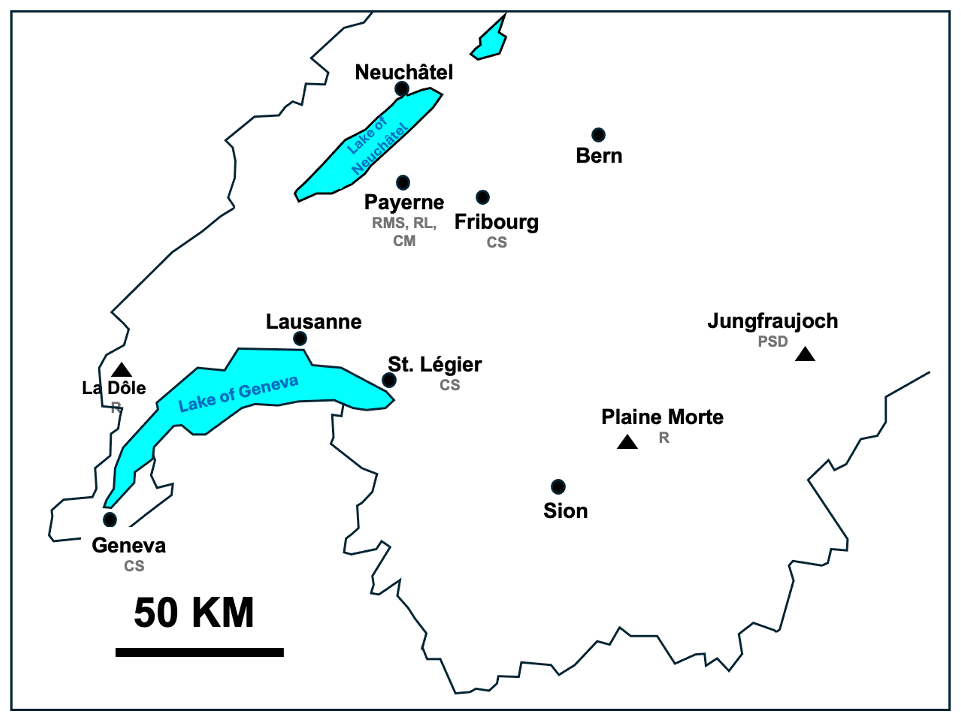
Figure 1Locations in western Switzerland with equipment mentioned in the text. CS: collection site; R: weather radar; RL: lidar radar; RMS: radio meteo sonde balloon launching site; PSD: particle size distribution determination site.
Table 1Sampling sites and analyses effectuated (iber.: iberulite; opt.: binocular imaging).

2.1 Observational data
Meteorological data were collected from radiosonde balloons launched by the Federal Office for Meteorology and Climatology of Switzerland (MeteoSwiss) station in Payerne (46.817° N, 6.933° E; Fig. 1) twice daily at 11:00 and 23:00 UTC. Payerne is located 17 km west and 47 km north of the collection sites in Fribourg and Saint-Légier, respectively. The station is equipped with a Raman lidar, ceilometers, and a Doppler radar to measure precipitation, aerosol concentrations, and wind profiles. On 6 February, the ceilometer profile series from Payerne showed gaps in the morning and smaller gaps in the afternoon due to ground fog. The area is also covered by two weather radars: one on La Dole Mountain (46.425° N, 6.099° E), west of Saint-Légier and near Geneva, and the other on Plaine Morte (46.383° N, 7.500° E; Fig. 1), in the central Bernese Alps southeast of the two collection sites.
The size distributions of fine- and coarse-mode aerosols in the dust cloud were measured at the high-altitude alpine station Jungfraujoch (JFJ, 7.98° N, 46.55° E; 3580 m a.s.l.; Fig. 1) in the Bernese Alps. Its remote location, far from local human sources, makes it ideal for monitoring background atmospheric conditions. Jungfraujoch lab hosts a comprehensive long-term in situ monitoring program for aerosols and trace gases as part of the World Meteorological Organization (WMO) and is included in the Swiss National Air Pollution Monitoring Network (Hüglin and Grange, 2021). Aerosol measurements were conducted using a custom-built scanning mobility particle size spectrometer (SMPS) (Jurányi et al., 2011; Wiedensohler et al., 2012) and a white-light optical particle size spectrometer (FIDAS, Palas GmbH, Germany) (Fischer and Hüglin, 2024; Brem et al., 2023).
2.2 Dust trajectory analysis
The dust RGB product, based on three infrared channels from the Spinning Enhanced Visible and Infrared Imager (SEVIRI) on EUMETSAT's second-generation MSG-11 satellite (Schmetz et al., 2002), was used to identify the source of dust arriving over western Switzerland in the afternoon of 6 February (Schepanski et al., 2009). The dust detection method is based on the decrease in the brightness temperature recorded by SEVIRI when dust is present in the atmosphere. Moderate dust loading can decrease the brightness temperature by 5–10 K (Sokolik, 2002). The plume's path was tracked using satellite images following the approach described by Ashpole and Washington (2013). The visually identified dust routes were confirmed using forward- and backward-trajectory calculations with the Hybrid Single-Particle Lagrangian Integrated Trajectory (HYSPLIT) model, developed by the NOAA's Air Resources Laboratory (Stein et al., 2015). HYSPLIT uses archived three-dimensional meteorological data from ground and satellite observations, along with short-term forecasts. For this study, the Global Forecast System dataset from the National Centers for Environmental Prediction at 0.25° resolution was used to perform back-trajectory calculations. In all, 18 back-trajectory calculations have been performed: 3 arrival altitudes × 6 arrival times. The SEVIRI images and the backward trajectories trace the dust's origin for an arrival time over Fribourg at 2000 m above ground level, between 12:00 and 18:00 UTC on 6 February, roughly coinciding with the period of highest cloud density, to the Algerian–Moroccan border. The dust source meteorological data were obtained via the Real-time Environmental Applications and Display System (READY) from the archived Global Data Assimilation System (Rolph et al., 2017). The data were collected for the center of the main dust source observed in the satellite image, located at 33.8° N, 1.5° W.
2.3 Scanning electron microscopy (SEM) and optical polarization microscopy (OPM) analyses
Both single particles and iberulites were isolated from samples collected on the ground in Saint-Légier and Geneva, as well as from the aluminum foil in Fribourg. A selection of iberulites was gently placed onto a in. (1.27 cm) pin stub (Ted Pella, Redding, CA, USA) and examined using an Olympus SZX12 binocular microscope (Tokyo, Japan). All single particles collected on the foil in Fribourg were dispersed onto a carbon-covered 1 in. (2.54 cm) pin stub and analyzed using automated scanning electron microscopy (SEM) and energy-dispersive X-ray (EDX) single-particle analysis (computer-controlled SEM, CCSEM). During CCSEM, particles are identified based on their back-scattered electron (BSE) contrast, and images, along with EDX spectra, are acquired. For this, an FEI Sirion FEG microscope equipped with an Oxford X-MAX EDX detector with a 150 mm2 sensor size, a four-quadrant BSE detector, and AZtecFeature software (Oxford Instruments) was used at the Department of Geoscience of the University of Fribourg (Fribourg, Switzerland). Analyses were conducted at 20 kV. Particles were identified by simple gray-value (BSE intensity) thresholding. EDX analyses were performed for each identified particle. The AZtec software automatically applied a ZAF correction (PAP version of the f(ρz) formalism; Pouchou and Pichoir, 1985) – considering atomic number (Z), absorption (A), and fluorescence (F) effects – to the raw data for elemental concentrations. Quantification was based on factory-calibrated standards. The ZAF correction assumes homogeneous samples with smooth surfaces perpendicular to the beam and thicknesses greater than the excitation volume – conditions not met by these particles due to their rough surfaces and small sizes. However, studies (Kandler et al., 2018; Meier et al., 2018; Weinbruch et al., 1997) have shown that for particles larger than 1 µm, the relative standard deviation of the corrected major-element concentrations is approximately 2 %. For minor elements, the deviation is higher. Since only particles > 1 µm in diameter were included in further data processing, ZAF-corrected concentrations were used without additional corrections. Several blank analyses of empty substrates have shown that, under the applied analytical conditions, the substrate surface contains, in an area of ca. 1 mm2, a maximum of five particles on unexposed substrates. These particles are organic in nature and most likely hair follicles.
2.4 Particle size and microstructure analysis
Images from both the optical microscope and the SEM were used to characterize the particle size distribution of the individual constituents of the iberulites, as well as their microstructure, using Avizo software (Thermo Fisher). Selected iberulites were placed in a 1 in. (2.54 cm) round container and filled with impregnation resin. The resulting cylindrical samples were polished on the side containing the iberulites and then examined by electron microscopy. A BSE image of a polished iberulite section was also segmented using the Avizo software (Thermo Fisher), enabling the counting of individual particles and the determination of their equivalent spherical diameter dve, defined as the diameter of a sphere with the same volume as the particle with irregular shape (Kandler et al., 2018; Ott and Peters, 2008):
where B is the projected area the particle occupies on the sample substrate, and P is the particle perimeter. Due to the resolution of the segmentation process, only particles larger than 0.05 µm can be detected and counted. To compare the SMPS with the SEM-derived PSDs, the mobility diameter dm obtained by SMPS must first be converted to the volume-equivalent diameter dve (DeCarlo et al., 2004):
with the inverse Cunningham slip correction factor ratio between the mobility and volume-equivalent diameters; CF the conversion factor; and the dynamic shape factor x,
which is defined as the ratio of the drag force on the nonspherical particle FP to the drag force on its volume equivalent sphere Fve when both move at the same relative velocity with respect to the gas (Hinds, 1999). The electrical mobility is the velocity ve of a sphere (x=1) with the same velocity as the measured particle with n the number of charges on the particles and e the elementary unit of charge:
From Eq. (4), the conversion Eq. (2) follows. Cc(dve) is unknown. The ratio has, to our knowledge, been measured only for salt particles smaller than 600 nm. The latter (extrapolated for particles > 600 nm) was used to convert the volume-equivalent diameter into the mobility diameter. It is always less than one, increases with size, and decreases with axis ratio. The axis ratios (ARs, the ratio of the longest dimension b to the orthogonal width) and shape factors appear to depend on size, flow regime (Alexander et al., 2016), and orientation (Cheng et al., 1988), ranging from near unity for smaller particles to a value of 3 for the largest particles. The average AR inside the iberulites is 1.46, close to 1.4 reported for dust particles in the 2 to 10 µm range (Ansmann et al., 2011; Rocha-Lima et al., 2018; Jeong, 2024). Overall, CF is mostly smaller than 1.0. The converted volume-equivalent diameters are smaller than the mobility diameters.
2.5 X-ray diffraction
A loose, single sample of dust particles, lacking iberulites but collected simultaneously with the iberulites that fell in Fribourg, was analyzed using a Rigaku Ultima IV diffractometer equipped with a position-sensitive detector. Diffractograms were recorded from 5 to 70° 2θ in step-scan mode (0.02° per step and 1 min per degree). The copper X-ray tube was operated at 40 kV and 40 mA. The Cu Kα radiation was filtered through a nickel foil. Quantitative phase analysis via Rietveld refinement (Bish and Post, 1993) was performed on the recorded patterns using the PDXL2 software package (Rigaku). The refined instrumental parameters included the zero shift, sample displacement, and peak shape, modeled with a pseudo-Voigt profile. Structure parameters for the phases in the sample were sourced from the International Center for Diffraction Data database; the scale factor, unit-cell parameters, isotropic overall temperature factor, and in some cases the preferred orientation parameter (phyllosilicates, calcite) were the only structural parameters refined using the March–Dollase formalism (Dollase, 1986). Phase fractions were determined through the scale factors. Atomic positions and site occupancies remained fixed during refinement. Multiple iterations were performed until the process converged.
Proposed iberulite formation mechanisms are either in- (ICS) or below-cloud scavenging (BCS). Parameters influencing the number of particles in a final hydrometeor formed through ICS are critical supersaturation for activation, particle size, and temperature dependencies of the CCN/ICN activation (Lemaitre et al., 2024). The number of particles inside a hydrometeor in a cloud can also increase by collecting (scavenging) inactive particles through continued growth or collision (impaction) with them (Prodi, 1976; Prodi et al., 2018; Song and Lamb, 1994; Yang et al., 2023). Aggregation and coalescence efficiency of ice particles and droplets, respectively (Connolly et al., 2012), as well as the mineralogy (Atkinson et al., 2013; Zolles et al., 2015; Lüönd et al., 2010; Peckhaus et al., 2016; Harrison et al., 2019) of the particles, are further influencing parameters. In the global and annual mean, the aerosol mass scavenged in stratiform clouds was primarily attributed to impaction processes. The aerosol number scavenged is primarily (> 90 %) attributed to impaction; 99 % of this impaction scavenging occurs in clouds with temperatures less than 273 K. The in-cloud scavenging efficiency by impaction is for both ice columns and platelets almost constant for aerosol particles 0.1–5 µm in diameter (Croft et al., 2010).
For BCS, the capture efficiency Λ, i.e., the number of particles captured by a drop or ice particle per unit time along the trajectory during the fall, depends on particle size and the capture mechanism. If a single drop with radius R falls vertically, i.e., without deviation by wind, the maximum number of possible collisions N with particles with radius r along a trajectory l within the dust layer, mass density Mair, and particle density d can be calculated:
The approximate number Ntotal in an iberulite with radius R was calculated using Avizo segmentation of a BSE image of a polished section of an iberulite to extract the number of particles in the central section Nsec, and using Eq. (1) to calculate the average equivalent diameter deq of the particles. To calculate Ntotal, the iberulite sphere was cut into i flat disks with radius ri, dve thick, and multiplied with the same particle number density Nsec as the central section:
For particles larger than 1 µm in diameter colliding head-on with a droplet, bouncing is unlikely, and the sticking efficiency is assumed to be 100 %. However, for particles with radii between 0.3 and 1.0 µm, Λ is less than 1. This occurs because of the airflow around the falling droplet. Particles in this size range, although on collision trajectories, tend to follow the flow lines and are diverted around the droplet. Larger particles, due to their inertia, cross the flow lines and impact the droplet directly, resulting in a Λ of 1 (capture by impaction). Small particles (< 0.3 µm) that follow the flow lines may be pushed by Brownian motion into the droplet's wake and deposited on its rear end (Brownian capture), with Λ also close to 1. Capture can also occur through thermophoretic and diffusiophoretic forces (Santachiara et al., 2013). Thermophoretic forces push aerosol particles toward a frozen drop during evaporation and away from it during vapor deposition. During diffusive crystal growth, a flow known as Stefan's flow occurs near the hydrometeor surface, exerting a force on nearby aerosol particles that pulls them toward the surface (Santachiara et al., 2023). For some particles following the flow lines, the latter approach the droplet's surface closer than their diameter. As a consequence, the particle contacts the droplet's surface and sticks to it (capture by interception). This process has a relatively low capture efficiency. For particles with radii between 0.3 and 1.0 µm, none of the preferred capture processes are effective, and the Λ decreases by 2 orders of magnitude. This reduction in Λ was first described by Greenfield (1957), and the absence of particles in the 0.3–1.0 µm range is called the Greenfield gap. Both formation mechanisms should lead to a depletion of particles in the 0.3–1.0 µm range in the iberulites relative to the dust cloud concentration, but the decrease is much more pronounced for BCS. The particle size distribution (PSD) inside an iberulite, compared to the PSD in the free atmosphere, can therefore indicate the formation mechanism of the iberulite.
4.1 Dust source and trajectory
For air masses arriving at 2000, 2500, and 3000 m a.s.l. over Fribourg in the early afternoon of 6 February, HYSPLIT back-trajectory calculations were performed for hourly arrival times from 09:00 to 15:00 UTC.
The dust originated in northwestern Africa (Fig. 2), between the southern Moroccan border and northwestern Algeria. Satellite images showed a dust plume forming in a region called “Hauts Plateaux” (also known as “Hautes Plaines”) between the pre-Sahara and the Tell Atlas (Fig. 3). The air masses arriving over the Hauts Plateaux during the early afternoon of 5 February were at altitudes ranging from 1500 to 3500 m a.s.l., which is within the planetary boundary layer (PBL; calculated with the READY software; Rolph et al., 2017), spanning from 2600 to 4500 m. Average surface wind velocity (at 10 m above ground level) increased from 40 km h−1 to approximately 70 km h−1.
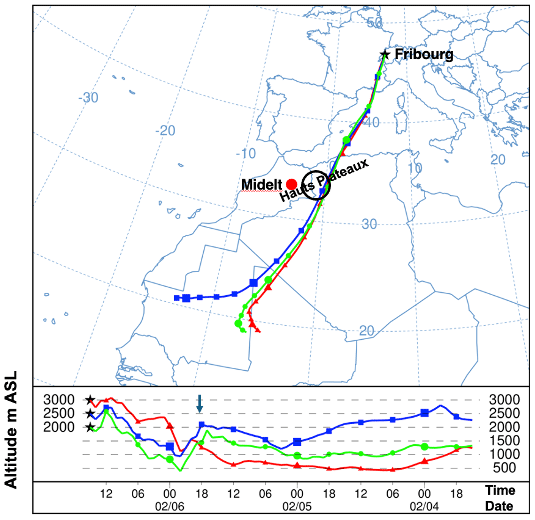
Figure 2Back trajectories for air masses arriving over Payerne at 15:00 UTC on 6 February. The black circle shows the location of the first appearance of the dust plume entrained across the Mediterranean Sea towards central Europe. Midelt is the location where meteorological conditions during the pickup of the dust are known. The black arrow points to the location markers inside the black circle, e.g., close to the dust plume visible in Fig. 3 (yellow circle).
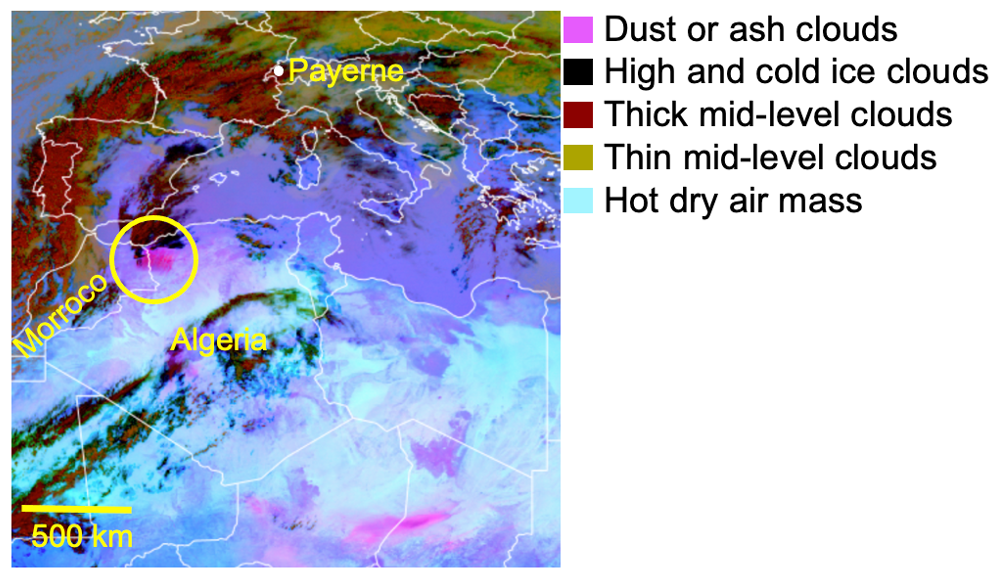
Figure 3Satellite RGB image (5 February 2021, 22:00 UTC) from the SEVIRI dust product. The dust plume transported to central Europe is seen east of the Moroccan–Algerian border (center of the yellow circle).
Weather stations in the Atlas Mountains recorded hurricane-force gusts (e.g., 117 km h−1 on 5 February 2021 in Midelt, Morocco; Fig. 2) (Hoshyaripour, 2021). These gusts exceeded the threshold wind speed for dust emissions given for western Algeria (Marticorena et al., 1997). The dust plume was transported northeastward toward the Mediterranean Sea, where a low-pressure system developed. The associated warm conveyor belt lifted the dust to higher altitudes and carried it with the polar jet across the Mediterranean in an “atmospheric river” toward central Europe (Francis et al., 2022; Rautela et al., 2024). Source sensitivities (the probability that an air mass originates from a given source along a certain path) for Saharan dust (fine mode) indicate that the most common pathway is from the Sahara, over the Mediterranean, directly to the Alps (Collaud Coen et al., 2026).
4.2 Local meteorology
On the afternoon of 6 February 2021, the Swiss Plateau – including Fribourg – experienced high-altitude mixed-phase clouds (altocumulus) that eventually gave way to periods of clear skies. Ground temperature measurements and T RH profiles from the radiosonde released at 11:00 UTC in Payerne showed relatively high temperatures for 6 February in western Switzerland (4 °C at the ground and a 0 °C level at 2800 m a.s.l.), along with a typical inversion (Fig. 4). Nevertheless, compared with conditions during previous IFs over the Iberian Peninsula (Diaz-Hernandez and Sanchez-Navas, 2016), the temperature was much lower. The vertical profile of relative humidity (RH) was complex: RH decreased from 97 % at ground level to 48 % at 1000 m, then increased to 61 % at 3200 m a.s.l. (Fig. 4). RH remained between 48 % and 55 % up to 4300 m a.s.l., where it began to increase to 97 %, resulting in a 100 m thick layer between 5000 and 5100 m a.s.l. with temperatures below the frost point. At this altitude, altocumulus clouds were reported.
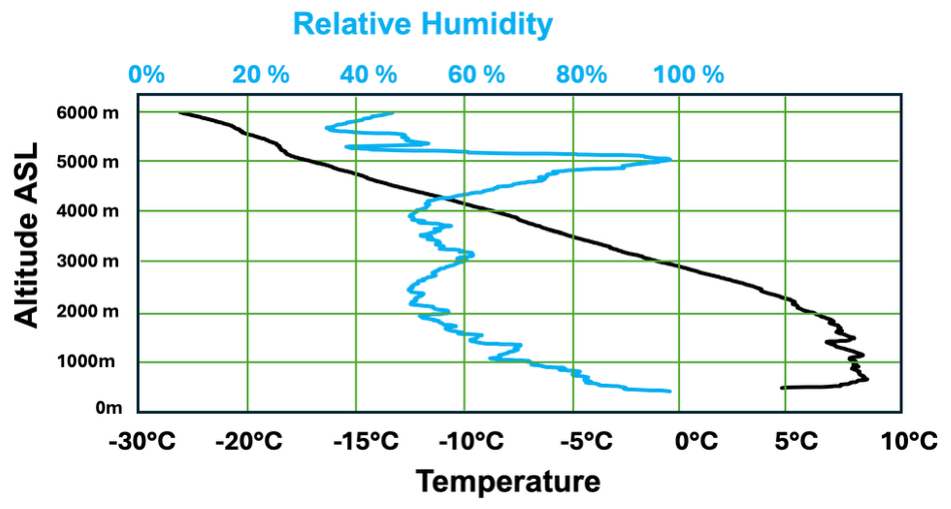
Figure 4Temperature (black line) and relative humidity (blue line) as a function of altitude from the radio sounding. The balloon was released in Payerne at 11:00 UTC. The balloon flew 30 km to the northwest during the above recording (MeteoSwiss).
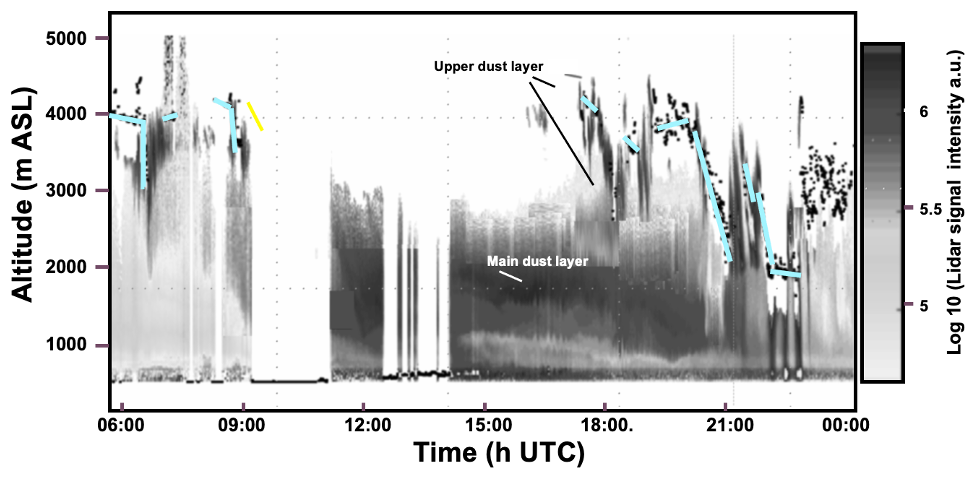
Figure 5Ceilometer profile for 6 February (MeteoSwiss). The small black dots and blue lines above the reflections indicate the meteorological cloud base. The white strips are gaps due to ground fog.
The Payerne ceilometer time profile (Fig. 5) shows a cloud base at 5000 m a.s.l. at midnight, with reflections above about 2500 m (the 0 °C level), which may be due to aerosol (SDE) or ice particles. Reflections from ice particles and dust are generally difficult to distinguish. Early in the morning, the cloud base lowered to 4000 m, and the reflections extended down to 2500 m. Below 2500 m a.s.l., the temperature is above 0 °C and rises rapidly; therefore, reflections below 2500 m a.s.l. in the afternoon are very unlikely to be from ice particles. The below-cloud reflections appear streaky in the ceilogram. After a large gap in ceilometer recordings between 09:00 and 11:00 UTC due to ground fog blocking the laser, a reflection wall extending to the ground appeared. These strong reflections from dust particles persisted throughout the day. The meteorological cloud base lowered from 4000 to 2000 m during the evening. Around 22:30 UTC, three short periods with very strong reflections were observed; during these times, precipitation was recorded on the ground. After 23:00 UTC, the reflections became less intense.
Lidar measurements were taken between 15:00 and 17:00 UTC, during the signal's peak, and the average was used to derive a mass concentration profile (Fig. 6) across the dust plume. The altitude range of 4000–5000 m served as the “no aerosol” reference. The profile was constructed using a lidar ratio of 0.57 m2 sr−1 ± 9 sr at 532 nm (Haarig et al., 2022), an Ångström coefficient of 0.5 for long-range-transported dust in northern Europe (Ansmann et al., 2001), and a mass extinction ratio at 532 nm of 0.47 ± 0.04 m2 g−1 (Nemuc et al., 2013). The profile showed three peaks. The highest concentration, 81 µg m−3, occurred at 1675 m. The second-largest concentration was recorded just above the ground, and a third small peak was located just above the cloud base at approximately 3500 m.
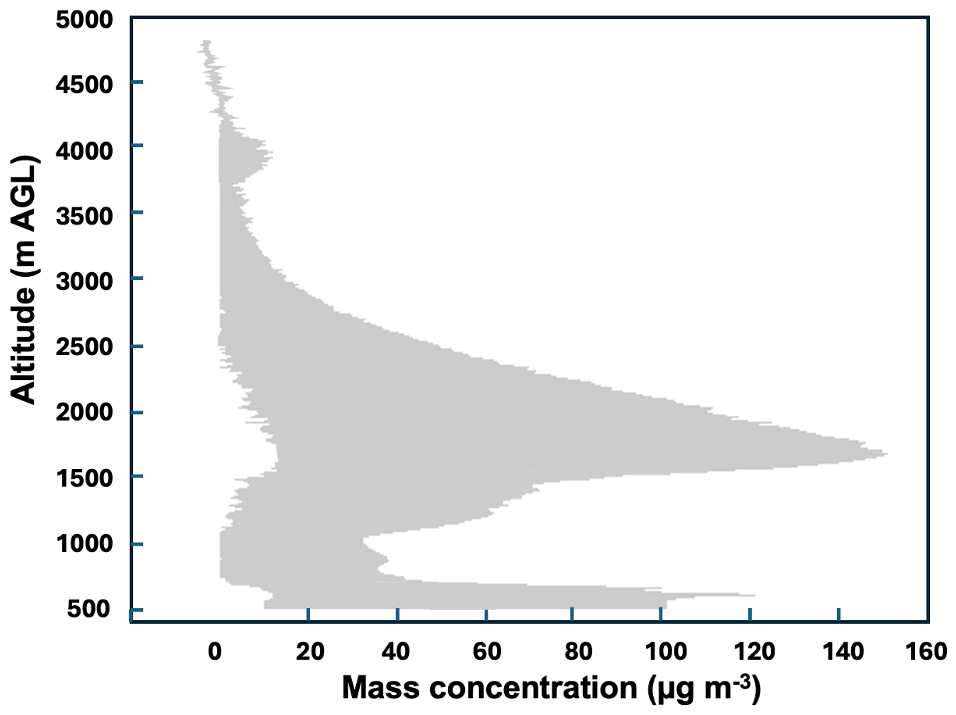
Figure 6Aerosol mass concentration profile across the dust cloud calculated from the average of lidar measurements taken between 15:00 and 16:59 UTC in Payerne (MeteoSwiss). The gray color indicates the bandwidth of the individual measurements.
4.3 Morphology and microstructure of iberulites
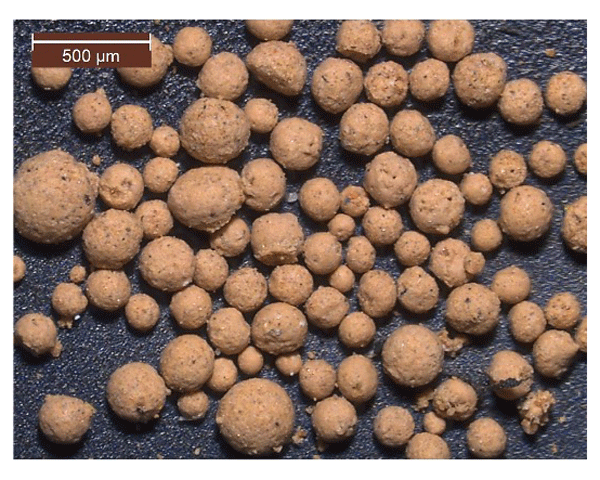
Giant particles were previously observed after long-range transport of Saharan dust. Rapid transport, high turbulence, and electrical forces are thought to counteract the particles' weight. In our case, the large “particles” were not individual particles but multimineral aggregates with spherical to slightly ellipsoidal shapes, known as iberulites after their first recording on the Iberian Peninsula (Fig. 7) (Díaz-Hernández and Párraga, 2008). The cores of the iberulites consist of coarser mineral grains (Figs. 8e, f and 9) that have accumulated without a visible cement matrix. Apart from a thin, dense surface layer, the iberulite cores show no internal structure, such as layering or preferred grain orientation. The iberulites collected in Saint-Légier and Fribourg (n=425) are larger than those from the Iberian Peninsula, with an average diameter of 113 µm (range: 43–365 µm). Most iberulites have smooth surfaces with few large surface pores (Fig. 8a–d), most likely due to particles ejected from the aggregates. Spherical surface depressions, formed due to vortices in the air around the rear end of falling water drops (Ren et al., 2020), as observed on Iberian iberulites (Díaz-Hernández and Párraga, 2008), are very rare among the sampled iberulites. Some iberulites were still wet.
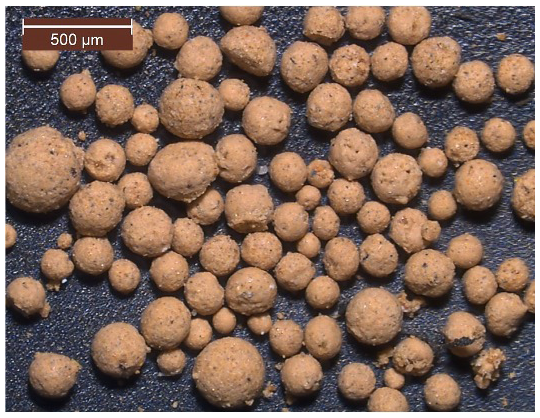
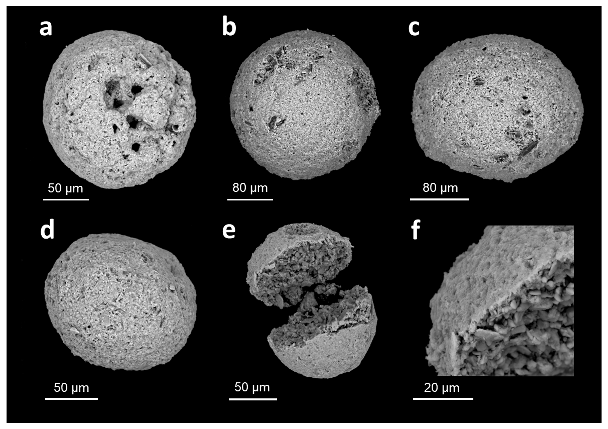
Figure 8SEM images of some iberulites collected in Saint-Légier on 6 February 2021. Panel (f) shows the fine-grained rim and the coarse core of an iberulite.
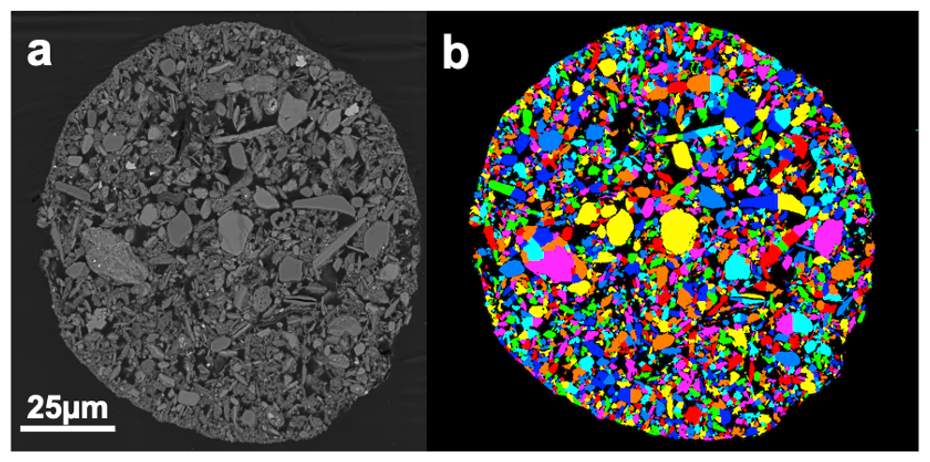
Figure 9(a) BSE image of a polished section through an iberulite and (b) the corresponding segmentation obtained from Aviso. The different colors are used to better distinguish individual particles but do not represent any specific elemental composition.
4.4 PSDs at JFJ and inside the iberulites
During periods when JFJ is cloud-free, above the PBL, and free of Saharan dust, the number PSD has two modes: a stronger one near 0.05 µm and a weaker one between 0.15 and 0.4 µm (Fig. 10, green bars). The PSD measured at 11:00 UTC on 6 February, when JFJ was within the Saharan dust plume, is monomodal, with a maximum near 0.150 µm (Fig. 10, yellow bars). It shows, similar to PSDs observed during previous Saharan dust episodes at JFJ (Chou et al., 2011), much higher concentrations than measurements without SDEs. The PSD of particles within the iberulites is monomodal, with a maximum at 2.5 µm (Fig. 10, blue bars), much larger than that for Saharan dust sampled at JFJ (e.g., 0.2 µm). For these dimensions, the PSD of the particles inside the iberulites shows rather a minimum.
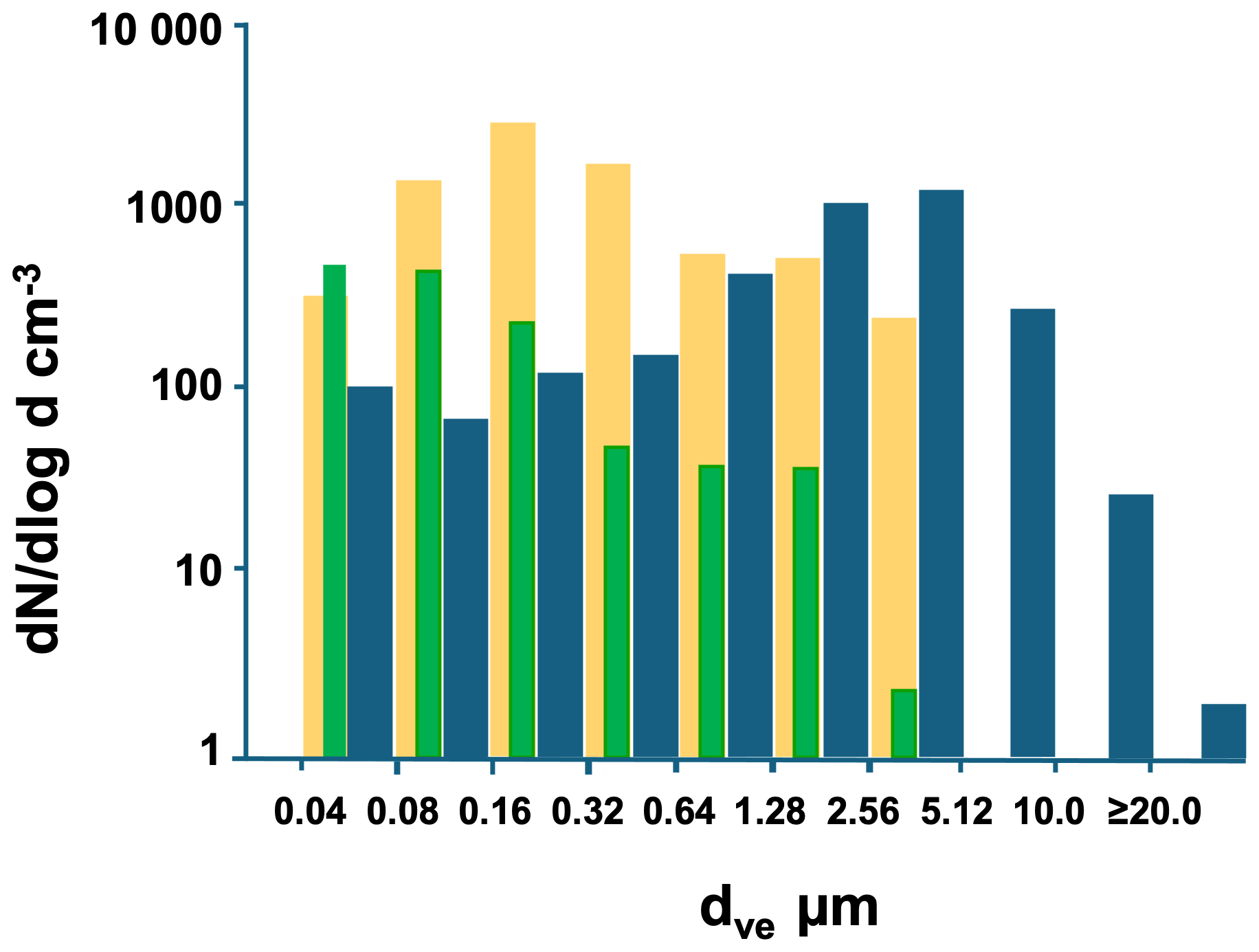
Figure 10Jungfraujoch PSD measured in April 2004, when JFJ was above the PBL and cloud-free, and there was no SDE (green bars); during the SDE of 6 February at 12:00 UTC (yellow bars, shifted one bin to the left relative to the original data; see text); and for an iberulite sample collected in Saint-Légier (blue bars).
The number of particles Nsec (598) in the iberulite section shown in Fig. 9a was determined after segmentation of the image, shown in Fig. 9b, using Aviso. The average equivalent diameter deq calculated with Eq. (1) is 2.0 µm, and the total number of particles in the iberulite shown in Fig. 9a is, using Eq. (6), 22 000! As a comparison, the number of collisions of an ice particle with a diameter of 1 mm along a 1000 m trajectory in air charged with 60 µg cm−3 of dust with particles 2.0 µm in diameter and with an average density of 2.0 g cm−3, assuming an average CE of 0.4, is calculated using Eq. (5): 26 000. Although both values are only an approximation due to the high variability in the variables entering the equations, it is nevertheless remarkable that they are of the same order of magnitude.
Coarse-mode particles arriving at JFJ have been well documented in previous studies of particle volume distributions in dust plumes, with a mode in number PSDs at 1.4 µm (Schwikowski et al., 1995) and in particle surface area distributions at 40 µm (Brunner et al., 2021). Saharan dust clouds transported over long distances, such as to Barbados during the SALTRACE campaign (Weinzierl et al., 2017), to AERONET sites in the eastern Caribbean (Velasco-Merino et al., 2018), over the Mediterranean Sea during the ChArMEx/ADRIMED campaign (Denjean et al., 2016), and over Cape Verde during the SAMUN2 campaign (Weinzierl et al., 2011), have similar PSDs. The largest particles observed at the Caribbean sites are well above the maximum diameter expected for settling under Stokes' law during transport. The modes observed at JFJ and in the campaigns cited above resemble the PSDs observed in the source regions (Panta et al., 2023; Bencherif et al., 2022; Dubovik et al., 2006) but are lower in concentration. The presence of particles with diameters > 10 µm inside the iberulites is thus not exceptional.
4.5 XRD results (Rietveld analysis) and energy-dispersive spectroscopy EDS analyses
X-ray diffraction of individual particle samples collected on the foil in Fribourg showed that the dust contained phyllosilicates (illite, muscovite, and kaolinite, totaling 35.1 wt %), followed by carbonates (28.0 wt % calcite, 4.0 wt % dolomite), quartz (23.3 wt %), and K-feldspar (1 wt %–2 wt %). The concentrations of gypsum and halite were below the detection limit. Analysis of individual particles within an iberulite confirms the XRD results. EDS analyses on the polished iberulite section have a resolution of 1–2 µm, depending on section thickness and local composition. Compositions of particles < 1 µm should therefore be interpreted with caution. Trends from the ideal muscovite composition toward the calcite composition, as well as toward the quartz compositions, in the (Mg + Fe + Si + K − Al − Ca) ternary diagram indicate that the particles are mixtures of the three phases (Fig. 11a). The ternary diagram (Mg + Fe + Si + K − S − Ca), with Mg + Fe + Si + K as the “silicate” corner and Ca as the “calcite” corner (Fig. 11b), shows measurements mainly along the joint between the silicate and calcite corners, indicating that the analyses are from particle aggregates containing both minerals and some measurements scattered in the triangle silicates–calcite–gypsum, indicating mixtures among these phases or the presence of sulfur on the particle surfaces. This lack of sulfur in the rims of the iberulites sampled in this campaign differentiates them from the iberulites of the Iberian Peninsula (Díaz-Hernández and Párraga, 2008; Párraga et al., 2021).
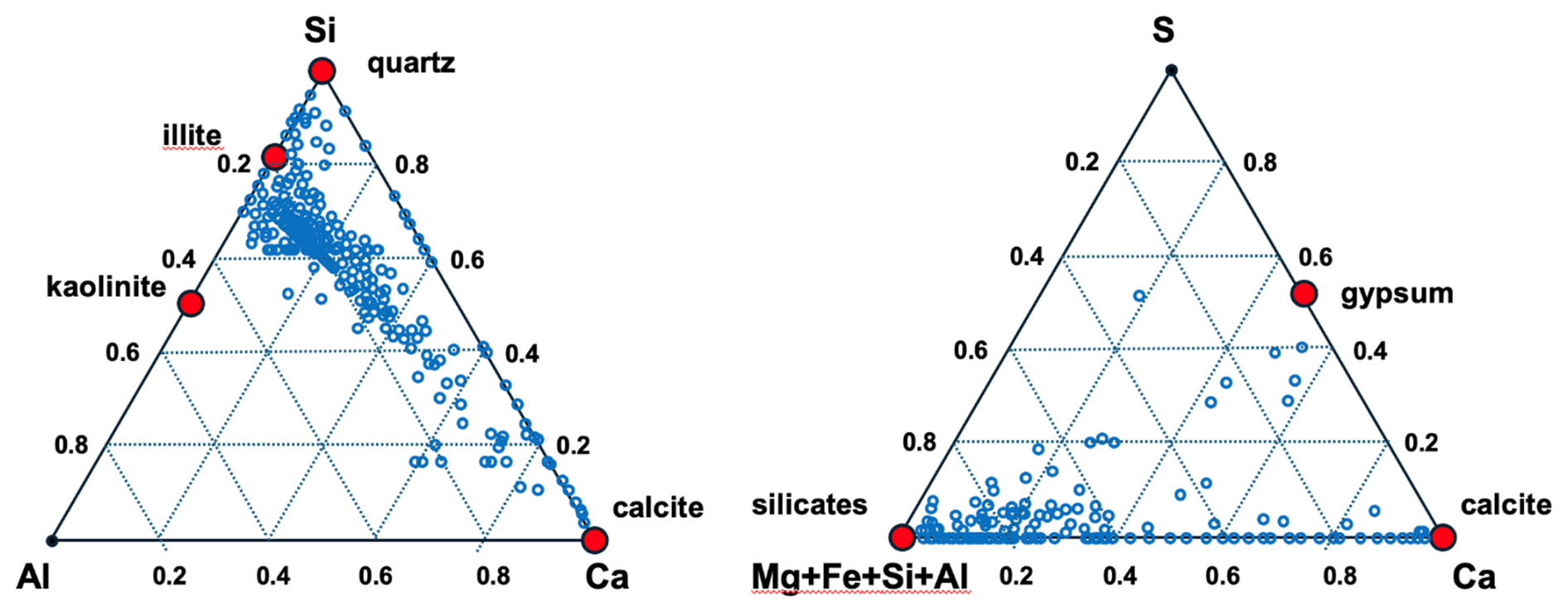
Figure 11Ternary diagrams: (a) (Mg + Fe + Si + K − Al − Ca), (b) (Mg + Fe + Si + K − S − Ca).
5.1 Dust composition
Dust from potential source areas has been characterized by bulk chemistry (Kandler et al., 2007) and mineralogy (Scheuvens et al., 2013a). Mineralogical fingerprints include phyllosilicates, such as the ratio of illite to kaolinite concentrations (I K) (Caquineau et al., 1998; Chester and Johnson, 1971; Scheuvens et al., 2013b). In northern Africa, the general trend is an increase in I K from south to north and from east to west. The value for the present single particles collected in Fribourg is approximately 2.9, consistent with values reported from the western Sahara (e.g., > 2 in NW Algeria and Morocco), which is the source area for the SDE determined from back-trajectory calculations and satellite data. High carbonate content (> 10 wt %, calcite > dolomite) is also a fingerprint of dust from northwestern Africa (Avila et al., 1997). Similar to illite, carbonate content decreases continuously toward the south (Paquet et al., 1984). High carbonate content is characteristic of dust emitted from regions within and adjacent to the Atlas Mountains (Grousset et al., 1992), the source for the present SDE determined by back-trajectory calculations and satellite imagery.
5.2 Iberulite formation and insights from internal structure
The layer at 5000 m altitude with supersaturated atmospheric conditions (0.11 % supersaturation) in a mixed-phase cloud is most likely the source of the ice/snowflake precipitation that led to the scavenging process by frozen hydrometeors. With an RH of 97 %, the highest value measured by the balloon sonde, and assuming a liquid water content > 0.01 g m3, the fraction of water bound in ice particles relative to the total water content is about 80 % (Korolev et al., 2017). The conditions are ideal for the crystallization of plate-like ice particles (Fukuta and Takahashi, 1999; Hallett and Bailey, 2009; Libbrecht, 2005). The temperature at the upper boundary of the dust layer was below 0 °C and became positive around 2800 m. However, melting of the frozen hydrometeors most likely began at a much lower level due to low relative humidity, in which the water vapor density of the surrounding air is lower than the equilibrium water vapor density of frozen hydrometeors at the freezing point; therefore, sublimation of water vapor occurs from the surface of the latter. Because of this sublimation process, latent cooling can push the surface temperature of the hydrometeor below 0 °C (Matsuo and Sasyo, 1981; Heymsfield et al., 2015). The width of the non-melting layer in the atmosphere increases nearly linearly with decreasing relative humidity, from 120 m at 90 % to 700 m at 50 %. The relative humidity at the top level of the main Sahara dust layer is around 50 % and remains constant down to an altitude of 1700 m a.s.l. It is therefore probable that the melting level is displaced far into the massive Saharan dust layer and that the encounter between dust and hydrometeors occurred when the latter were frozen. Although difficult to distinguish from aerosol particles, the reflections just below the cloud base may originate from frozen hydrometeors. Both solid ice crystals and snow crystals can capture particles. Several studies on BCS (Kyrö et al., 2009; Paramonov et al., 2011) indicate that frozen hydrometeors are more effective scavengers of aerosol particles than rain on an equivalent water-content basis. The fluttering, zigzagging fall style of frozen hydrometeors (Hashino et al., 2016; Kajikawa, 1992; Tagliavini et al., 2021; McCorquodale and Westbrook, 2021; Stringham et al., 1969) prolongs their trajectories, thereby increasing the probability of collisions with aerosol particles and, consequently, CE. CE also increases with temperature and relative humidity, although there is a discrepancy between experimental/natural data and theory (Santachiara et al., 2023). The highest CE has been recorded for mixed precipitation types at temperatures slightly below and above 0 °C (Miller and Wang, 1989). The temperatures between the likely origin of the frozen hydrometeors and 2000 m a.s.l. are in this range.
At these temperatures, frozen hydrometeors develop a stickier liquid layer on their surfaces. The increase in CE at higher RH is attributable to increased collector capacitance (Paramonov et al., 2011). Thus, the conditions for effective scavenging were met. The Greenfield gap for frozen hydrometeor fall situations was smaller, spanning 0.09–0.3 µm, compared with the gap observed for rain. This range is also observed in the iberulites collected in the present fieldwork, supporting the role of frozen hydrometeors as dust scavengers and indicating that BCS was at work. The increased CE of frozen hydrometeors is probably also responsible for the larger diameters observed in Swiss iberulites than in Iberian iberulites. When frozen hydrometeors exit the non-melting zone, they melt or evaporate, exhibiting a wide range of melting behaviors (Hallett and Oraltay, 2005). All frozen hydrometeors form thin liquid films on the surface and become stickier (Knight, 1979; Leinonen and Lerber, 2018; Hallett and Oraltay, 2005). Large frozen hydrometeors increase in size through coalescence in the melting layer (McFarquhar et al., 2007). The behavior of scavenged aerosol particles within melting hydrometeors has not been analyzed to date. Most likely, they are incorporated into the newly formed raindrops. Within and below the melting layer, due to the very low relative humidity (45 % at 1000 m, at the bottom of the massive dust layer), raindrops will dry very rapidly. A technological analog of this process is the (spray) drying of a powder suspension, which is used, e.g., in the ceramic, food, and pharmaceutical industries (Santos et al., 2018). The difference between the drying of a droplet in a spray dryer and that of a rain droplet falling out of a cloud is the temperature difference between the droplet and the drying airstream, which is around 200 °C in a spray dryer. Droplets in a spray dryer relax into spherical shapes, analogous to raindrops. The latent heat of water evaporation induces a strong heat flux from the droplet surface into the gas stream. This, in turn, drives thermophoretic particle displacement toward the droplet surface and a specific microcirculation in a layer near the surface, driven by the surface-tension gradient (Iskandar et al., 2003). This microcirculation entrains particles toward the droplet surface, leading to size- and density-based segregation. Smaller and/or less dense particles move faster toward the droplet surface, forming a surface layer. Coarser particles are concentrated in the core. Such a shell–core structure was observed in the present iberulite and has also been reported in the Iberian examples (Díaz-Hernández and Párraga, 2008; Párraga et al., 2021), with fine-grained phyllosilicates concentrated in the shell and coarse-grained quartz grains in the core. The sulfur-rich rims observed in Iberian iberulites, but lacking in our iberulite, were explained by the condensation of gaseous sulfuric acid on the iberulite rind and the absorption of atmospheric SO2 attributed to industrial emissions in northern Africa. If the present iberulites are formed through BCS above western Switzerland with few heavy industries, such rims are not expected. Even if ICS occurred before the dust cloud arrives over Switzerland should be the iberulite formation mechanism, the trajectory of the air masses arriving over Fribourg crosses only over Marseille (France), a region with heavy industries. The air masses crossed the Algerian sea border between the industrial hotspots of Algier and Arzew–Mostaganem (Etkind et al., 2026) and at 2000 m a.s.l. over Marseille, with a PBL height which in wintertime is around 1000 m (Riandet et al., 2023), i.e., below the dust cloud level.
To our knowledge, this analysis is the first detailed meteorological study of iberulite fall. In contrast to the Iberian cases, the IF fall occurred under much colder conditions, e.g., temperatures around 0° and decreasing relative humidity along the fall trajectory. Iberulites form through the accumulation of particles inside raindrops. A comparison of the PSD inside the iberulites with the PSD measured in the dust cloud at the Jungfraujoch, which encountered the same dust cloud, revealed a Greenfield gap in the iberulite PSD, i.e., a lack of particles in the range between 0.1 and 0.3 µm. The presence of a Greenfield gap within the iberulites supports below-cloud scavenging, i.e., particle capture via collisions with droplets below a cloud, as the mechanism for particle accumulation. The gap arises from particle trajectories in the flow around the falling droplet, which depend on particle size. The freezing temperature, low relative humidity, and ceilogram signals suggest that particle collisions occurred not with raindrops but with snowflakes or ice crystals. These are known to be better scavengers than raindrops. Since the paper was submitted the check of bulk aerosol samples revealed that more than 50 % contained iberulites.
There is no code written by us. All codes are commercially available. There are over 20 codes for the Greenfield gap. We took average results. Phase analysis and Rietveld refinement (Bish and Post, 1993) were performed on the recorded patterns using the PDXL2 software package (Rigaku). Nano CT results were analyzed using Avizo software (Thermo Fisher).
The XRD data are in the file “iberulite_xrd_stlegier.pdf”, the CT data in the file “iberulite_nano_ct.pdf” of https://folia.unifr.ch/unifr/documents/337054 (last access: 11 October 2026).
RJ, FP, and JD initiated the research. RJ, FP, JD, and NC carried out the measurements. GB, RJ, FP, JVD, and NC analyzed the data. SM provided data from Jungfraujoch. GB wrote the paper. All co-authors proofread and commented on the paper. GB prepared the manuscript with contributions from all co-authors.
The contact author has declared that none of the authors has any competing interests.
Publisher's note: Copernicus Publications remains neutral with regard to jurisdictional claims made in the text, published maps, institutional affiliations, or any other geographical representation in this paper. The authors bear the ultimate responsibility for providing appropriate place names. Views expressed in the text are those of the authors and do not necessarily reflect the views of the publisher.
The authors acknowledge Maxime Hervo from MeteoSwiss for supplying meteorological and lidar data. We also thank Mario Wannier for supplying iberulites collected in Saint-Légier. We acknowledge the Paul Scherrer Institute (PSI) for providing the data from the Jungfraujoch and further thank High Altitude Research Stations Jungfraujoch and Gornergrat HFSJG for logistical and operational support for the data collection. We acknowledge the NOAA Air Resources Laboratory (ARL) for providing access to the HYSPLIT model.
This paper was edited by Shahzad Gani and reviewed by two anonymous referees.
Alexander, J. M., Bell, D. M., Imre, D., Kleiber, P. D., Grassian, V. H., and Zelenyuk, A.: Measurement of size-dependent dynamic shape factors of quartz particles in two flow regimes, Aerosol Sci. Tech., 50, 870–879, https://doi.org/10.1080/02786826.2016.1200006, 2016.
Ansmann, A., Bösenberg, J., Chaikovsky, A., Comerón, A., Eckhardt, S., Eixmann, R., Freudenthaler, V., Ginoux, P., Komguem, L., Linnè, H., Linné, H., Márquez, M. A. N. L., Matthias, V., Mattis, I., Mitev, V., Müller, D., Music, S., Nickovic, S., Pelon, J., Sauvage, L., Sobolewsky, P., Srivastava, M. K., Stohl, A., Torres, O., Vaughan, G., Wandinger, U., and Wiegner, M.: Longr range transport of Saharan dust to northern Europe: The 11th October 2001 outbreak observed with EARLINET, J. Geophys. Res.-Atmos., 108, 4783, https://doi.org/10.1029/2003JD003757, 2001.
Ansmann, A., Petzold, A., Kandler, K., Tegen, I., Wendisch, M., Müller, D., Weinzierl, B., Müller, T., and Heintzenberg, J.: Saharan Mineral Dust Experiments SAMUM–1 and SAMUM–2: what have we learned?, Tellus B, 63, https://doi.org/10.1111/j.1600-0889.2011.00555.x, 2011.
Ashpole, I. and Washington, R.: A new high-resolution central and western Saharan summertime dust source map from automated satellite dust plume tracking, J. Geophys. Res.-Atmos., 118, 6981–6995, https://doi.org/10.1002/jgrd.50554, 2013.
Atkinson, J. D., Murray, B. J., Woodhouse, M. T., Whale, T. F., Baustian, K. J., Carslaw, K. S., Dobbie, S., O'Sullivan, D., and Malkin, T. L.: The importance of feldspar for ice nucleation by mineral dust in mixed-phase clouds, Nature, 498, 355–358, https://doi.org/10.1038/nature12278, 2013.
Avila, A., Queralt-Mitjans, I., and Alarcón, M.: Mineralogical composition of African dust delivered by red rains over northeastern Spain, J. Geophys. Res.-Atmos., 102, 21977–21996, https://doi.org/10.1029/97jd00485, 1997.
Bencherif, H., Bounhir, A., Bègue, N., Millet, T., Benkhaldoun, Z., Lamy, K., Portafaix, T., and Gadouali, F.: Aerosol Distributions and Sahara Dust Transport in Southern Morocco, from Ground-Based and Satellite Observations, Remote Sens., 14, https://doi.org/10.3390/rs14102454, 2022.
Bish, D. L. and Post, J. E.: Quantitative mineralogical analysis using the Rietveld full-pattern fitting method, Am. Mineral., 78, https://doi.org/10.2138/am-1993-9-1001, 1993.
Brem, B., Gysel, M., and Gysel-Beer, M.: EMEP, CREATE, ACTRIS, GAW-WDCA, 2020–2023, Particle number size distribution at Jungfraujoch, EBAS at NILU [data set], https://doi.org/10.48597/MNVM-38BX, 2023.
Brennan, K. P. and Wilhelm, L.: Saharan dust linked to European hail events, Atmos. Chem. Phys., 25, 10823–10836, https://doi.org/10.5194/acp-25-10823-2025, 2025.
Brunner, C., Brem, B. T., Collaud Coen, M., Conen, F., Hervo, M., Henne, S., Steinbacher, M., Gysel-Beer, M., and Kanji, Z. A.: The contribution of Saharan dust to the ice-nucleating particle concentrations at the High Altitude Station Jungfraujoch (3580 m a.s.l.), Switzerland, Atmos. Chem. Phys., 21, 18029–18053, https://doi.org/10.5194/acp-21-18029-2021, 2021.
Buseck, P. R. and Pósfai, M.: Airborne minerals and related aerosol particles: Effects on climate and the environment, P. Natl. Acad. Sci. USA, 96, https://doi.org/10.1073/pnas.96.7.3372, 1999.
Caquineau, S., Gaudichet, A., Gomes, L., Magonthier, M. C., and Chatenet, B.: Saharan dust: Clay ratio as a relevant tracer to assess the origin of soil-derived aerosols, Geophys. Res. Lett., 25, 983–986, https://doi.org/10.1029/98GL00569, 1998.
Cheng, Y.-S., Yeh, H.-C., and Allen, M. D.: Dynamic Shape Factor of a Plate-Like Particle, Aerosol Sci. Tech., 8, 109–123, https://doi.org/10.1080/02786828808959176, 1988.
Chester, R. and Johnson, L. R.: Atmospheric dusts collected off the Atlantic coasts of North Africa and the Iberian Peninsula, Mar. Geol., 11, 251–260, https://doi.org/10.1016/0025-3227(71)90027-2, 1971.
Chou, C., Stetzer, O., Weingartner, E., Jurányi, Z., Kanji, Z. A., and Lohmann, U.: Ice nuclei properties within a Saharan dust event at the Jungfraujoch in the Swiss Alps, Atmos. Chem. Phys., 11, 4725–4738, https://doi.org/10.5194/acp-11-4725-2011, 2011.
Collaud Coen, M., Weingartner, E., Schaub, D., Hueglin, C., Corrigan, C., Henning, S., Schwikowski, M., and Baltensperger, U.: Saharan dust events at the Jungfraujoch: detection by wavelength dependence of the single scattering albedo and first climatology analysis, Atmos. Chem. Phys., 4, 2465–2480, https://doi.org/10.5194/acp-4-2465-2004, 2004.
Collaud Coen, M., Brem, B. T., Gysel-Beer, M., Modini, R., Henne, S., Steinbacher, M., Putero, D., Gini, M. I., and Eleftheriadis, K.: Detection and climatology of Saharan dust frequency and mass at the Jungfraujoch (3580 m a.s.l., Switzerland), Atmos. Chem. Phys., 26, 1623–1645, https://doi.org/10.5194/acp-26-1623-2026, 2026.
Connolly, P. J., Emersic, C., and Field, P. R.: A laboratory investigation into the aggregation efficiency of small ice crystals, Atmos. Chem. Phys., 12, 2055–2076, https://doi.org/10.5194/acp-12-2055-2012, 2012.
Croft, B., Lohmann, U., Martin, R. V., Stier, P., Wurzler, S., Feichter, J., Hoose, C., Heikkilä, U., van Donkelaar, A., and Ferrachat, S.: Influences of in-cloud aerosol scavenging parameterizations on aerosol concentrations and wet deposition in ECHAM5-HAM, Atmos. Chem. Phys., 10, 1511–1543, https://doi.org/10.5194/acp-10-1511-2010, 2010.
Cuadros, J., Diaz-Hernandez, J. L., Sanchez-Navas, A., and Garcia-Casco, A.: Role of clay minerals in the formation of atmospheric aggregates of Saharan dust, Atmos. Environ., 120, 160–172, https://doi.org/10.1016/j.atmosenv.2015.08.077, 2015.
Cuevas-Agulló, E., Barriopedro, D., García, R. D., Alonso-Pérez, S., González-Alemán, J. J., Werner, E., Suárez, D., Bustos, J. J., García-Castrillo, G., García, O., Barreto, Á., and Basart, S.: Sharp increase in Saharan dust intrusions over the western Euro-Mediterranean in February–March 2020–2022 and associated atmospheric circulation, Atmos. Chem. Phys., 24, 4083–4104, https://doi.org/10.5194/acp-24-4083-2024, 2024.
DeCarlo, P. F., Slowik, J. G., Worsnop, D. R., Davidovits, P., and Jimenez, J. L.: Particle Morphology and Density Characterization by Combined Mobility and Aerodynamic Diameter Measurements. Part 1: Theory, Aerosol Sci. Tech., 38, 1185–1205, https://doi.org/10.1080/027868290903907, 2004.
Denjean, C., Cassola, F., Mazzino, A., Triquet, S., Chevaillier, S., Grand, N., Bourrianne, T., Momboisse, G., Sellegri, K., Schwarzenbock, A., Freney, E., Mallet, M., and Formenti, P.: Size distribution and optical properties of mineral dust aerosols transported in the western Mediterranean, Atmos. Chem. Phys., 16, 1081–1104, https://doi.org/10.5194/acp-16-1081-2016, 2016.
Díaz-Hernández, J. L. and Párraga, J.: The nature and tropospheric formation of iberulites: Pinkish mineral microspherulites, Geochim. Cosmochim. Ac., 72, 3883–3906, https://doi.org/10.1016/j.gca.2008.05.037, 2008.
Diaz-Hernandez, J. L. and Sanchez-Navas, A.: Saharan dust outbreaks and iberulite episodes, J. Geophys. Res., 121, https://doi.org/10.1002/2016JD024913, 2016.
Di Mauro, B., Garzonio, R., Rossini, M., Filippa, G., Pogliotti, P., Galvagno, M., Morra di Cella, U., Migliavacca, M., Baccolo, G., Clemenza, M., Delmonte, B., Maggi, V., Dumont, M., Tuzet, F., Lafaysse, M., Morin, S., Cremonese, E., and Colombo, R.: Saharan dust events in the European Alps: role in snowmelt and geochemical characterization, The Cryosphere, 13, 1147–1165, https://doi.org/10.5194/tc-13-1147-2019, 2019.
Dollase, W. A.: Correction of intensities for preferred orientation in powder diffractometry: application of the March model, J. Appl. Crystallogr., 19, 267–272, https://doi.org/10.1107/s0021889886089458, 1986.
Dubovik, O., Sinyuk, A., Lapyonok, T., Holben, B. N., Mishchenko, M., Yang, P., Eck, T. F., Volten, H., Muñoz, O., Veihelmann, B., van der Zande, W. J., Leon, J. F., Sorokin, M., and Slutsker, I.: Application of spheroid models to account for aerosol particle nonsphericity in remote sensing of desert dust, J. Geophys. Res.-Atmos., 111, https://doi.org/10.1029/2005jd006619, 2006.
Etkind, A., Kaup, G.-H., Ayanlade, A., and Andreao, G.: The global refining disorder: The political geography of crude processing, Energy Research & Social Science, 137, https://doi.org/10.1016/j.erss.2026.104776, 2026.
Fiol, L. A. and Guijarrro, J. A.: Small spheres of aeolic dust, a peculiar type of dry deposition in the city of Palma (Mallorca island), Bolleti de la Societat d'Historia Natural de les Balears, 43, RACO Open Access Repository, https://raco.cat/index.php/BolletiSHNBalears/article/view/169500 (last access: 11 October 2026), 2000.
Fiol, L. A., Fornós, J. J., Gelabert, B., and Guijarro, J. A.: Dust rains in Mallorca (Western Mediterranean): Their occurrence and role in some recent geological processes, Catena, 63, 64–84, https://doi.org/10.1016/j.catena.2005.06.012, 2005.
Fischer, A. and Hüglin, C.: Partikelmessungen im NABEL, Messbericht 2024, Empa, Abteilung Luftfremdstoffe/Umwelttechnik, Dübendorf, https://www.bafu.admin.ch/dam/en/sd-web/wl28-y2TXfSG/Partikelmessungen-NABEL-2024.pdf (last access: 9 October 2026), 2024.
Flentje, H., Briel, B., Beck, C., Collaud Coen, M., Fricke, M., Cyrys, J., Gu, J., Pitz, M., and Thomas, W.: Identification and monitoring of Saharan dust: An inventory representative for south Germany since 1997, Atmos. Environ., 109, 87–96, https://doi.org/10.1016/j.atmosenv.2015.02.023, 2015.
Francis, D., Eayrs, C., Chaboureau, J. P., Mote, T., and Holland, D. M.: Polar Jet Associated Circulation Triggered a Saharan Cyclone and Derived the Poleward Transport of the African Dust Generated by the Cyclone, J. Geophys. Res.-Atmos., 123, https://doi.org/10.1029/2018jd029095, 2018.
Francis, D., Fonseca, R., Nelli, N., Bozkurt, D., Picard, G., and Guan, B.: Atmospheric rivers drive exceptional Saharan dust transport towards Europe, Atmos. Res., 266, https://doi.org/10.1016/j.atmosres.2021.105959, 2022.
Fukuta, N. and Takahashi, T.: The Growth of Atmospheric Ice Crystals: A Summary of Findings in Vertical Supercooled Cloud Tunnel Studies, J. Atmos. Sci., 56, 1963–1979, https://doi.org/10.1175/1520-0469(1999)056<1963:Tgoaic>2.0.Co;2, 1999.
Fussell, J. C. and Kelly, F. J.: Mechanisms underlying the health effects of desert sand dust, Environ. Int., 157, https://doi.org/10.60910/4x9t-ghuu, 2021.
Greenfield, S. M.: Rain Scavenging of Radioactive Particulate Matter from the Atmosphere, J. Meteorol., 14, 115–125, https://doi.org/10.1175/1520-0469(1957)014<0115:Rsorpm>2.0.Co;2, 1957.
Grousset, F. E., Rognon, P., Coudé-Gaussen, G., and Pédemay, P.: Origins of peri-Saharan dust deposits traced by their Nd and Sr isotopic composition, Palaeogeogr. Palaeocl., 93, 203–212, https://doi.org/10.1016/0031-0182(92)90097-O, 1992.
Haarig, M., Ansmann, A., Engelmann, R., Baars, H., Toledano, C., Torres, B., Althausen, D., Radenz, M., and Wandinger, U.: First triple-wavelength lidar observations of depolarization and extinction-to-backscatter ratios of Saharan dust, Atmos. Chem. Phys., 22, 355–369, https://doi.org/10.5194/acp-22-355-2022, 2022.
Hallett, J. and Bailey, M. P.: A Comprehensive Habit Diagram for Atmospheric Ice Crystals: Confirmation from the Laboratory, AIRS II, and Other Field Studies, J. Atmos. Sci., 66, 2888–2899, https://doi.org/10.1175/2009jas2883.1, 2009.
Hallett, J. and Oraltay, R. G.: The Melting Layer: A Laboratory Investigation of Ice Particle Melt and Evaporation near 0 °C, J. Appl. Meteorol. Clim., 44, 206–220, https://doi.org/10.1175/jam2194.1, 2005.
Harrison, A. D., Lever, K., Sanchez-Marroquin, A., Holden, M. A., Whale, T. F., Tarn, M. D., McQuaid, J. B., and Murray, B. J.: The ice-nucleating ability of quartz immersed in water and its atmospheric importance compared to K-feldspar, Atmos. Chem. Phys., 19, 11343–11361, https://doi.org/10.5194/acp-19-11343-2019, 2019.
Hashino, T., Cheng, K. Y., Chueh, C. C., and Wang, P. K.: Numerical study of motion and stability of falling columnar crystals, J. Atmos. Sci., 73, 1923–1942, https://doi.org/10.1175/JAS-D-15-0219.1, 2016.
Heald, C. L., Ridley, D. A., Kroll, J. H., Barrett, S. R. H., Cady-Pereira, K. E., Alvarado, M. J., and Holmes, C. D.: Contrasting the direct radiative effect and direct radiative forcing of aerosols, Atmos. Chem. Phys., 14, 5513–5527, https://doi.org/10.5194/acp-14-5513-2014, 2014.
Heymsfield, A. J., Bansemer, A., Poellot, M. R., and Wood, N.: Observations of ice microphysics through the melting layer, J. Atmos. Sci., 72, 2902–2928, https://doi.org/10.1175/JAS-D-14-0363.1, 2015.
Hinds, W. C.: Aerosol Technology, John Wiley and Sons, New York, ISBN 978-0-471-19410-1, 1999.
Hoshyaripour, A.: February 2021: A dusty month for Europe, EGU Blogs, Atmospheric Sciences (AS) Division, European Geosciences Union (EGU), https://blogs.egu.eu/divisions/as/2021/04/03/february-2021-a-dusty-month-for-europe/ (last access: 9 October 2026), 3 April 2021.
Hüglin, C. and Grange S. K.: Chemical characterisation and source identification of PM10 and PM2.5 in Switzerland, EMPA, Dübendorf, https://www.bafu.admin.ch/dam/de/sd-web/oyMXRQizcq24/chemical-characterisation-and-source-id entification-of-pm-in-switzerland.pdf (last access: 8 October 2026), 2021.
Iskandar, F., Chang, H., and Okuyama, K.: Preparation of microencapsulated powders by an aerosol spray method and their optical properties, Adv. Powder Technol., 14, 349–367, https://doi.org/10.1163/15685520360685983, 2003.
Jeong, G. Y.: Microanalysis and mineralogy of Asian and Saharan dust, Journal of Analytical Science and Technology, 15, https://doi.org/10.1186/s40543-024-00425-5, 2024.
Jones, N. R., de Jersey, A. M., Lavers, J. L., Rodemann, T., and Rivers-Auty, J.: Identifying laboratory sources of microplastic and nanoplastic contamination from the air, water, and consumables, J. Hazard. Mater., 465, 133276, https://doi.org/10.1016/j.jhazmat.2023.133276, 2024.
Jurányi, Z., Gysel, M., Weingartner, E., Bukowiecki, N., Kammermann, L., and Baltensperger, U.: A 17 month climatology of the cloud condensation nuclei number concentration at the high alpine site Jungfraujoch, J. Geophys. Res., 116, https://doi.org/10.1029/2010jd015199, 2011.
Kajikawa, M.: Observations of the Falling Motion of Plate-Like Snow Crystals Part I: The Free-Fall Patterns and Velocity, J. Meteorol. Soc. Jpn. Ser. II, 70, 1–9, https://doi.org/10.2151/jmsj1965.70.1_1, 1992.
Kandler, K., Benker, N., Bundke, U., Cuevas, E., Ebert, M., Knippertz, P., Rodríguez, S., Schütz, L., and Weinbruch, S.: Chemical composition and complex refractive index of Saharan Mineral Dust at Izaña, Tenerife (Spain) derived by electron microscopy, Atmos. Environ., 41, 8058–8074, https://doi.org/10.1016/j.atmosenv.2007.06.047, 2007.
Kandler, K., Schneiders, K., Ebert, M., Hartmann, M., Weinbruch, S., Prass, M., and Pöhlker, C.: Composition and mixing state of atmospheric aerosols determined by electron microscopy: method development and application to aged Saharan dust deposition in the Caribbean boundary layer, Atmos. Chem. Phys., 18, 13429–13455, https://doi.org/10.5194/acp-18-13429-2018, 2018.
Kearsley, A. T., Burchell, M. J., Hörz, F., Cole, M. J., and Schwandt, C. S.: Laboratory simulation of impacts on aluminum foils of the Stardust spacecraft: Calibration of dust particle size from comet Wild‐2, Meteorit. Planet. Sci., 41, 167–180, https://doi.org/10.1111/j.1945-5100.2006.tb00201.x, 2010.
Kellogg, C. A. and Griffin, D. W.: Aerobiology and the global transport of desert dust, Trends Ecol. Evol., 21, 638–644, https://doi.org/10.1016/j.tree.2006.07.004, 2006.
Knight, C. A.: Observations of the morphology of melting snow, J. Atmos. Sci., 36, 1123–1130, https://doi.org/10.1175/1520-0469(1979)036<1123:OOTMOM>2.0.CO;2, 1979.
Korolev, A., McFarquhar, G., Field, P. R., Franklin, C., Lawson, P., Wang, Z., Williams, E., Abel, S. J., Axisa, D., Borrmann, S., Crosier, J., Fugal, J., Krämer, M., Lohmann, U., Schlenczek, O., Schnaiter, M., and Wendisch, M.: Mixed-Phase Clouds: Progress and Challenges, Meteor. Mon., 58, 5.1–5.50, https://doi.org/10.1175/amsmonographs-d-17-0001.1, 2017.
Kyrö, E.-M., Grönholm, T., Vuollekoski, H., Virkkula, A., Kulmala, M., Laakso, L., and Kyrö, E.: Snow scavenging of ultrafine particles: field measurements and parameterization, Boreal Environ. Res., 14, 11, https://doi.org/10.60910/4x9t-ghuu, 2009.
Leinonen, J. and Lerber, A. V.: Snowflake Melting Simulation Using Smoothed Particle Hydrodynamics, J. Geophys. Res.-Atmos., 123, 1811–1825, https://doi.org/10.1002/2017JD027909, 2018.
Lemaitre, P., Quérel, A., Dépée, A., Guerra Devigne, A., Monier, M., Hiron, T., Soto Minguez, C., Hardy, D., and Flossmann, A.: Microphysical modelling of aerosol scavenging by different types of clouds: description and validation of the approach, Atmos. Chem. Phys., 24, 9713–9732, https://doi.org/10.5194/acp-24-9713-2024, 2024.
Li, T., Cohen, A. J., Krzyzanowski, M., Zhang, C., Gumy, S., Mudu, P., Pant, P., Liu, Q., Kan, H., Tong, S., Chen, S., Kang, U., Basart, S., Toure, N. E., Al-Hemoud, A., Rudich, Y., Tobias, A., Querol, X., Khomsi, K., Samara, F., Hashizume, M., Stafoggia, M., Malkawi, M., Wang, S., Zhou, M., Shi, X., Jiang, G., and Shen, H.: Sand and dust storms: a growing global health threat calls for international health studies to support policy action, Lancet Planet Health, 9, e34–e40, https://doi.org/10.1016/S2542-5196(24)00308-5, 2025.
Lian, L., Huang, J., Chen, S., Du, S., Zhang, L., and Yang, J.: A Comprehensive Review of Dust Events: Characteristics, Climate Feedbacks, and Public Health Risks, Current Pollution Reports, 11, https://doi.org/10.1007/s40726-025-00347-9, 2025.
Libbrecht, K. G.: The physics of snow crystals, Rep. Prog. Phys., 68, 855–895, https://doi.org/10.1088/0034-4885/68/4/r03, 2005.
Lüönd, F., Stetzer, O., Welti, A., and Lohmann, U.: Experimental study on the ice nucleation ability of size‐selected kaolinite particles in the immersion mode, J. Geophys. Res.-Atmos., 115, https://doi.org/10.1029/2009jd012959, 2010.
Marticorena, B., Bergametti, G., Aumont, B., Callot, Y., N'Doumé, C., and Legrand, M.: Modeling the atmospheric dust cycle 2. Simulation of Saharan dust sources, J. Geophys. Res.-Atmos., 102, https://doi.org/10.1029/96jd02964, 1997.
Matsuo, T. and Sasyo, Y.: Melting of Snowflakes below Freezing Level in the Atmosphere, J. Meteorol. Soc. Jpn. Ser. II, 59, 10–25, https://doi.org/10.2151/jmsj1965.59.1_10, 1981.
Matzenauer, E.: Tectonics of the Préalpes Klippen and the subalpine molasse (canton Fribourg, Switzerland), GeoFocus, 31, 207 pp., https://doi.org/10.51363/unifr.sth.2025.037, 2011.
McCorquodale, M. W. and Westbrook, C. D.: TRAIL: A novel approach for studying the aerodynamics of ice particles, Q. J. Roy. Meteor. Soc., 147, 589–604, https://doi.org/10.1002/qj.3935, 2021.
McFarquhar, G. M., Timlin, M. S., Rauber, R. M., Jewett, B. F., Grim, J. A., and Jorgensen, D. P.: Vertical Variability of Cloud Hydrometeors in the Stratiform Region of Mesoscale Convective Systems and Bow Echoes, Mon. Weather Rev., 135, 3405–3428, https://doi.org/10.1175/MWR3444.1, 2007.
Meier, M. F., Mildenberger, T., Locher, R., Rausch, J., Zünd, T., Neururer, C., Ruckstuhl, A., and Grobéty, B.: A model based two-stage classifier for airborne particles analyzed with Computer Controlled Scanning Electron Microscopy, J. Aerosol Sci., 123, 1–16, https://doi.org/10.1016/j.jaerosci.2018.05.012, 2018.
Middleton, N. J.: Desert dust hazards: A global review, Aeolian Res., 24, 53–63, https://doi.org/10.1016/j.aeolia.2016.12.001, 2017.
Miller, N. L. and Wang, P. K.: Theoretical determination of the efficiency of aerosol particle collection by falling columnar ice crystals, J. Atmos. Sci., 46, 1656–1663, https://doi.org/10.1175/1520-0469(1989)046<1656:TDOTEO>2.0.CO;2, 1989.
Nemuc, A., Vasilescu, J., Talianu, C., Belegante, L., and Nicolae, D.: Assessment of aerosol's mass concentrations from measured linear particle depolarization ratio (vertically resolved) and simulations, Atmos. Meas. Tech., 6, 3243–3255, https://doi.org/10.5194/amt-6-3243-2013, 2013.
Ott, D. K. and Peters, T. M.: A Shelter to Protect a Passive Sampler for Coarse Particulate Matter, PM10–2.5, Aerosol Sci. Tech., 42, 299–309, https://doi.org/10.1080/02786820802054236, 2008.
Panta, A., Kandler, K., Alastuey, A., González-Flórez, C., González-Romero, A., Klose, M., Querol, X., Reche, C., Yus-Díez, J., and Pérez García-Pando, C.: Insights into the single-particle composition, size, mixing state, and aspect ratio of freshly emitted mineral dust from field measurements in the Moroccan Sahara using electron microscopy, Atmos. Chem. Phys., 23, 3861–3885, https://doi.org/10.5194/acp-23-3861-2023, 2023.
Paquet, G., Rognon, P., Coude-Gaussen G., and Wendling, R.: Etude minéralogique de poussières sahariennes le long d'un itinéraire entre 19 et 35° de latitude nord, Rev. Géol. Dyn. Géogr., 25, 257–265, 1984.
Paramonov, M., Grönholm, T., and Virkkula, A.: Below-cloud scavenging of aerosol particles by snow at an urban site in Finland, Boreal Environment Research, 16, 304–320, https://www.borenv.net/BER/archive/pdfs/ber16/ber16-304.pdf (last access: 9 October 2026), 2011.
Párraga, J., Martín-García, J. M., Delgado, G., Molinero-García, A., Cervera-Mata, A., Guerra, I., Fernández-González, M. V., Martín-Rodríguez, F. J., Lyamani, H., Casquero-Vera, J. A., Valenzuela, A., Olmo, F. J., and Delgado, R.: Intrusions of dust and iberulites in Granada basin (Southern Iberian Peninsula). Genesis and formation of atmospheric iberulites, Atmos. Res., 248, https://doi.org/10.1016/j.atmosres.2020.105260, 2021.
Peckhaus, A., Kiselev, A., Hiron, T., Ebert, M., and Leisner, T.: A comparative study of K-rich and Na/Ca-rich feldspar ice-nucleating particles in a nanoliter droplet freezing assay, Atmos. Chem. Phys., 16, 11477–11496, https://doi.org/10.5194/acp-16-11477-2016, 2016.
Pouchou, J. L. and Pichoir, F.: PAP ø(pZ) procedure for improved quantitative microanalysis, in: Microbeam Analysis, edited by: Armstrong, J. T., San Francisco Press, 103–106, 1985.
Prodi, F.: Scavenging of Aerosol Particles by Growing Ice Crystals, in: International Conference on Cloud Physics, Boulder, CO, 26–30 July 1976, Boulder, Colorado, American Meteorological Society, 70–75, 1976.
Prodi, F., Amirante, G., Di Natale, F., Santachiara, G., and Belosi, F.: Further Laboratory Experiments on Aerosol Scavenging in Mixed Clouds to Assess the Role of Phoretic Forces and Particle Solubility, Atmospheric and Climate Sciences, 08, 235–247, https://doi.org/10.4236/acs.2018.82015, 2018.
Proestakis, E., Papachristopoulou, K., Georgiou, T., Chatoutsidou, S. E., Lazaridis, M., Gkikas, A., Fountoulakis, I., Tsikoudi, I., Petrakis, M. P., and Amiridis, V.: Atmospheric dust and air quality over large-cities and megacities of the world, Atmos. Chem. Phys., 25, 14777–14823, https://doi.org/10.5194/acp-25-14777-2025, 2025.
Pruppacher, H. R. and Klett, J. D.: Microphysics of Clouds and Precipitation, Springer Science + Business Media B.V. Media, ISBN 978-0-306-48100-0, https://doi.org/10.1007/978-0-306-48100-0, 2010.
Rautela, K. S., Singh, S., and Goyal, M. K.: Characterizing the spatio-temporal distribution, detection, and prediction of aerosol atmospheric rivers on a global scale, J. Environ. Manage., 351, 119675, https://doi.org/10.1016/j.jenvman.2023.119675, 2024.
Ren, W., Reutzsch, J., and Weigand, B.: Direct Numerical Simulation of Water Droplets in Turbulent Flow, Fluids, 5, https://doi.org/10.3390/fluids5030158, 2020.
Riandet, A., Xueref-Remy, I., Popovici, I., Lelandais, L., Armengaud, A., and Goloub, P.: Diurnal and Seasonal Variability of the Atmospheric Boundary-Layer Height in Marseille (France) for Mistral and Sea/Land Breeze Conditions, Remote Sens., 15, https://doi.org/10.3390/rs15051185, 2023.
Rocha-Lima, A., Martins, J. V., Remer, L. A., Todd, M., Marsham, J. H., Engelstaedter, S., Ryder, C. L., Cavazos-Guerra, C., Artaxo, P., Colarco, P., and Washington, R.: A detailed characterization of the Saharan dust collected during the Fennec campaign in 2011: in situ ground-based and laboratory measurements, Atmos. Chem. Phys., 18, 1023–1043, https://doi.org/10.5194/acp-18-1023-2018, 2018.
Rolph, G., Stein, A., and Stunder, B.: Real-time Environmental Applications and Display sYstem: READY, Environ. Model. Softw., 95, 210–228, https://doi.org/10.1016/j.envsoft.2017.06.025, 2017.
Santachiara, G., Prodi, F., and Belosi, F.: Atmospheric aerosol scavenging processes and the role of thermo- and diffusio-phoretic forces, Atmos. Res., 128, 46–56, https://doi.org/10.1016/j.atmosres.2013.03.004, 2013.
Santachiara, G., Prodi, F., Belosi, F., and Nicosia, A.: A Review of Thermo- and Diffusio-Phoresis in the Atmospheric Aerosol Scavenging Process. Part 2: Ice Crystal and Snow Scavenging, Atmospheric and Climate Sciences, 13, 466–477, https://doi.org/10.4236/acs.2023.134026, 2023.
Santos, D., Maurício, A. C., Sencadas, V., Santos, J. D., Fernandes, M. H., and Gomes, P. S.: Spray Drying: An Overview, in: Biomaterials – Physics and Chemistry – New Edition, InTech, https://doi.org/10.5772/intechopen.71618, 2018.
Schepanski, K., Tegen, I., Todd, M. C., Heinold, B., Bönisch, G., Laurent, B., and Macke, A.: Meteorological processes forcing Saharan dust emission inferred from MSG‐SEVIRI observations of subdaily dust source activation and numerical models, J. Geophys. Res.-Atmos., 114, https://doi.org/10.1029/2008jd010325, 2009.
Scheuvens, D., Schütz, L., Kandler, K., Ebert, M., and Weinbruch, S.: Bulk composition of northern African dust and its source sediments – A compilation, Earth-Sci. Rev., 116, 170–194, https://doi.org/10.1016/j.earscirev.2012.08.005, 2013a.
Scheuvens, D., Schütz, L., Kandler, K., Ebert, M., and Weinbruch, S.: Bulk composition of northern African dust and its source sediments – A compilation, Earth-Sci. Rev., 116, 170–194, https://doi.org/10.1016/j.earscirev.2012.08.005, 2013b.
Schmetz, J., Pili, P., Tjemkes, S., Just, D., Kerkmann, J., Rota, S., and Ratier, A.: An Introduction to Meteosat Second Generation (MSG), B. Am. Meteorol. Soc., 83, 977–992, https://doi.org/10.1175/BAMS-83-7-Schmetz-2, 2002.
Schwikowski, M., Seibert, P., Baltensperger, U., and Gaggeler, H. W.: A study of an outstanding Saharan dust event at the high-alpine site Jungfraujoch, Switzerland, Atmos. Environ., 29, 1829–1842, https://doi.org/10.1016/1352-2310(95)00060-c, 1995.
Sokolik, I. N.: The spectral radiative signature of wind‐blown mineral dust: Implications for remote sensing in the thermal IR region, Geophys. Res. Lett., 29, https://doi.org/10.1029/2002gl015910, 2002.
Song, N. and Lamb, D.: Experimental Investigations of Ice in Supercooled Clouds. Part II: Scavenging of an Insoluble Aerosol, J. Atmos. Sci., 51, 104–116, https://doi.org/10.1175/1520-0469(1994)051<0104:Eioiis>2.0.Co;2, 1994.
Stein, A., Draxler, R. R., Glenn, D. R., Barbara, J. B., Stunder, M. D. C., and Fong N.: NOAA's HYSPLIT Atmospheric Transport and Dispersion Modeling System, B. Am. Meteorol. Soc., 96, 2059–2077, https://doi.org/10.1175/BAMS-D-14-00110.1, 2015.
Stringham, G. E., Simons, D. B., and Guy, H. P.: The behavior of large particles falling in quiescent liquids, U.S. Geological Survey, Professional Paper 562, C1–C36, https://doi.org/10.3133/pp562C, 1969.
Tagliavini, G., McCorquodale, M., Westbrook, C., Corso, P., Krol, Q., Holzner, M., Tagliavini, G., McCorquodale, M., Westbrook, C., Corso, P., and Krol, Q.: Drag coefficient prediction of complex-shaped snow particles falling in air beyond the Stokes regime, Int. J. Multiphas. Flow, 140, 103652, https://doi.org/10.3929/ethz-b-000480012, 2021.
Tan, F., Zhang, H., Xia, K., Jing, B., Li, X., Tong, S., and Ge, M.: Hygroscopic behavior and aerosol chemistry of atmospheric particles containing organic acids and inorganic salts, npj Clim. Atmos. Sci., 7, https://doi.org/10.1038/s41612-024-00752-9, 2024.
Tobias, A., Karanasiou, A., Amato, F., Roqué, M., and Querol, X.: Health effects of desert dust and sand storms: A systematic review and meta-analysis protocol, BMJ Open, 9, e029876, https://doi.org/10.1136/bmjopen-2019-029876, 2019.
UNCCD: Sand and Dust Storms Compendium: Information and Guidance on Assessing and Addressing the Risks, United Nations Convention to Combat Desertification (UNCCD), Bonn, Germany, ISBN: 978-92-95118-10-2, 2022.
Velasco-Merino, C., Mateos, D., Toledano, C., Prospero, J. M., Molinie, J., Euphrasie-Clotilde, L., González, R., Cachorro, V. E., Calle, A., and de Frutos, A. M.: Impact of long-range transport over the Atlantic Ocean on Saharan dust optical and microphysical properties based on AERONET data, Atmos. Chem. Phys., 18, 9411–9424, https://doi.org/10.5194/acp-18-9411-2018, 2018.
Wang, Q., Gu, J., and Wang, X.: The impact of Sahara dust on air quality and public health in European countries, Atmos. Environ., 241, https://doi.org/10.1016/j.atmosenv.2020.117771, 2020.
Weinbruch, S., Wentzel, M., Kluckner, M., Hoffmann, P., and Ortner, H. M.: Characterization of individual atmospheric particles by element mapping in electron probe microanalysis, Mikrochim. Acta, 125, 137–141, https://doi.org/10.1007/BF01246176, 1997.
Weinzierl, B., Sauer, D., Esselborn, M., Petzold, A., Veira, A., Rose, M., Mund, S., Wirth, M., Ansmann, A., Tesche, M., Gross, S., and Freudenthaler, V.: Microphysical and optical properties of dust and tropical biomass burning aerosol layers in the Cape Verde region – an overview of the airborne in situ and lidar measurements during SAMUM-2, Tellus B, 63, https://doi.org/10.1111/j.1600-0889.2011.00566.x, 2011.
Weinzierl, B., Ansmann, A., Prospero, J. M., Althausen, D., Benker, N., Chouza, F., Dollner, M., Farrell, D., Fomba, W. K., Freudenthaler, V., Gasteiger, J., Groß, S., Haarig, M., Heinold, B., Kandler, K., Kristensen, T. B., Mayol-Bracero, O. L., Müller, T., Reitebuch, O., Sauer, D., Schäfler, A., Schepanski, K., Spanu, A., Tegen, I., Toledano, C., and Walser, A.: The Saharan Aerosol Long-Range Transport and Aerosol–Cloud-Interaction Experiment: Overview and Selected Highlights, B. Am. Meteorol. Soc., 98, 1427–1451, https://doi.org/10.1175/bams-d-15-00142.1, 2017.
Wiedensohler, A., Birmili, W., Nowak, A., Sonntag, A., Weinhold, K., Merkel, M., Wehner, B., Tuch, T., Pfeifer, S., Fiebig, M., Fjäraa, A. M., Asmi, E., Sellegri, K., Depuy, R., Venzac, H., Villani, P., Laj, P., Aalto, P., Ogren, J. A., Swietlicki, E., Williams, P., Roldin, P., Quincey, P., Hüglin, C., Fierz-Schmidhauser, R., Gysel, M., Weingartner, E., Riccobono, F., Santos, S., Grüning, C., Faloon, K., Beddows, D., Harrison, R., Monahan, C., Jennings, S. G., O'Dowd, C. D., Marinoni, A., Horn, H.-G., Keck, L., Jiang, J., Scheckman, J., McMurry, P. H., Deng, Z., Zhao, C. S., Moerman, M., Henzing, B., de Leeuw, G., Löschau, G., and Bastian, S.: Mobility particle size spectrometers: harmonization of technical standards and data structure to facilitate high quality long-term observations of atmospheric particle number size distributions, Atmos. Meas. Tech., 5, 657–685, https://doi.org/10.5194/amt-5-657-2012, 2012.
Yang, Y., Peng, X., Zhang, G., Hu, X., Guo, Z., Sun, W., Fu, Y., Jiang, F., Ou, J., Ding, X., Wang, X., and Bi, X.: In-cloud scavenging of chemically segregated particle types by individual particle observation, Appl. Geochem., 152, https://doi.org/10.1016/j.apgeochem.2023.105657, 2023.
Zolles, T., Burkart, J., Hausler, T., Pummer, B., Hitzenberger, R., and Grothe, H.: Identification of ice nucleation active sites on feldspar dust particles, J. Phys. Chem. A, 119, 2692–2700, https://doi.org/10.1021/jp509839x, 2015.